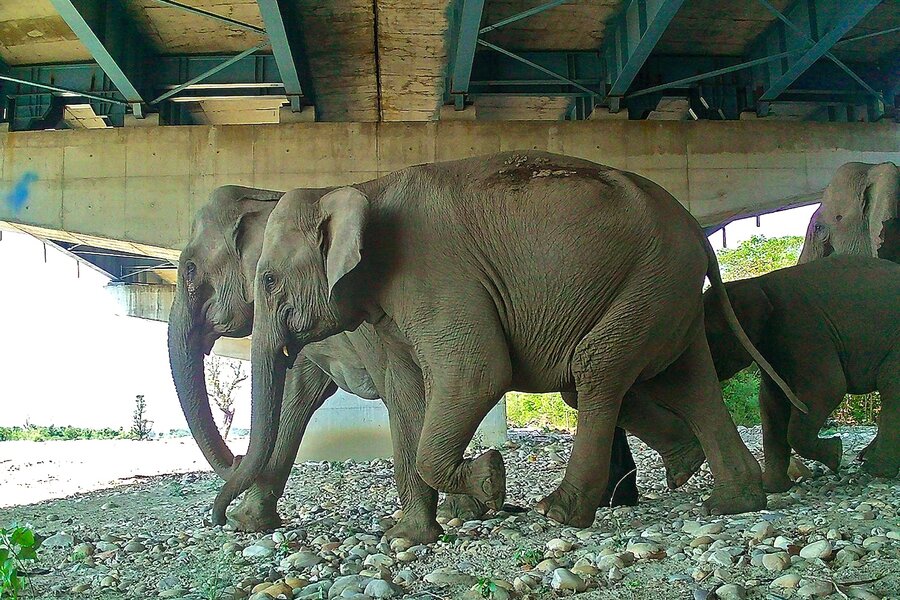
The old joke “Why did the chicken cross the road?” has a new, if serious, answer: Because it found a safe passage.For much of the past century, countless species of wildlife have not been able to “get to the other side” when they needed to. Highways disrupted migratory routes and feeding ranges – and increased vehicle-wildlife collisions.But now, things are changing, thanks to a shift in public attitudes to designing infrastructure in ways that enhance animal-human safety and longer-term coexistence.From the Americas to Asia, government planners, Indigenous inhabitants, conservationists, and ordinary citizens are working together to build highway overpasses and underpasses, adapt drainage culverts, and weave together treetop bridges to allow freer movement of creatures large and small.One of the latest structures – and largest – will open in Southern California this December, spanning 10 lanes of U.S. Highway 101. The overpass is being naturalized with rocks and native plants.Ben Goldfarb, journalist and author of the book “Crossings: How Road Ecology Is Shaping the Future of Our Planet,” offers an expansive perspective of what he calls “these giant, striking visual reminders” that humans inhabit a shared landscape.“I love wildlife crossings,” Mr. Goldfarb said on a podcast last month, for “their ability to ... remind us that we’re sort of global citizens of a planet that we share with wildlife.” His 2023 book chronicles that the worldwide movement for such structures is not just feel-good environmentalism but based on verifiable research that demonstrates efficacy and benefits.In the United States, some 1 million annual vehicle-wildlife collisions cost an estimated $10 billion in repairs, medical care, and lost productivity. A 2026 study in Virginia showed that strategically positioned crossings reduce such crashes by up to 97%. In April, the state passed a bill to fund their construction. Utah, Idaho, and Oregon have enacted similar legislation to advance wildlife connectivity.A July 27 report showed that an overwhelming 81% of Americans – including 80% of hunters – support investment in wildlife crossings. And, unlike surveys of political or economic sentiment, this one showed barely any variance among Democrats, Republicans, and independents.Even in relatively resource-strapped nations, there is a broad recognition of humans’ responsibility toward the natural world.In Southeast Asia, as in the Amazon rainforest, civilians and scientists are constructing woven bridges that can be used by langurs and other apes to safely cross busy roads. These cost only a few hundred or thousand dollars and are made from local materials.India has built 10 of the world’s largest wildlife underpasses and overpasses since 2017. In a 40-day period, researchers documented more than 40,000 animals – including elephants, primates, and big cats – using a single such underpass, which extended their feeding and breeding range while reducing potential conflict with humans.Whether a simple sisal canopy bridge or a sophisticated multimillion-dollar structure, wildlife crossings are concrete symbols of people wanting to protect the intrinsic worth of nature. The answer to the chicken joke needs an update.
Helping wildlife roam, one safe path at a time
Full Article
Original Source
Read the full article at Csmonitor →KhanList aggregates and links to publicly available news content. We do not host full articles from third-party sources. Always verify important information with original sources.