
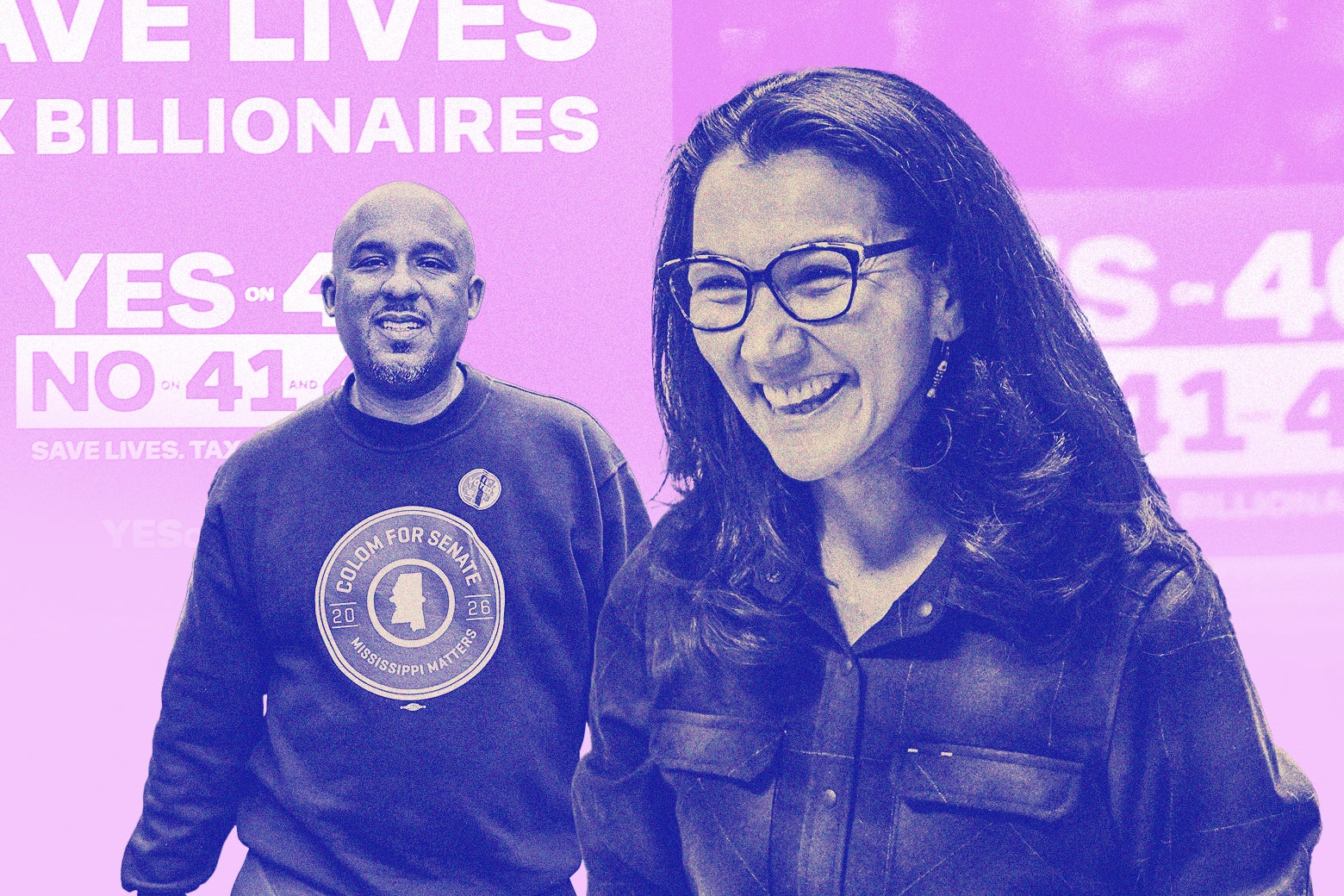
The Slatest Democrats are closing in on the Senate’s biggest majority since the early Obama years. Photo illustration by Slate. Photos by Justin Sullivan/Getty Images, Aron Smith/Jackson State University via Getty Images, and Patrick T. Fallon/AFP via Getty Images. This story is adapted from the Slatest newsletter. You can sign up here to get it in your inbox every day. Forget Election Day; in America, it’s more like Election Week. The 2020 presidential election famously took nearly four days to call as the country awaited newly tabulated batches of swing-state ballots. In 2022, slow vote counting in California meant it took days to determine how slim Republicans’ House majority would be. And while things haven’t been quite so dramatic this time—it was clear on election night that Democrats would retake Congress—several important races remain uncalled. Meanwhile, the latest results have also dealt liberal policies some surprising setbacks. Here’s where things stand. The Senate Democrats have flipped seven seats so far, for a total of 54. And although we’re still waiting on final results in Alaska and Mississippi, the broad story is pretty clear: Democrats are likely to grow that majority even further. In Alaska, Democratic former Rep. Mary Peltola leads Republican Sen. Dan Sullivan by about 2,500 votes with nearly a quarter of the expected ballots still outstanding, according to the Associated Press. Alaska takes so long to count in part because of how rural it is, but the remaining ballots appear to be coming from Democrat-friendly areas. Barring an unforeseen change, Peltola is probably going to prevail. It’s a similar story in Mississippi, where Democratic District Attorney Scott Colom has been slowly growing a nearly identical lead over Republican Sen. Cindy Hyde-Smith as the state counts its final provisional ballots. If both Colom and Peltola win as expected, Democrats will have claimed 56 seats this year—the biggest majority either party has held since Barack Obama was president. The House Democrats’ majority in the lower chamber stands at 255. But the party is on track to achieve the largest majority either party has held since 1993 by flipping more seats than Democrats have in any year since Richard Nixon got booted from office. Democratic candidates lead in four races the AP has yet to call. In Colorado, things aren’t looking good for MAGA firebrand Lauren Boebert. While the AP still counts her race as undecided, CNN has called it for Boebert’s Democratic challenger, retired Navy Rear Adm. Eileen Laubacher. Another endangered pro-Trump Republican is North Carolina Rep. Virginia Foxx, who chairs the powerful House Rules Committee. Foxx is also (in)famous for having written a letter to a 10-year-old boy in her district that accused his teacher of “indoctrinating” him after the boy advocated tax rebates for electric cars as part of a school assignment. Referendums Voters also weighed in on a host of ballot initiatives around the country last week. The latest results reveal a surprising pattern: Even in states where Democrats romped, voters rejected the kinds of tax increases that could be necessary to enact marquee liberal policies. Californians voted down Proposition 40, which would have greenlit a 5 percent wealth tax on billionaires. North Carolinians made it harder to raise property taxes and capped the state’s income tax. And despite electing a Democratic senator and governor for the first time in years, Iowans simultaneously made it harder to raise income taxes. Few people like higher taxes, and what voters want at the state level is sometimes different from what they’ll support federally. But these results look like an undertow of warning beneath the blue tsunami. Many of the Democrats’ legislative goals—from expanding healthcare access to passing universal childcare and pre-K programs—would require either tax increases or massive additions to an already-ballooning federal debt. On Tuesday, though, inflation-pinched voters seemed to signal wariness with the former approach. Tolga Akdoğan My colleagues have a few ideas about how to pass the time as we all continue to wait (and wait and wait) for the remaining election results: Reevaluate your vices: Even though smoking is at an all-time low, nicotine in other forms is having a moment. Cigarettes are out; Zyn is in. Andrew Zaleski investigates this new trend and finds some surprising answers. Say goodbye (and good riddance) to the Cybertruck: Elon Musk has announced that Tesla is winding down production of its stainless steel polygonal eyesore. Matthew DeBord’s postmortem gives a rundown of the reasons why the Cybertruck was such an epic failure. Turn off cable news: These days, fewer people are tuning in to traditional news broadcasts, and more are tuning in to livestreams on Twitch and YouTube. On ICYMI, host Kate Lindsay talks with media reporter Max Tani about what’s driving this change. Read romantasy with a twist: The latest volume of A Court of Thorns and Roses, the megapopular romantasy series by Sarah J. Maas, ventures into new territory for the genre: parenthood. A Court of Splintered Harmony features a 6-month-old baby, complete with nursing and diaper changes. Some readers are displeased—but Rebecca Onion offers a defense of this new plot point. OK, that’s all from me today. Enjoy the rest of your evening!
Hello, More Democratic Senators. Bye-Bye, Lauren Boebert?
Full Article
Original Source
Read the full article at Slate →KhanList aggregates and links to publicly available news content. We do not host full articles from third-party sources. Always verify important information with original sources.