
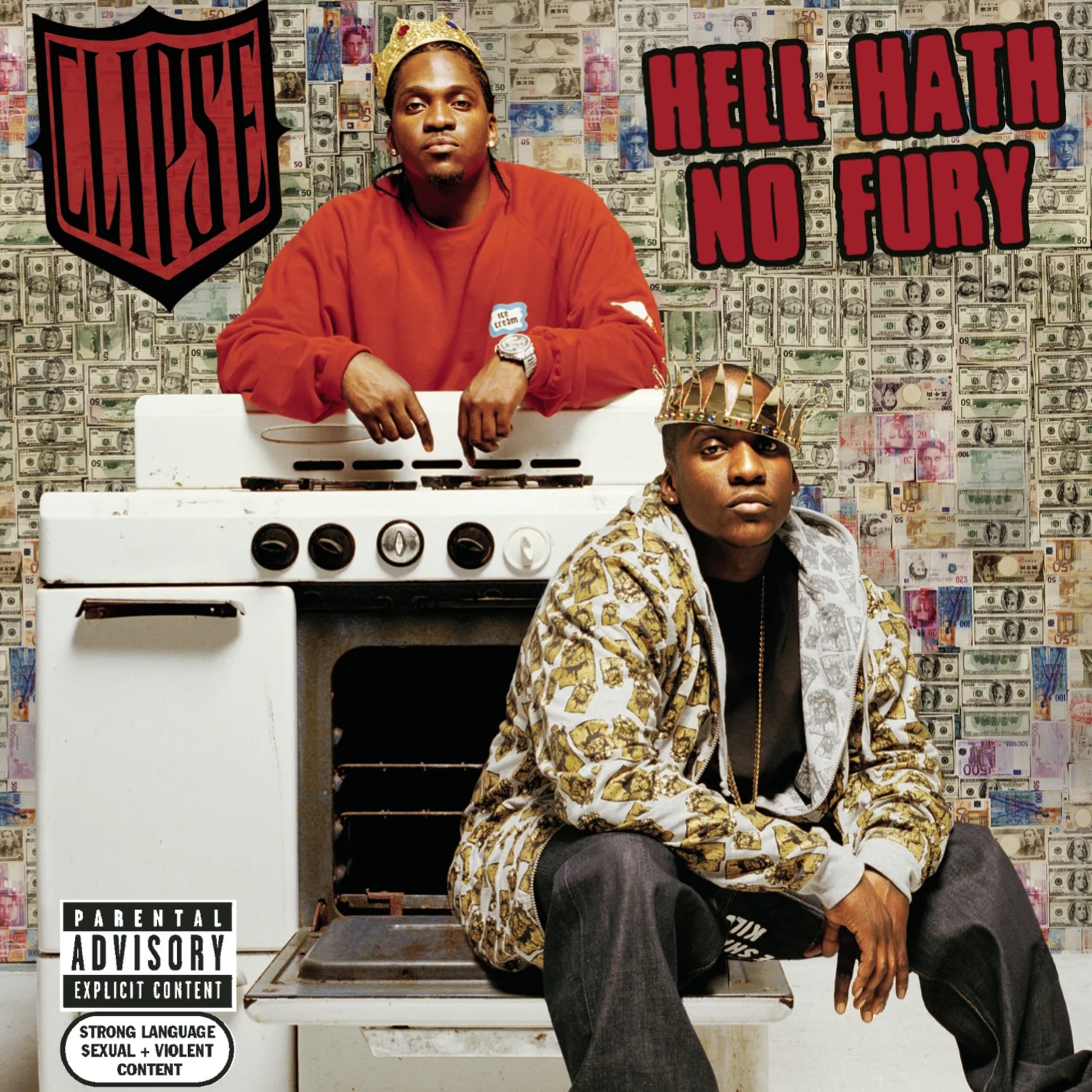
Re-Up Gang/Star Trak/Arista/Zomba2006The labels weren't playing fair jive. That was the narrative. Everybody else was getting richer than Scrooge McDuck, but the Thornton brothers, Malice and Pusha T, were stuck on the shelf, casualties of a corporate restructuring that they were too disgusted to navigate. Somehow, some way, the Clipse had made it out of Virginia Beach and started making hits. Thanks in large part to the Neptunes, the suddenly hot production duo who put them on and produced their entire debut album, Clipse had taken their dead-eyed and densely constructed tales of dirty money straight to the radio. Then one company bought another company, and the brothers got shuffled off to some label that hadn't signed them and sued to get out of their deal. It took them more than four years, an eternity in rap time, to follow up their gold-selling 2002 album Lord Willin'. Their momentum was lost, and they were pissed the fuck off.With two decades of distance, we can now say that the clueless corporate label people did all of us a favor. By wasting all that momentum and alienating the brothers, those business idiots gave the Clipse enough venom to motivate them to record some of the sharpest, meanest rap music in history. In destroying any chance that the Clipse might make another radio hit on the level of "Grindin'," the already-unconventional thwack-snarl that the duo rode to success, they allowed the Thorntons to realize that they needn't bother even trying to make something that might cross over. Instead, label negligence gave the duo permission to make a sonically hostile art-rap tour de force that pushed their confrontational sound and appeal to its logical extreme, leaving us with a diamond-hard masterpiece that sounds as good today as it did when it came out, exactly two decades ago come Saturday. Clipse are legends today because the labels fucked them up.Clipse had done this dance before. In 1999, as the Neptunes were just starting to build a catalog, they helped broker a deal between Clipse and Elektra, but the duo's would-be debut album Exclusive Audio Footage never came out. With Lord Willin', they got another shot, and they connected. The Neptunes produced the whole record, and their oblique funk worked just right with the Clipse's nihilistically frank trafficking talk. For a minute, Clipse were in radio rotation alongside Nelly and Ludacris. They made "What Happened To That Boy" with Birdman, and that experience apparently led to a rift with Cash Money that would continue to reverberate for decades. But when label reshuffling moved the Clipse from Arista to Jive, not even their connection to the peak-era Neptunes could save the Clipse. They had blown up with "Grindin'," but they found themselves back on the shelf, with no option but to grind.They did something about it. They sued to get out of their contract, which probably took them out of the game for even longer, and they let their frustration out on their classic We Got It 4 Cheap mixtapes. There, they sneered at the suits and vowed to keep their alternate income streams flowing if the recording contracts didn't line up right: "Fuck Zomba, I sell nose candy, Willy Wonka." What they didn't expect was that those two Got It 4 Cheap mixtapes, especially 2005's exceptional Vol. 2, would find them a whole new audience of critics and hipsters. Suddenly, the Clipse were cool, a state of being that they'd never bothered to chase. Maybe that emboldened them, or maybe they already knew they were the shit. Either way, the newfound love didn't hurt.Finally, lawsuits were settled, deals signed, and the prospect of a second Clipse album became real. The release of Hell Hath No Fury was endlessly delayed, but it finally arrived in stores on the Tuesday after Thanksgiving, sending critics scrambling to reorder their year-end lists. Clipse, scarred and angry over those contract battles, opted not to even try to generate income for the labels that had forsaken them. Instead, they resolved to make the malevolent masterwork that they knew they had in them. They attacked the task with purpose. There would be no hits, no superstar crossovers. There would only be vengeance.Hell Hath No Fury is not a record made in conversation with the rest the rap music of its day. Lord Willin' is a hard, rigorous album in its own right, but it has frothy party songs and hooky for-the-ladies songs. B-list stars like Fabolous and Jermaine Dupri make appearances. It's an album made with commercial considerations in mind. Even if Clipse didn't expect it to be a blockbuster, they probably knew they could parlay its success into, say, appearing on Justin Timberlake's first solo single. On Hell Hath No Fury, that's all gone. Clipse's only collaborators are the close friends who were on the same wavelength and, for one hook, their fellow Neptunes beneficiary Slim Thug, whose own spotlight moment was right about to end.Hell Hath No Fury doesn't sound like a major-label rap record from 2006. It doesn't sound like snap music or hyphy or triumphantly larger-than-life Atlanta trap à la T.I. or Young Jeezy, nor does it sound like a reaction against those things. It doesn't sound like an indie-label rap record from 2006, either. For that matter, it doesn't sound like a major or indie rap record from any other year. Instead, it sounds like Clipse and their small circle of collaborators closing ranks and speaking to each other. It's sui generis — influenced, more than anything, by itself.When Clipse made the We Got It 4 Cheap mixtapes, they hijacked the hottest beats of the moment and used them for their own purposes — the same strategy that turned their adversary Lil Wayne into rap's biggest star during that same moment. But Clipse weren't trying to become Wayne. They only wanted to post up on the sidelines, staring at Wayne with abject disgust. That's what lead single "Mr. Me Too" is about.The real issues between Wayne and Clipse were a lot deeper than the fact that Wayne started wearing Bathing Ape after Clipse did. That's just a stand-in for some larger gripes, like the fact that suddenly every big rap star spent all their time discussing the intricacies of the cocaine trade. Even if its focus is small, "Mr. Me Too" still sounds gigantic. Intentionally or not, Pharrell's verse plays as a grim parody of cash-money millionaire excess: "Just last week, I was out in Aspen/ Me and Puff hoppin' off a plane, both us laughin'." But Malice and Pusha T aren't up in Donatella's crib with 10 hoes. They've got other concerns, like the dumb shit that their peers were doing in their absence: "I was just assumin' you'd keep the coke movin'/ But I got one question: Fuck y'all been doin'?"Pusha T hits that fuck so hard. He and Malice hit everything so hard, intoning phrases that continue to ricochet around inside my skull. "Have that money right or end up in the truck taped up." "Peel money rolls till our thumbs get the papercuts." "Who gon' stop us? Not a got-damn one of ya." They reel off designer names with joyless precision, like they're annoyed that they have to tell you these things that you should already know. Meanwhile, the Neptunes beats — just Pharrell operating independently of his onetime partner Chad Hugo, according to Clipse interviews from years later — make up a dumbfounding tapestry of drones and hums and subsonic rumbles, pierced by militant handclaps, mechanized ratatat snare-bursts, and syncopated shakers. This was what they sent to radio."Wamp Wamp," the second single, wasn't much friendlier. At least theoretically, a catchphrase-driven Slim Thug hook might've been enough to convince some skeptics in the aftermath of Houston screw's big pop moment. But the frantically ping-ponging steel drums and bagpipes ensured that wasn't going to happen. "Wamp Wamp" sounds less like Houston, more like the Hadron Collider. The drums are all upside down, and Pusha T's skip-scatter verse is all big-money word games: "Can't stand the bright from the ice, the chain xenon lamp ya." You have to feel for the girls who had to figure out how to shake ass to that all-elbows music in the video.All of Hell Hath No Fury sits in that register. The Neptunes were able to make brain-scattering pop hits out of discordant keyboard-blats and empty space, but the Hell Hath No Fury production turns their sound into funky abstraction. Nothing makes sense — the stuttering harp-string sustain of "Ride Around Shining," the gasping choirs and swimming-upstream woodblocks of "Keys Open Doors," the wildly panning hovering-spaceship vwerps of "Trill." Even at their most outlandish, though, those tracks always hit with the brisk simplicity of a Marley Marl track. Malice and Pusha T always found the pockets on those beats. They rapped over berserk sounds like it was a normal thing to do.There are a few slight tonal shifts on Hell Hath No Fury, as on the regretful and downbeat ballad "Nightmares." But in a time of jagged, piecemeal multi-producer rap records, Clipse simply continued to chip away at the same piece of marble. Hell Hath No Fury is a tight, focused record. The mood remains consistent throughout. Even when Clipse talk to the ladies on "Dirty Money," they're making a point, not flirting. The album never ventures far from the heightened realm of the coke-dealer lifestyle. So even when Clipse tell you about all the baubles they'll buy for you, they make sure you know that they're buying those baubles with ill-gotten gains. "Now, tell me: Is the dirty money really that bad?" — the question is rhetorical.Two years after the release of Hell Hath No Fury, Malice rapped, "I'm not a part of your coke-rap genre." This was a clear message to the many, many critics, me probably included, who fixated on all of the album's artfully brusque yayo talk: "Open the Frigidaire, 25 to life in there/ So much white you might think your holy Christ was near," "Coke money clean through Merrill Lynch, accountant just gasp at the smell of it." And it's true that Clipse didn't talk about selling coke the same way that contemporaries like Jeezy and Cam'ron did. Instead, it's a crucial part of a larger backdrop.The criminal underworld of Hell Hath No Fury isn't compelling just because they're talking about cocaine. It's compelling because it's about life lived at extremes, which allows them to get into paranoia, distrust, jealousy, bulletproof confidence, moneyed instability, and all sorts of other ideas. I'm writing this while fully immersed in Grand Theft Auto VI, the biggest sensation in any medium this year, and it's set in the exact same world. There's a reason that Miami Vice lifestyle fascinates even those of us who never touch cocaine crumbs, either as sellers or buyers.When Hell Hath No Fury arrived, what really stood out was the imperious wordplay, the way that the Clipse bent language into dazzling new shapes without ever veering into abstraction: "Flow chameleon, worth 'bout a million/ Sell Bolivian, feds in oblivion/ Bitch Brazilian, purse reptilian/ Took her from far-off island like Gilligan." Listening to it today, that stuff remains astonishing, but now it's enriched by the past two decades of Clipse history — their long hiatus, Pusha's solo run, Malice's religious awakening, their eventual triumphant return.Almost every track on Hell Hath No Fury follows the same blueprint: Pusha verse, hook, Malice verse, hook, back-and-forth Pusha-and-Malice verse, final hook, moment for the beat to ride out. If there's a guest, they'll mix the formula up slightly, but it'll almost always be Pusha first, then Malice. The construction throws their personality differences into relief. Pusha is flashier, angrier, and more militant: "They're prayin' I never go solo." Malice's heavy conscience and inner-conflict torment, always present in the music, become louder. Back then, I took "Momma I'm So Sorry" as facetious shit-talk. Listening now, it sounds a lot more like an actual sincere apology. Malice still talks his shit, but he clearly hates to think that his little brother ever had to get involved in a fundamentally amoral life.When Hell Hath No Fury finally came out, the Clipse were subject to a whole lot of pocket-watching. This was a time when, at least in rap, record sales were all bound up with cultural influence and artistic respect. An album that didn't move Kanye West numbers could become an object of ridicule on the XXL blogs. Hell Hath No Fury got rapturous reviews, including a rare XXL rating from XXL itself, but maybe that only meant that critics were hopelessly out of touch with rap's audience. In any case, Hell Hath No Fury, an album that was never intended to become a blockbuster, did not become a blockbuster. Instead, it debuted at #14 and never even went gold. In some people's eyes, it was a failure. But it mattered.Today, Hell Hath No Fury stands as an early example of major-label prestige-rap. It's somewhere between mainstream and underground, and it resonated in ways that the charts could never properly convey. The critical acclaim made a reputational difference, if not a commercial one. On the 2006 Pazz & Jop poll, Hell Hath No Fury finished at #7, between the Arctic Monkeys and Neko Case. Now that I look at that list, some of the other rap records in the top 40 — Ghostface Killah's Fishscale, the Roots' Game Theory, Lupe Fiasco's Food & Liquor — fit somewhere into that prestige-rap dynamic, too. (T.I.'s King, J Dilla's Donuts, and the Coup's Pick A Bigger Weapon are on there, as well, but it's a lot easier to place those records on the mainstream/underground divide.)Clipse discovered that they had a very real audience, though it probably wasn't the one that they wanted. They embraced the new crowd, to an extent. They played indie rock festivals like Pitchfork as well as big rap shows like the Brooklyn one I went to that was supposed to celebrate the launch of the Zune. They opened for Modest Mouse. These days, Clipse are once again fixtures on the music-festival landscape. But after Hell Hath No Fury, they tried to swing back toward rap's mainstream. Their 2009 follow-up Till The Casket Drops had boldfaced-name guests — Kanye West, Cam'ron — and production from people other than the Neptunes. It was not the same uncompromising object as Hell Hath No Fury, and it didn't have the same impact. Soon after its release, Malice decided that he was done, and Pusha became the sharpest shooter on West's G.O.O.D. Music roster.Nineteen years after Hell Hath No Fury, Clipse finally returned with Let God Sort Em Out, and they sounded more rejuvenated than anyone could've hoped. They explicitly made that record in the image of Hell Hath No Fury, holing up with Pharrell and shutting out all possible contemporary influences. It's a distant echo, but it was strong enough to finally earn the Clipse respect from institutions — the Grammys, the Vatican — that ignored Hell Hath No Fury. Once again, they had to go through a whole lot of label bullshit to release the album that they wanted to release. Once again, the label idiots might've done us a favor.
Hell Hath No Fury Turns 20
Full Article
Original Source
Read the full article at Stereogum →KhanList aggregates and links to publicly available news content. We do not host full articles from third-party sources. Always verify important information with original sources.