
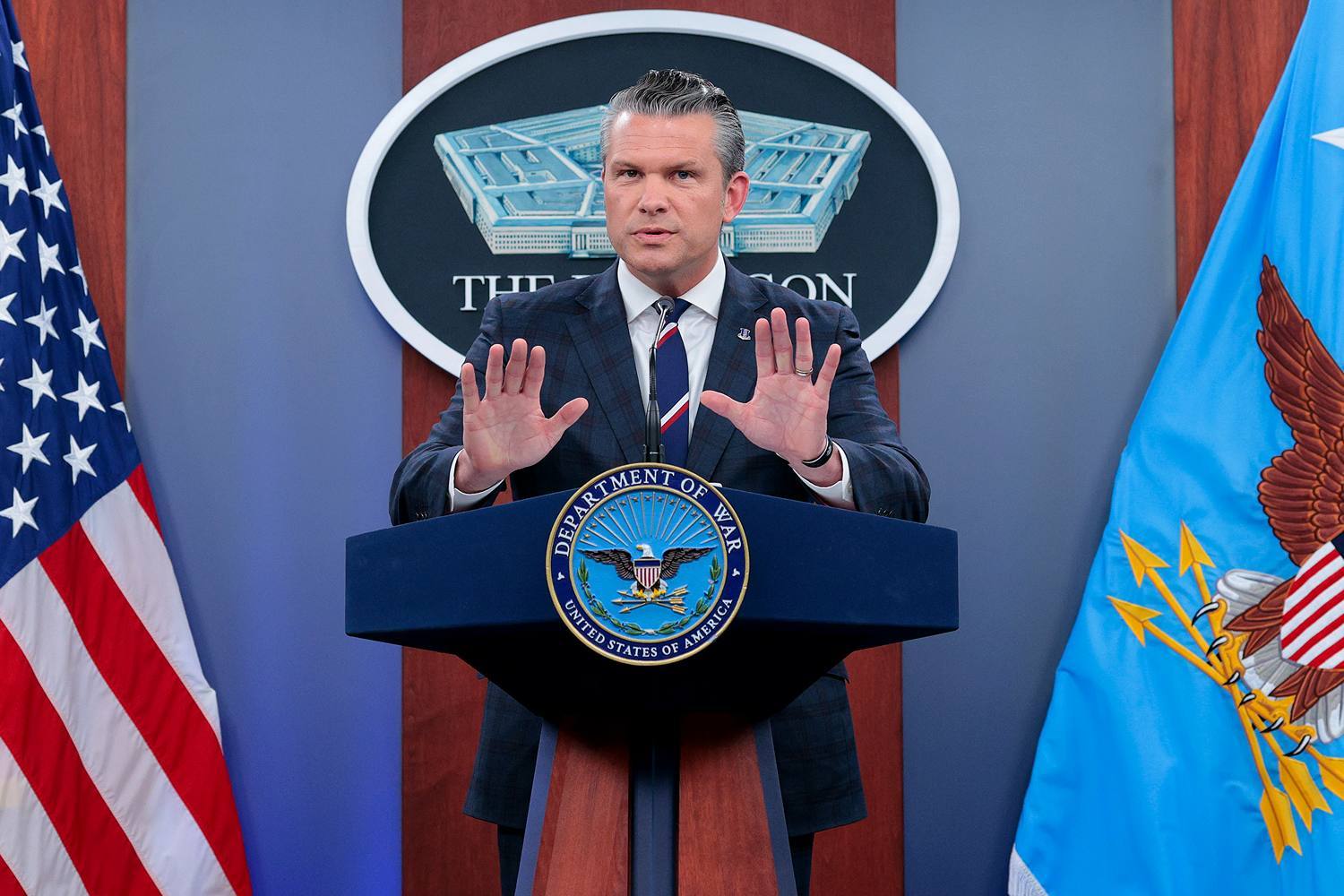
Welcome back to Foreign Policy’s Situation Report. It’s been a wild week of news, and our heads are still spinning. We’ve got a very full edition for you this week. Here’s what’s on tap for the day: Hegseth escapes impeachment for the time being, Russia’s ambassador to Washington dies, and Nvidia CEO Jensen Huang resigns. U.S. Defense Secretary Pete Hegseth narrowly escaped an impeachment effort this week, but questions remain over his job security. The push to impeach Hegseth, led by outgoing Republican Rep. Thomas Massie, was blocked by Republicans in the House on Tuesday. The House voted 211 to 204 on a motion to refer the articles of impeachment to the House Judiciary Committee, which effectively tanked the chances of Hegseth getting impeached—for now. Eleven Democrats missed the vote, which helped House Republicans pass the motion by seven votes. But Hegseth’s troubles are far from over as Republicans continue to contend with the fallout from their disastrous performance in the midterms, which was driven in part by voter discontent over the economic consequences of the Iran war. In Washington, Hegseth is seen as the face of that war, as well as other controversial military actions that President Donald Trump has taken in Latin America, putting the defense secretary’s future in question as the political landscape shifts. What’s next for Hegseth. Democrats could launch another effort to impeach Hegseth in a new Congress. “This is not the end of it. It’s just the beginning,” Democratic Rep. Hakeem Jeffries, who is expected to be the next House speaker, said after the impeachment vote this week. Democrats will have the votes in the House to impeach Hegseth in a new Congress. But they’re less likely to garner the support of enough Republicans in the Senate to convict and remove the defense secretary. Whether Democrats pursue impeachment or not, Hegseth will be under a microscope. Democrats have been clear that they will leverage their oversight powers to investigate him on everything from the Iran war and the military operation that led to the capture of Venezuelan President Nicolás Maduro to the lethal strikes on alleged drug-trafficking boats near Latin America. Even some Republicans in recent days have suggested that he should just resign and said that they want more answers on the Iran war. Trump has backed Hegseth so far and signaled that he doesn’t plan to fire him. As long as the president stands by him, Hegseth might be able to save his job. People have been “predicting that Secretary Hegseth would be on his way out” since the Signalgate controversy, said Peter Feaver, a professor of political science and public policy at Duke University. “He’s shown that he’s quite adept at holding on to his position because he’s maintained the confidence of the one person that matters in the administration, and that’s President Trump,” Feaver said. “I don’t see evidence that he has lost President Trump’s confidence. If anything, Trump is more fulsome in his expressions of support for Secretary Hegseth.” Hegseth vs. Congress. Hegseth, a former Fox News host, went on the offensive in the past week, launching a campaign-style media blitz against his opponents in Congress, posting about it on social media, and delivering a fiery speech at a rare press conference from the Pentagon. It was indicative of the unusually partisan approach that Hegseth has taken to his role. Some watchdogs have also suggested that Hegseth’s messaging campaign violated federal law. Defense secretaries are meant to be political animals who are “very nonpartisan” but “really wily at working Congress,” Feaver said. “Hegseth has not fit that mold,” Feaver added, describing him as the “most partisan” defense secretary in modern times. While this has helped Hegseth maintain Trump’s trust, the defense secretary “also answers to Congress,” Feaver said, especially when it comes to the defense budget that the Defense Department relies on. The National Defense Authorization Act, the annual defense policy bill that dictates yearly U.S. military spending levels, is stalled in Congress. The White House has been pressing Congress to pass a record budget request of $1.5 trillion, but Hegseth’s recent attack campaign may have made this even harder than it already was in a lame-duck session. It also doesn’t set the Pentagon up “for success in the last two years in terms of working with the new Congress,” Feaver said. Trump on Thursday called on Senate Republicans to “IMMEDIATELY” pass $350 billion in defense spending via reconciliation before Democrats take over. Hegseth is used to a less active Congress, but that’s about to change with Democrats at the helm. “There’s a saying in the military—you don’t fight against the terrain,” Feaver said. Russian Ambassador to the United States Alexander Darchiev died aged 66 in Moscow, the Russian Foreign Ministry announced on Wednesday. Darchiev had been posted in Washington since March 2025 but returned to Moscow to seek treatment for a chronic illness, CNN reported. Erik Slavin, the former editor in chief of the Pentagon-funded newspaper Stars and Stripes, announced on Wednesday that he would be joining the Atlantic as a staff writer covering the U.S. military. Slavin was fired from his post at Stars and Stripes in August for alleged insubordination after he defended the publication’s editorial independence. What should be high on your radar, if it isn’t already. Russia-Ukraine stalemate continues. Trilateral talks involving Russia, Ukraine, and the United States held in Abu Dhabi, United Arab Emirates, failed to yield a major breakthrough this week, save for an agreement for Russia and Ukraine to exchange prisoners of war. The broader sticking points that have dogged the conflict remain, including the prospect of a temporary cease-fire and both sides’ territorial claims on the front lines. The Kremlin appears unwilling to cede any ground, with lead Russian negotiator Vladimir Medinsky telling reporters after the talks that “every square foot of land will be returned to Russia one way or another.” U.S. negotiators Jared Kushner and Steve Witkoff met with Russian President Vladimir Putin in Moscow on Thursday before heading to Dublin for talks with Ukrainian President Volodymyr Zelensky that same day. Witkoff told reporters in Moscow that European officials will join the next round of talks—a potentially significant step given that Putin has long resisted any European role in talks to end the war. Vance reassigned. Trump announced in a Truth Social post on Thursday that he has ordered Vice President J.D. Vance “to focus his complete and total attention on the Massive Corruption and Crime taking place in Democrat run Cities and States throughout the U.S.” instead of working on negotiations with Iran. Vance has been leading those negotiations and was reportedly set to meet with a senior Iranian security official to try to end the war. “We don’t need a deal with Iran. Those days have long since passed. We’ve got their money, Hundreds of Billions of Dollars, and we’ve got their Strait!,” Trump wrote. As John reported, Vance last week blamed the Iran war for Republicans’ midterm losses in a rare public statement. Huang’s out. Nvidia CEO Jensen Huang resigned on Thursday—the latest twist in a weekslong scandal that has unleashed turmoil at the $4 trillion company whose semiconductor chips have become indispensable to the development of artificial intelligence. Huang admitted to having an affair with a woman alleged to be a Chinese spy and is accused of having another one with a subordinate at Nvidia. Huang, who co-founded Nvidia in 1993, has overseen the company’s rise into a technology behemoth and has himself become the face of the global AI race. His departure has implications far beyond the company or any one country. Rishi explains why in his piece on the saga. Pro-Palestinian protestors are seen at a demonstration at Trinity College in Dublin. Pro-Palestinian protesters attend a rally at Trinity College in Dublin, Ireland, on Nov. 10 during a visit by former U.S. President Joe Biden.Li Mangmang/Xinhua via Getty Images Monday, Nov. 16: The Association of Southeast Asian Nations (ASEAN) summit begins in Manila, Philippines, with the group hosting bilateral summits with China, Australia, and South Korea. Tuesday, Nov. 17: Trump arrives in Manila for the ASEAN-U.S. special summit and Quad leaders summit. France holds a general strike. Wednesday, Nov. 18: The Asia-Pacific Economic Cooperation economic leaders meeting begins in Shenzhen, China. Thursday, Nov. 19: The International Court of Justice is scheduled to pronounce its final judgment on accusations of genocide against Myanmar over its campaign against Rohingya Muslims. Friday, Nov. 20: The European Union hosts the EU-U.K. summit. 50—the number of ballistic missiles that Iran continues to produce every month, according to Western intelligence estimates cited by Bloomberg. “My analogy would be … the Titanic hit the iceberg on Nov. 3, and I came up with a life raft, and they said, ‘No thanks, we’re going to stick on the Titanic.’” —Massie to MS NOW after his motion to impeach Hegseth failed in the House. Hegseth’s Leadership Has Damaged the Pentagon by Kori Schake Why Kushner and Witkoff Keep Failing by Stephen M. Walt The Experts Are Taking Their Revenge Again by David Milne
Hegseth’s Troubles Are Far From Over
Full Article
Original Source
Read the full article at Foreignpolicy →KhanList aggregates and links to publicly available news content. We do not host full articles from third-party sources. Always verify important information with original sources.