
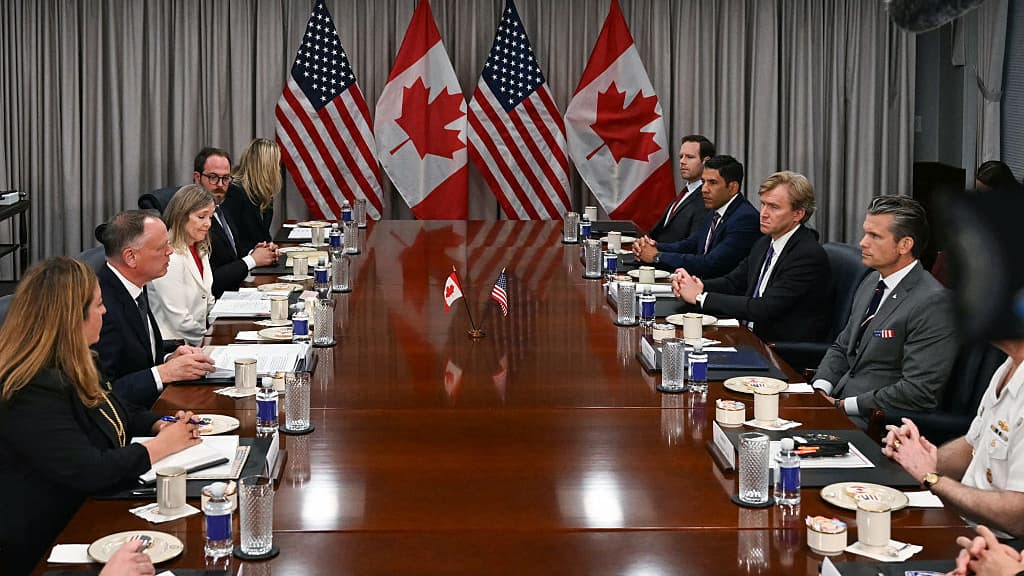
The Pentagon has accused Canada of falling short as a credible partner in defending North America, escalating tensions between the neighboring countries amid an ongoing trade war.In a two-page fact sheet released Monday, the Pentagon under Defense Secretary Pete Hegseth outlined what it described as Canada's “defense shortfalls,” issuing a sharp rebuke of the country's leadership under Prime Minister Mark Carney. "Canada must get serious and focused," read the fact sheet.The document criticized, what it characterized as, Canada's underinvestment in the Canadian Armed Forces (CAF) and its defense spending plan for NATO. Canada joined allies at the 2025 NATO summit at the Hague in pledging to reach 5% of GDP by 2035 in defense spending. The country’s latest budget projects combined defense and security spending of 4.1% of GDP by 2027-28, but Canada’s Parliamentary Budget Officer’s assessment last week stated that the path to reach 5% by 2035 remains “unclear.” The Pentagon, meanwhile, has accused Canada of deferring its largest increases needed to actualize the NATO spending target until after the 2029 federal election.The Pentagon said Hegseth is “laser focused” on enabling Canada’s military modernization “after decades of American taxpayers footing the bill for its homeland defense.” The rhetoric follows that displayed by President Donald Trump, who has repeatedly accused Canada of “ripping off” the United States.Going a step further, the Pentagon accused Canadian leaders of prioritizing domestic economic interests over military effectiveness, referencing Ottawa's ongoing review of its planned purchase of American-made F-35 fighter jets, arguing that the uncertainty surrounding the deal could undermine the North American Aerospace Defense Command (NORAD) cooperation. Carney ordered the review in March 2025, amid an escalating tariffs row and Trump’s repeated threats to annex Canada and make it the “51st state.” The Pentagon said this review, along with Canada’s other alleged shortcomings, has prompted concerns as to whether the country can fulfill its commitments to NORAD, which is jointly operated by the two countries. The Pentagon also questioned the readiness of Canada's military, claiming that only 41.9% of its air force fleet and 53.9% of its naval fleet were serviceable in 2025-26, while army readiness stood at 48%. The document framed these items as a burden on U.S. taxpayers. Canada has responded to the accusations by emphasizing its commitment to cooperating with the U.S. on matters of defense.“As founding members of NATO, Canada and the United States have stood together in support of collective defense since 1949, and for nearly 70 years we have defended North America together through NORAD, the world’s only binational command,” a spokesperson for the office of Canada’s Minister of National Defense David McGuinty told TIME on Tuesday. “Canada will continue to do its part to defend North America, as we keep having constructive discussions with our American partners on how best to strengthen our shared defense and security.”Canada also announced over the weekend that it will join European NATO allies in exploring a pilot project in Keflavík, Iceland, as part of a proposed logistics network to support maritime patrols and anti-submarine operations in the North Atlantic and Arctic.The move comes as Canada seeks to reduce its reliance on the U.S. by expanding its economic relationships and alliances with other countries. Carney has notably pursued a closer partnership with the European Union, and has laid out his vision for Canada becoming an “associate” member of the bloc. Both sides have expressed openness to a deeper cooperation in critical sectors including defense, technology, and AI.While some of Canada’s international relationships are flourishing, the public tensions with the U.S. over defense priorities could have a negative impact on future alliances, experts argue.“Our greatest advantages are the NATO and NORAD alliances, and we are looking to provide support to other partners,” says Andrea Charron, the director of the Centre for Defense and Security Studies at the University of Manitoba in Canada. “This kind of public shaming of a very close and important ally sends a chilling effect throughout all the allyships and partnerships that again serves no one but the adversaries.”Typically, adversaries of the U.S. and Canada are “always looking for evidence of fractures in the allied relationship,” she adds, noting that now those people can “quote the Secretary of Defense.”The release of the fact sheet follows a report by the Washington Post last week that said Hegseth had circulated a classified memorandum imposing new restrictions on military cooperation with Canada.McGuinty responded to the report by saying he had not seen the memorandum and had no evidence of any changes to military cooperation between the two countries.Joseph Jockel, a professor of Canadian studies at St. Lawrence University, says the noise around the memo regarding restrictions is “the second symbolic warning that [the U.S.] has sent Ottawa.” The first came in May, he says, when the Defense Department paused U.S. participation with Canada on the Permanent Joint Board on Defence (PJBD), a long-standing low profile mechanism for discussions on U.S.-Canada defense coordination.“It sent a strong symbolic gesture, and now they're doing the same thing, they're looking for symbolic steps,” he argues. Republican Senator Mike Rounds of South Dakota, a member of the Senate Armed Services Committee, sought to downplay the significance of the reported restrictions, suggesting they were largely symbolic and would not affect day-to-day military operations, intelligence sharing, or defense planning.“They’re basically limiting some social engagements, and they’re asking people to get permission before they come in and do think tanks and so forth,” he said at the Halifax International Security Forum on Nov. 21. “We don’t expect any real changes over the way it has been going for the last year or a year and a half.”Chief Pentagon spokesperson Sean Parnell told TIME that the Department of Defense “is taking steps to ensure its engagements with Canada advance tangible U.S. defense objectives and ultimately support a reinvigorated defense relationship."“This guidance does not impact defense intelligence cooperation, our binational NORAD command, or our cooperation through NATO,” he added.Despite those reassurances, the developments have raised concerns about the future of the countries' longstanding defense relationship.Canadian Conservative opposition leader Pierre Poilievre said Sunday that any “restrictions on Canada-U.S. military cooperation by the Administration” would amount to a "terrible" mistake.U.S.-Canada rift grows as trade war stretches onThe Pentagon's public criticism of Canada's military capabilities and leadership comes as relations between the two countries remain strained by an ongoing trade war, with negotiations stalled and no clear path toward a deal.U.S. Trade Representative Jamieson Greer told Fox News over the weekend that the two sides were having “constructive conversations” and had “made a lot of progress,” but raised concerns over Canada's decision to lower tariffs on a quota of Chinese electric vehicles and provide relief for certain Chinese steel and aluminum imports.Carney's pivot toward China and the trade alliances drawn up between the two countries have also drawn criticism from Trump. Experts tell TIME that the growing economic relationship could potentially give Ottawa greater leverage in future trade negotiations with Washington.Trump and Carney met on the sidelines of the Asia-Pacific Economic Cooperation (APEC) summit in China last week, but the conversation delivered no tangible results, save for a commitment to stay in close contact. Meanwhile, Canada and Qatar are expected to sign an investment pact on Tuesday, according to Reuters, in another sign of Carney’s efforts to reduce Ottawa’s reliance on Washington.
Hegseth’s Pentagon Accuses Canada of Failing as Credible Defense Partner Amid Tensions
Full Article
Original Source
Read the full article at Time →KhanList aggregates and links to publicly available news content. We do not host full articles from third-party sources. Always verify important information with original sources.