
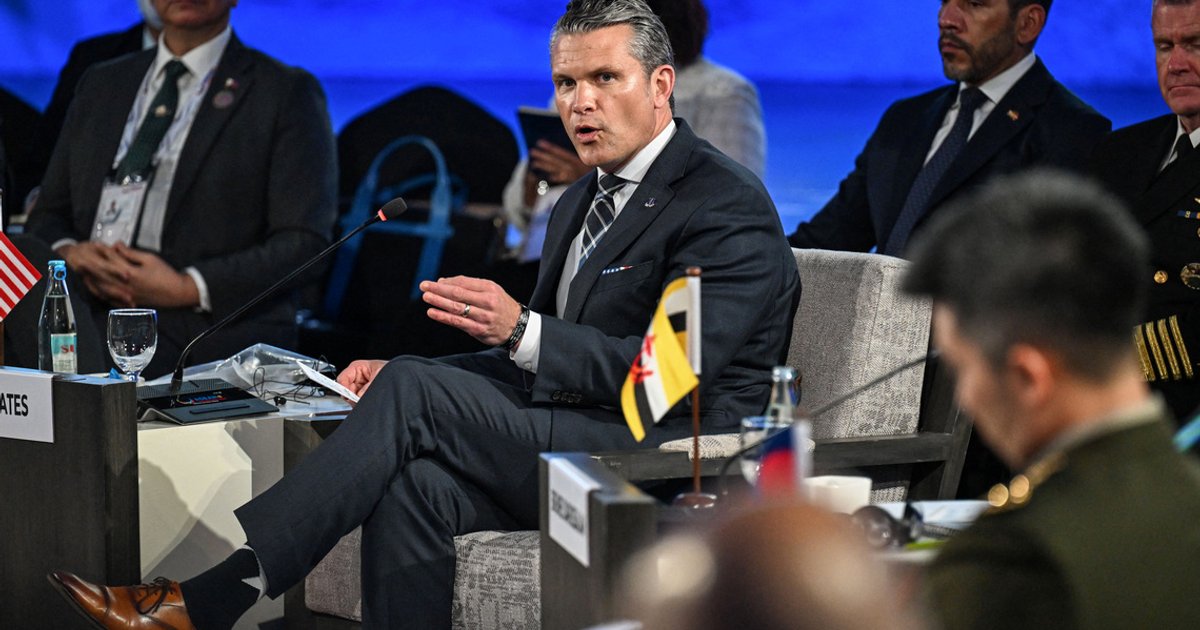
CEBU, Philippines – US Defense Secretary Pete Hegseth sought to reassure South-east Asian counterparts on Oct 28 of Washington’s commitment to the Indo-Pacific, pledging that Washington would defend its interests and those of its allies and partners.Hegseth, who is participating in the two-day ASEAN defence ministers and related meetings in Cebu, Philippines, said the United States would back that commitment with practical cooperation, including stronger maritime domain awareness, greater interoperability and cooperation among navies.“These are not symbolic things. They are concrete demonstrations of what serious partners do,” he said. “Serious partners train together, learn together, plan together and build confidence and competence necessary to prevent conflict.”Hegseth is visiting the region as governments in South-east Asia and the wider Asian region weigh Washington’s ability to stay focused on the Asia-Pacific as the Iran war strains US military resources and creates political pressure at home.He described the US approach as “strong, quiet and clear”, saying it would be “strong enough to deter coercion and aggression”, quiet enough to avoid “needless escalation or public theatrics”, and clear enough that friends and potential adversaries understood Washington’s position.“We will defend our interests and the interests of our allies and partners. That is, by definition, peace through strength,” Hegseth said.He also proposed developing a US-ASEAN framework for defence cooperation to guide ties during what he said would be the “critically important next several years”, as the two sides mark half a century of formal relations next year.Economies grappling with Iran war impactSouth-east Asia is grappling with the effects of the Iran war, while tension between the Philippines and Beijing has added another source of friction to a forum meant to promote dialogue and practical cooperation on security.The Iran war, which began with US and Israeli strikes on Feb 28, has disrupted global shipping and oil markets, exposing South-east Asia’s vulnerability to imported-fuel shocks and pushing energy security further up ASEAN’s agenda.Greg Poling, director of the Asia Maritime Transparency Initiative, which tracks developments in the South China Sea, said Hegseth would get an opportunity at the gathering to tackle aspects regarding China, the South China Sea and Washington’s commitments to its treaty allies.The topic is critical for the Philippines, a US treaty ally whose ties with Beijing have soured amid repeated confrontations in the disputed South China Sea, Chinese sanctions, and more recently, a summoning of the Chinese ambassador.China claims almost the entire South China Sea while other countries in South-east Asia, including the Philippines, Vietnam and Malaysia, claim parts of it.China’s defence attache in the Philippines will attend the meeting, its defence ministry said on Oct 27.Days before the meeting, the Philippine military said it monitored and shadowed China’s Liaoning aircraft carrier group as it passed through waters off the southern Philippines towards the Celebes Sea.Stronger signals were more likely to figure in talks among like-minded partners, added Poling.Such partners include the Squad, an informal grouping of the US, Japan, Australia and the Philippines, whose defence chiefs are set to meet on Oct 28.Hegseth will also join an expanded defence ministers’ meeting on Oct 29, bringing together ASEAN’s 11 members and eight partners, including Australia, China, India, Japan, New Zealand, South Korea and Russia.Eventual chairman’s statement seen as restrainedThe eventual chairman’s statement was likely to be more restrained than talks behind closed doors and would employ familiar ASEAN language, said Collin Koh, a security scholar at Singapore’s S. Rajaratnam School of International Studies.Manila’s position as ASEAN chair while embroiled in a dispute with China was “particularly sensitive”, he added.Poling said the Philippines had to balance “aspirational cooperation” on issues such as energy connectivity, the digital economy and coast guard cooperation against rising tension with China and stalled progress on a South China Sea code of conduct.“For the Philippines, the whole ASEAN chair year has been a difficult balance,” added Poling, who is also a fellow with the Southeast Asia Program at the Center for Strategic and International Studies.“I’d expect tactical cooperation on the ADMM workstreams ... but no strategic alignment on the South China Sea or other thorny issues,” he said, referring to the bloc’s effort to tackle issues such as maritime security and counter-terrorism. REUTERS
Hegseth reassures South-east Asia of US commitment, pledges stronger defence ties
Full Article
Original Source
Read the full article at Straitstimes →KhanList aggregates and links to publicly available news content. We do not host full articles from third-party sources. Always verify important information with original sources.