
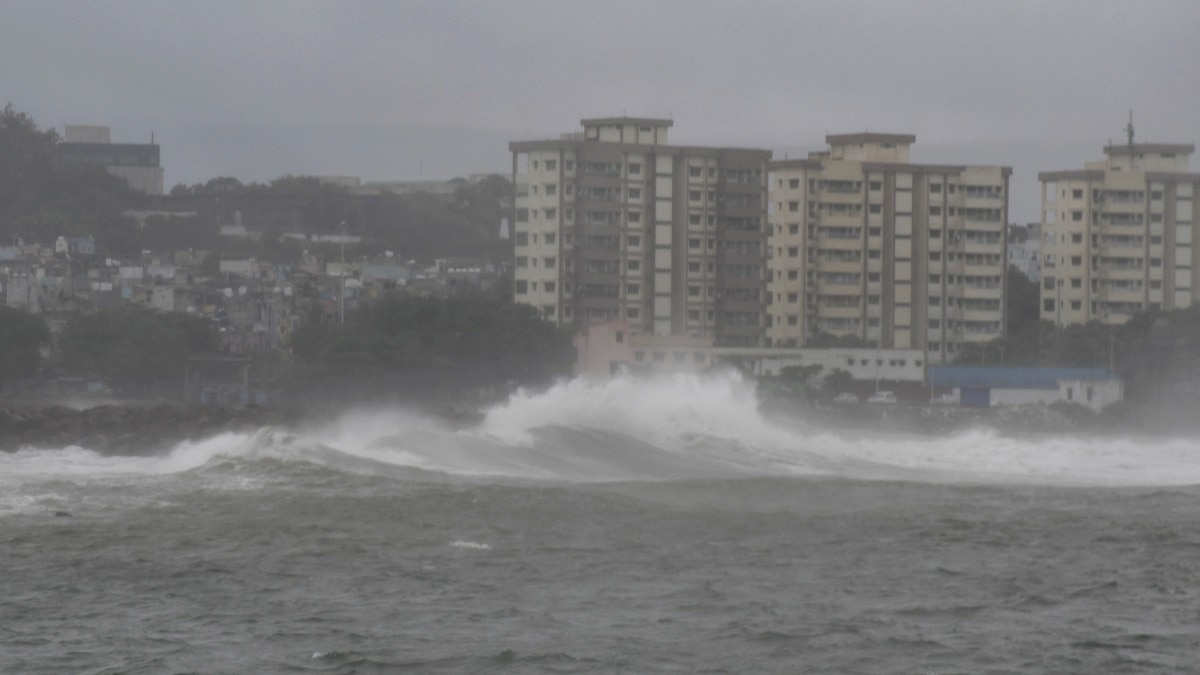
The India Meteorological Department (IMD), in its latest bulletin, said Cyclone Arnab was over the Bay of Bengal, about 170 km south-southeast of Visakhapatnam in Andhra Pradesh.High tidal waves hit the coast under overcast skies amid rain in Visakhapatnam on Tuesday. (Photo: PTI)New Delhi,Oct 27, 2026 18:50 ISTCyclone Arnab intensified into a very severe cyclonic storm over the Bay of Bengal on Tuesday, bringing heavy rain and strong winds to parts of Andhra Pradesh and Odisha ahead of its landfall along the Andhra Pradesh coast on Wednesday.The storm was around 170 km south-southeast of Visakhapatnam at 11.30 am on Tuesday, the India Meteorological Department (IMD) said. It is forecast to move west-northwestwards before turning northwestwards and crossing the Andhra Pradesh and Yanam coasts, close to Yanam and between Bapatla and Visakhapatnam, by Wednesday morning.The very severe cyclonic storm has forecast sustained winds of 125-135 kmph, gusting up to 150 kmph. Heavy to extremely heavy rainfall is expected across several states, including West Bengal, Jharkhand, Chhattisgarh and Uttar Pradesh, as the system moves inland.ANDHRA STEPS UP EVACUATION EFFORTSNearly 50,000 people had been moved to shelters from vulnerable areas in Andhra Pradesh by Monday night, out of an estimated four lakh who may need evacuation, Prakhar Jain, Managing Director of the Andhra Pradesh State Disaster Management Authority, told Reuters. "Evacuation is continuing," he said. Chief Minister N Chandrababu Naidu has directed officials to evacuate people from low-lying areas, ensure relief supplies and prepare for power restoration. The state has identified 2,131 shelter locations across 20 districts and issued alerts to around 2.70 crore people in 18 districts. More than 30,000 fishing boats have been secured.The state government has deployed 1,087 medical teams, arranged 8,281 emergency beds and kept 1,274 ambulances ready. It has stocked 21,536 doses of anti-snake venom and shifted 1,351 pregnant women to hospitals. Water tankers, generators and reverse osmosis plants have been arranged, while two months' worth of essential commodities are available at 14,686 ration shops. Advisories have also been issued to 35.96 lakh farmers. Heavy rain has been reported in Srikakulam, with strong winds in Visakhapatnam and Kakinada. Waves have risen between one and two metres, disrupting traffic along the Uppada-Kakinada stretch. Two IndiGo flights were cancelled, while around 600 km of railway tracks are under surveillance.ODISHA PREPARES FOR MASS EVACUATIONOdisha had not begun evacuations as of Tuesday, Rajesh Prabhakar Patil, the state's Special Relief Commissioner, told Reuters. The state government was preparing to move around 48,000 people from low-lying and landslide-prone areas, including around 11,000 each from Gajapati and Nabarangpur.Schools and colleges in five districts were announced closed for Tuesday and Wednesday, while schools in eight districts were also set to remain shut. Odisha has identified 135 permanent cyclone shelters and around 1,600 temporary shelters.A total of 294 rescue teams have been mobilised, including nine National Disaster Response Force (NDRF) teams, 60 State Disaster Response Force (SDRF) teams and 225 Fire Services teams. Ganjam has the highest deployment, with two NDRF and nine SDRF teams. The state has earmarked Rs 19 crore for relief and preparedness and set a zero-casualty target.Ports at Paradip, Dhamra and Gopalpur have been put on alert, and fishermen advised not to venture into the sea. An orange alert forecasts 12-20 cm of rain in Puri, Gajapati, Ganjam, Rayagada, Koraput and Malkangiri. Officials are also alert to possible flash floods from rainfall in the upper catchment areas of rivers in Chhattisgarh and Jharkhand.SEVERAL TRAINS CANCELLED, COASTAL AREAS DESERTEDAt least 12 trains were cancelled in the east, while rail services on 53 routes along the southern coast were suspended for Tuesday and Wednesday, regional railway authorities said. Television footage showed waves crashing on deserted beaches and shops shuttered along affected coastal areas."I've never seen anything like this before," 35-year-old Kotesh Kumar told AFP, adding that the government had warned people to stock up on groceries. "There was a cyclone here three years ago, but the water didn't rise this much," he said.SEVERAL STATES, NEIGHBOURING COUNTRIES ON ALERTThe IMD has warned of heavy rain in West Bengal, Jharkhand, Chhattisgarh and Uttar Pradesh as the system moves inland. West Bengal is expected to see heavy rain in several districts on Tuesday and Wednesday, followed by parts of north Bengal on October 29 (Thursday) and 30 (Friday). Fishermen have been warned against venturing into the sea until October 29.Jharkhand has issued yellow and orange alerts for several districts, with heavy rain expected through October 30. Chhattisgarh is bracing for heavy to extremely heavy rain on Tuesday and Wednesday, particularly in the Bastar region.Uttar Pradesh is also bracing for heavy rain, thunderstorms and strong winds between October 28 and 31 under the influence of Cyclone Arnab. The IMD has issued a yellow alert for October 28 in Sonbhadra, Mirzapur, Chandauli, Varanasi, Bhadohi, Ghazipur and Ballia, where winds are likely to blow at 30-40 kmph.An orange alert has been issued for October 29, with heavy rainfall and strong winds forecast in Chitrakoot, Kaushambi, Prayagraj, Fatehpur, Pratapgarh, Raebareli, Amethi and Sultanpur. On October 30, Bareilly, Pilibhit and Shahjahanpur, along with parts of Purvanchal, Awadh and the Terai region, are likely to receive heavy rain and strong winds.NEIGHBOURING COUNTRIES ON ALERTArnab's impact is also expected to be witnessed in neigbouring countries such as Nepal and Sri Lanka.Sri Lanka has closed schools for few days and warned of torrential rain, flash floods and mudslides. The military has been placed on alert, its Disaster Management Centre said.On Tuesday, Nepal's disaster authority warned that the storm could travel inland towards the Himalayas, likely overnight on Thursday (October 29), bringing heavy rainfall and a high risk of heavy snowfall, snowstorms and avalanches. Tourists have been advised against travelling to high mountain areas, while those already there have been asked to remain in safe locations.Nepal is still recovering from an August 26 flood triggered by a glacial mountain collapse. The disaster swept away more than 1,400 people and left over 5,000 missing.- Ends
Heavy rain in Andhra, Odisha as Cyclone Arnab closes in on coast with 150 kmph winds
Full Article
Original Source
Read the full article at Indiatoday →KhanList aggregates and links to publicly available news content. We do not host full articles from third-party sources. Always verify important information with original sources.