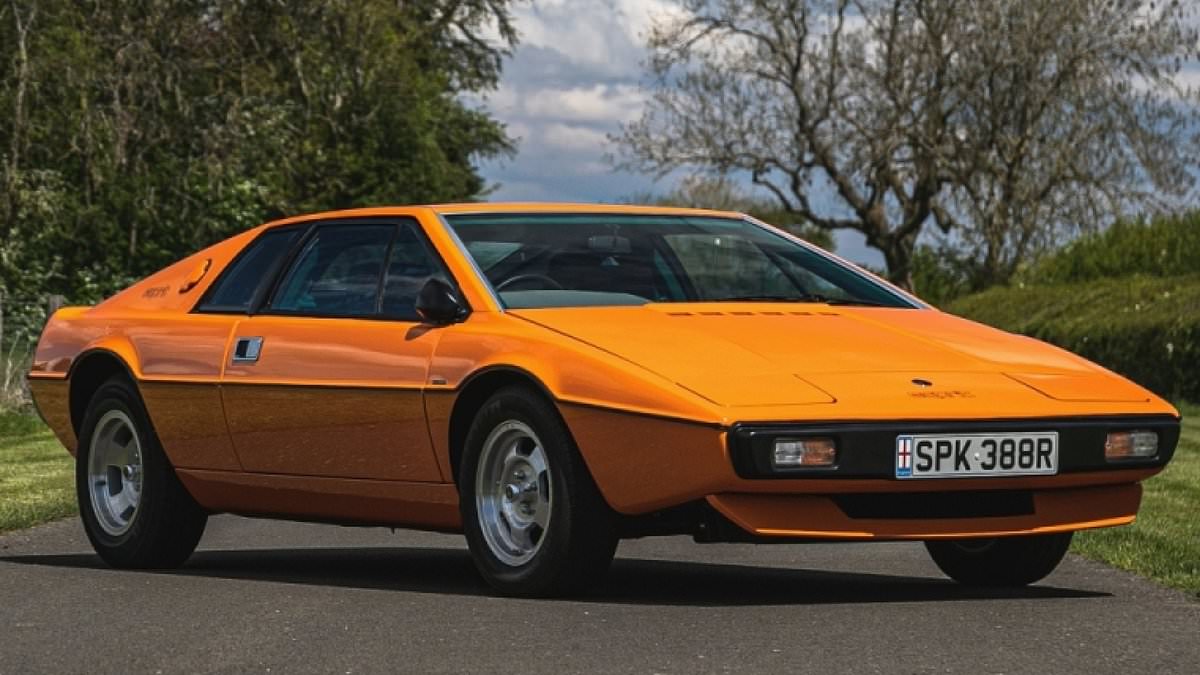
As Britons are warned to prepare for another heatwave later this summer, now's the perfect opportunity to think back to the last time the country was baked in such balmy conditions.For those of a certain vintage, the mind automatically jumps to 1976.With fifteen consecutive days between June and July when somewhere in England experienced temperatures of more than 32.2 degrees, anyone in their mid-50s or older will likely recall that scorching summer.For today's drivers, the thought of a time when you could climb into a car without air conditioning in such stifling heat is an uncomfortable one.But even the newest and most luxurious models debuting 50 years ago lacked the technology we enjoy today to cope with merciless temperatures.Forget ventilated seats, climate control and cabin pre-conditioning; drivers in 1976 were lucky to have cloth material on the chairs rather than vinyl, and an efficient ventilation system that allowed a half-decent throughput of air.We've teamed up with classic car insurer Hagerty to list eight memorable models that launched that year - and reveal what each is worth today for enthusiasts wanting to transport themselves back to a time when motor vehicles were far less equipped to cope with sweltering conditions.Alfa Romeo Sprint (1976-1983)Typical value today: £13,975 The Alfasud Sprint wasn't just incredibly handsome; it was brilliant to drive. Debuting in autumn 1976, customers fortunately dodged the stifling summer weather Sometimes strong genes can take you very far. Case in point: Erling Haaland, the Manchester City and Norway goalscoring sensation and son of former professional footballer Alf-Inge. Then there's Emily in Paris star Lily Collins, daughter of famed singer, drummer, songwriter, record producer and actor Phil Collins. Jos Verstappen's son, Max, is pretty handy in an F1 car too.These are just a few examples. And the Alfa Romeo Sprint - or Alfasud Sprint - is the automotive equivalent.It inherited its DNA from the Alfasud, a model that debuted in 1972 and blew away the opposition. The Italian marque's entry-level car, which used a flat-four-cylinder engine to send power to the front wheels, was dynamically superior to virtually every other small hatchback on the market at the time.In 1976, Alfa extended its chassis and draped it in a svelte coupé body styled by renowned design house Giugiaro to create the very pretty Sprint, which was also thoroughly excellent to drive.Hagerty's Antony Ingram says: 'As far as coping with the heatwave was concerned, technically the Sprint arrived that autumn, so buyers didn't get a chance to find out.'But it had a few neat features regardless: its Alfa cloverleaf symbols in the C-pillars were the outlets for interior ventilation, while the rear windows could actually wind down slightly, pivoting from the rear corner.'As for values today, Hagerty - which uses auction sale prices and insurance records to calculate what classic cars are worth - says £14,000 will get you a good one.BMW E24 6 Series (1976-1989)Typical value today: £24,700-£53,875 The original 6 Series has aged very well. As such, values of the big BMW remain relatively strong. Air conditioning wasn't even an optional extra in 1976 Join the discussionWhich 1976 classic would you most want to drive during a heatwave, and why?What's your view?BMW stopped making the 6 Series in 2023, but the original dates back to 1976.It was more than just a stylish take on the contemporary 7 Series saloon; it had sharper steering, tauter handling and generally better all-round performance. It looked fantastic too, and has aged exceptionally well.As such, values are holding up strongly. While the launch 628 and 633 were quick enough, it's the larger fuel-injected powertrains introduced from 1979 that are most desirable today, namely the 635CSi.A good example will set you back around £24,700. The 1984-onwards M635CSi is a collector's item, commanding values in excess of £50,000.'While the smartly styled and driver-centric dashboard layout was an ergonomic delight, air conditioning wasn't yet on the options list for UK buyers, despite an on-the-road price of around £14,000,' Antony explains.'Standard airflow wasn't great, with Autocar reporting in its October 1976 road test that the flow of air "tends to be inadequate", and you really needed the rear side windows open to aid cooling.' Ferrari 400 (1976-1979)Typical value today: £57,675-£63,450 Ferrari's mid-Seventies grand tourer is a beauty. Yet, by the iconic Italian brand's standards, it remains relatively affordable to buy today. Better still, it came with air conditioning as standardIn a catwalk of the most beautiful Ferraris ever produced, we think the 400 deserves to be strutting among the most stylish cars ever to leave the Maranello factory.When it debuted in 1976, it sat between the earlier 365 GT4 2+2 and the later 400i and 412.The epically proportioned car was a genuine grand tourer, with period-correct pop-up headlamps and a V12 delivering the power.And in a major heatwave boost, this is the only car in our list to feature air conditioning as standard.'Controlled by a slightly bewildering array of toggles and levers on the centre console, it had only four round vents on the dash to breathe through, but at least the 4.8-litre V12 wouldn't struggle when you fired up the system,' says Ingram.Want to know how much one would cost today? Hagerty reckons a Ferrari 400 in good order would set collectors back almost £58,000, while a later 412 could breach the £60,000 mark.Ford Fiesta Mk1 (1976-1983)Typical value today: £4,000 The Mk1 Fiesta arrived in 1976. Over the course of the next five decades, it would become Britain's best-selling car of all time. Pictured: A 1977 Ford Fiesta Mk1 1300 Sport The year 1976 saw the arrival of Britain's most popular car of all time: Ford's Fiesta.The US brand desperately needed a compact hatchback to compete in a market dominated by European rivals, like the Fiat 127, Renault 5 and VW Polo.The Fiesta was cleverly engineered, lightweight yet more spacious inside than an Escort, and Ford kept costs down too with smart design decisions, such as reducing the capacity of the well-proven Kent engine.'Naturally, the only real tool Fiesta buyers had to escape the 1976 heat was a pair of wind-down windows – early cars had only two face-level vents for interior ventilation,' Antony says.'Fortunately, the seats were upholstered in fabric as standard, which at least provided some breathability.'Today, a decent example will cost in the region of £4,000.Lotus Esprit (1976-1987)Typical value today: £20,000-£38,000The Lotus Esprit arrived on UK roads bang in the middle of the summer heatwave. The wedge-shaped sports car became an icon – but ventilation in stifling conditions wasn't its forte Despite its official unveiling in 1975, the super-cool Lotus Esprit hit UK showrooms the following June – right in the midst of the heatwave.Like the Alfa Sprint listed above, it was penned by the renowned Giorgetto Giugiaro. But while the Italian model was a looker, the British Esprit became an icon. In fact, it defined a generation of wedge-shaped sports cars that would continue well into the 1980s.The earliest iterations arrived with a modest 2.0-litre twin-cam engine producing 156bhp. But given its featherweight construction – a hallmark of Lotus cars – the 0-60mph time was just 6.8 seconds.'Ice-cool air wasn't a priority, to the extent that the driver had just a lone vent for comfort,' Antony remarks.Value-wise, it very much depends on the version you choose, with prices typically varying from £20,000 to £38,000.Mercedes-Benz W123 (1976-1985)Typical value today: £12,800-£29,100 The Mercedes-Benz W123 arrived in Britain in 1976 but, surprisingly, without the option of air conditioning Mercedes-Benz's W123 generation of saloons defined luxury for an era.Its build quality, understated style and wide array of engines put it ahead of its rivals. It also became the first Mercedes offered in estate form 1980 onwards.It wasn't cheap back in 1976, though. If you were seen driving one, people knew you had money.'With driver comfort always a high priority in a Mercedes, it's unsurprising to learn from contemporary reviews that the W123 would have fared better than most in the summer heat – though it's also one of the few cars here to have offered vinyl rather than fabric seats across most of the range,' Ingram says.'MB-Tex is legendary for its durability, but in scorching sunlight, you'd be more concerned about the durability of your thighs on contact with the vinyl if you were wearing anything less than long trousers...'Given the broad variety of engines, some are more desirable than others, which explains the wide valuation range of £12,800 to £29,100.Porsche 924 (1976-1988)Typical value today: £6,000-£60,000 The 924 arrived in time for the blistering summer heatwave of '76 – and its ventilation system, which it shared with the VW Golf, performed admirably While the 924 emerged in time for the sizzling summer of 1976, it wasn't until 1978 that the affordable Porsche truly became hot, when the turbocharged version arrived.The brand's entry-level sports car replaced the old mid-engined 914 and was the first Porsche to use a front-engined transaxle layout and a water-cooled engine. Its reputation was somewhat tarnished, however, by the fact the 2.0-litre powerplant also saw service in a VW van.Its design is becoming increasingly appreciated today, not least because it deviated from the flagship 911s of the era with its glass-backed coupé body.'Air conditioning wasn't an option in 1976, but the ventilation system it shared with the Golf was suitably up to date, and testers actually reckoned the ventilation was better than the heating – so perhaps this sports car was better suited to summer heatwaves than winter freezes,' says Ingram.Collectors today can get their hands on a 924 Lux coupé for as little as £6,000. However, they would need to pay ten times that if they want the more desirable homologation-special Carrera GT Coupé.Triumph TR7 (1976-1981)Average value today: £7,000 The Triumph TR7 debuted in the US in 1974. It arrived in the UK in May 1976, ideally timed for the summer heatwave The TR7 hit the US market first in 1974. However, its UK arrival was timed to heatwave perfection, landing in May 1976.There wasn't a convertible version until 1979, so the first customers in Britain endured the boiling temperatures from the confines of the wedge-shaped coupé.TR7 manufacturing would be hamstrung by constant strikes at the Speke factory in Liverpool, which led to production issues and reliability problems later in life; owners regularly complained about rusting bodies, leaking engines and worrying oil-pressure fluctuations.As such, it's still a relatively affordable option today, typically costing in the region of £7,000.In America, it was available new with air conditioning as an option for buyers in hotter states. But UK customers didn't get the choice.'Four large face-level vents on the dash provided airflow via a three-speed fan, and Autocar reported that ventilation was pretty good even on the lowest speed,' Ingram says. CARS & MOTORING: ON TEST
Heatwave classics: Eight memorable cars that debuted in scorching 1976
Full Article
Original Source
Read the full article at Dailymail →KhanList aggregates and links to publicly available news content. We do not host full articles from third-party sources. Always verify important information with original sources.