
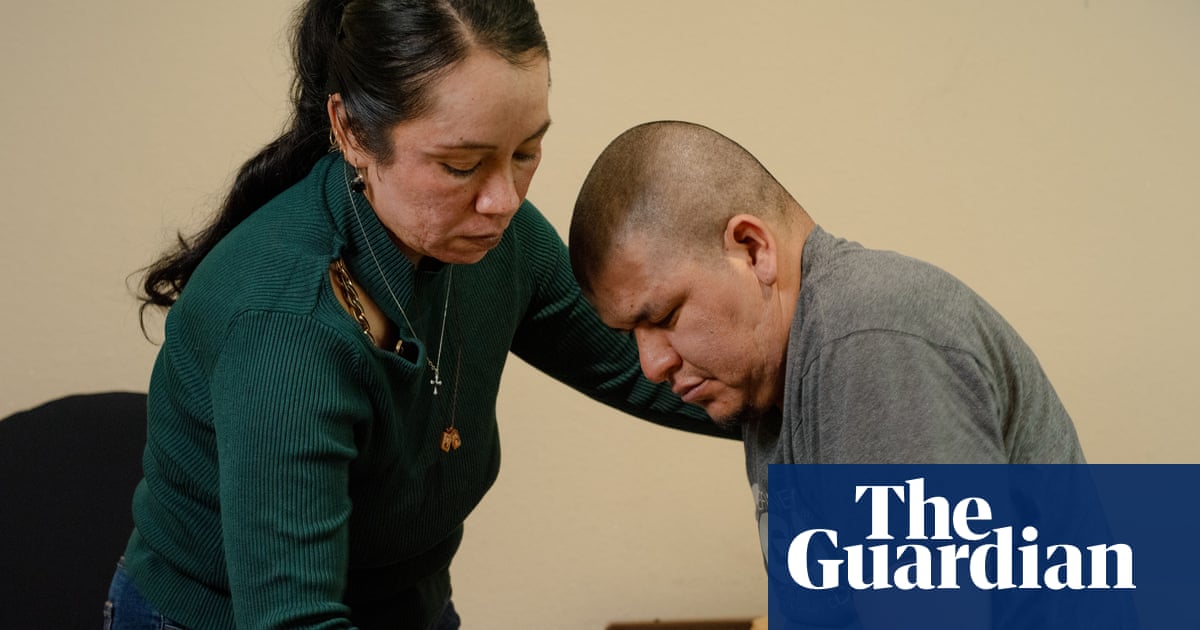
It was 4pm and 90F (32C) when Carlos Vargas Moreno and other farm workers set out to weed a watermelon field in Goldsboro, North Carolina, on 19 July 2022.The work day had begun at 7am and included two 15-minute breaks and a one-hour lunch eaten outdoors. The heat index – what the temperature feels like to the human body when relative humidity is combined with the air temperature – was 98.3F. It was the kind of day that a heat safety app created by the Occupational Safety and Health Administration (Osha) and the National Institute for Occupational Safety and Health (Niosh) defined as “hazardous” for outdoor workers.According to court documents, government records and testimony from workers present that day, Vargas Moreno paused to get a drink of water just before 6pm. A few seconds later, he staggered and collapsed. He was later diagnosed with heatstroke.Since then, the 38-year-old man is unable to walk or care for himself. In the absence of federal and state standards to protect farm workers from dangerous heat, there has been little accountability for the employer who twice failed to implement many basic safety measures – including on-site supervision and access to timely emergency medical care. Vargas Moreno’s family is telling their story to the Guardian, Prism Reports and Enlace Latino NC for the first time, as they continue adjusting to their changed lives in North Carolina.Heatstroke is a preventable condition – and it should have been on the minds of Vargas Moreno’s employers, a company called Florida Orange Gold. Almost exactly two years earlier, another man it employed, Carmen Sebastian Hernandez Mosqueda, died from the condition while also weeding a North Carolina field.‘Had to put up with the work’Ever since “the accident”, everything about Vargas Moreno’s life has changed, said Daysi Romero Arellano, the farm worker’s wife.“Accident” is a nicety. The heatstroke caused brain injury and disability, meaning Vargas Moreno must use a wheelchair. Romero Arellano now bathes her husband, dresses him, helps him use the restroom and feeds him.Carlos Vargas Moreno receives assistance from his wife, Daysi Romero Arellano, inside their home in Raleigh. Photograph: Kaoly Gutierrez/The Guardian“Nothing is the same,” Romero Arellano said through an interpreter during an August interview. Seated next to Vargas Moreno, she lovingly rubbed his head. Verdad, Carlos? “Isn’t that right?” she asked him. Vargas Moreno locked eyes with his wife and nodded.Due to the brain injury that resulted in cognitive and linguistic deficits, Vargas Moreno cannot verbally articulate the facts associated with his case.The Guardian, Prism and Enlace Latino NC spoke to the farm worker’s family; attorneys Katherine and Francisco Bricio, who represented Vargas Moreno in his workers’ compensation case and civil suit; and Aaron Jacobson, a supervising attorney for the Farmworker Unit of Legal Aid of North Carolina who is representing the farm worker in an immigration case.This reporting is also based on thousands of pages of government records and court documents. This includes depositions of farm workers, Florida Orange Gold employees and North Carolina department of labor (NC DOL) officials. Accounts include contradictory information, including whether workers had sufficient water or breaks in extreme heat.Florida Orange Gold has denied that Vargas Moreno’s condition was a result of workplace injury; the farm worker later won a workmen’s compensation case. The company did not respond to several requests for comment regarding allegations against it in NC DOL records and as part of Vargas Moreno’s case. When the Guardian, Prism and Enlace Latino NC called a phone number listed for Florida Orange Gold’s bookkeeper, Gilberto Gutierrez, the person who answered hung up and did not respond to text messages. No one responded to queries sent to the company’s email address.Vargas Moreno first worked for Florida Orange Gold in 2021 as part of the federal H-2A visa program for temporary agricultural workers. A skilled farm worker, he previously worked side by side with his wife in Mexico’s fields, harvesting strawberries, asparagus and blueberries. When a relative told him about the H-2A program, Vargas Moreno told his wife he wanted to work in the US so that she could stay home and raise their young daughter.He eventually signed on with Florida Orange Gold, a company formed in 2017 by Jose Javier Gutierrez, a farm labor contractor (FLC). Florida Orange Gold obtained approximately 500 H-2A workers in 2022, and Vargas Moreno was one of 314 people sent to North Carolina that year. Gutierrez’s father was also a labor recruiter with his own business, and Gilberto is Jose’s brother.The company operates across Florida and North Carolina, and it is one of hundreds of intermediaries nationwide contracted by US growers and crop farmers to hire migrant farm workers and oversee their work. FLCs are the fastest-growing segment of farm employment, and data shows they are the worst violators of federal employment law violations in agriculture. Though they manage hundreds of vulnerable workers in an industry rife with wage theft, labor trafficking and other serious abuses, farm labor contractors require no special training or certification.Her husband’s decision to enter the H-2A program now haunts Romero Arellano. “Our life in Mexico was poor, but it was simple and we shared everything. I wish we moved forward with the little that we had,” she said at the couple’s apartment in Raleigh. In the dining room, there are balloons and streamers, remnants of another birthday celebration held over WhatsApp for their 13-year-old daughter in Mexico.Starting in May 2022, Vargas Moreno’s second year with Florida Orange Gold, he began to share alarming details about his work when he called his wife during meals and at night when back at the labor camp where he was housed.“He said they were working him very hard and that there wasn’t enough water; there wasn’t a way to carry the water with them while they were working and that they weren’t given enough breaks to drink water,” she recalled.As part of Vargas Moreno’s workers’ compensation case after his injury, she said in a June 2024 deposition that her husband told her on a daily basis that Florida Orange Gold wasn’t giving them enough breaks. He also told her that workers had to buy their own water to have at the labor camp and that there weren’t enough refrigerators to keep beverages cold. Vargas Moreno also reportedly detailed meetings in which Florida Orange Gold discussed H-2A workers fleeing the job.The work was merciless. From 16 July 2022 until his heatstroke that occurred at about 5.50pm on 19 July 2022, Vargas Moreno worked between eight and 11 hours each day, with the heat index never dipping below 94.4F.side by side photos, the left a close-up of a farm worker carrying bushels of lettuce under their arm and the right of two people helping a man using a walkerWhen he collapsed, there was no Florida Orange Gold supervisor on site. Farm workers tend to have little control over their work conditions and surroundings, said Taylor Arnold, a Wake Forest University School of Medicine assistant professor who studies the impacts of heat on child farm workers.“Often workers are very spread out in a large area. So they may not notice if someone is in distress and they may not receive adequate training about what to do if someone is experiencing heatstroke. Workers can have difficulty communicating their exact location to emergency responders because fields are often remote or lack easily identifiable addresses. All of these factors together are extremely dangerous,” Arnold said.Vargas Moreno’s fellow workers didn’t know what to do when he began to have a seizure. A worker called Florida Orange Gold’s founder, Jose Gutierrez, who was in another field several miles away. Gutierrez did not instruct workers to call 911, and he did not call 911. Instead, the contractor told the workers to wait for him.The farm workers carried Vargas Moreno on to a bus without air conditioning and drove him to the side of a nearby road. Vargas Moreno, now unconscious, was then placed on the ground outside the bus until Jose arrived about 15 minutes later. Rather than putting him in the cab of his air-conditioned, four-door pickup, Jose Gutierrez had workers load Vargas Moreno on to the bed of the truck.By the time they arrived at the emergency room at 6.32pm, Vargas Moreno was unresponsive, covered in vomit and had a body temperature of 109F. He remained in the hospital for almost a year.During Romero Arellano’s deposition, Gutierrez’s attorney asked whether Vargas Moreno was the type of person who could stand up for himself and ask to work fewer hours. Romero Arellano wavered.“Yes,” she said, but he also wanted to “obey the bosses” who were paying him. “He said he had to put up with the work.”In a deposition, Jose Gutierrez said that on the day of Vargas Moreno’s injury, he asked the laborers if they wanted to continue working in scorching 3pm temperatures; he claimed they said yes. In NC DOL’s investigation of Vargas Moreno’s heatstroke, weeks after the incident occurred, the workers Florida Orange Gold provided to NC DOL for interviews claimed they agreed to continue working, that they previously received heat stress training, that they took additional breaks that day, and that Florida Orange Gold often ended their days early if it was too hot. But these claims were later contradicted by additional H-2A workers deposed in Vargas Moreno’s workers’ compensation case, suggesting to attorneys that some might have coached by the farm labor contractor.Johana Ramirez, the NC DOL safety compliance officer who oversaw the investigation into Vargas Moreno’s heatstroke, noted some of these inconsistencies in her files. In her own deposition, Ramirez said she heard of the workers’ decision to continue working from company sources and not directly from farm workers.Refusing work has sharp consequences for H-2A workers. Florida Orange Gold required its workers to sign a statement that said: “I understand that if I refuse to do any work or leave early, then I forfeit my job, and the three quarters guarantee housing benefit and transportation.” Losing an H-2A job also means losing the ability to lawfully work in the United States.The standard is no standardWhile Vargas Moreno felt he had no choice, Florida Orange Gold didn’t adopt practices that could save workers’ lives and that were strongly recommended after a farm worker’s death in the blistering southern summer of 2020.Carmen Sebastian Hernandez Mosqueda was one of 40 H-2A workers who spent 18 July 2020 pruning tobacco plants and hand-weeding rows of sweet potatoes. That week, the National Weather Service issued an advisory warning of dangerous heat. Florida Orange Gold H-2A workers still spent between 11 and 12 hours in the fields each day.At approximately 4pm, when the heat index peaked at 108F, Hernandez Mosqueda reportedly said he wanted to take the rest of the day off because he “felt tired”. As he exited the field, he buckled.There was no Florida Orange Gold supervisor at the scene, and workers did not call 911.Daysi Romero Arellano inside her home in Raleigh. Photograph: Kaoly Gutierrez/The GuardianThe closest hospital to the field was UNC Health Johnston, located about 24 minutes away in Smithfield. But for unknown reasons, Hernandez Mosqueda was driven for 14 minutes to a parking lot in Newton Grove, where he was transferred to another vehicle. While en route to Sampson Regional medical center 22 minutes away, Hernandez Mosqueda lost consciousness. Only then was 911 called – 50 minutes after the man first collapsed. The records are not clear about who was driving each vehicle or who called 911.Heatstroke is a time-sensitive emergency. By the time an ambulance arrived at 5.07pm, Hernandez Mosqueda’s body temperature was 101.5F. By 5.15pm, he was dead. He was 25 years old. The medical examiner later listed his cause of death as hyperthermia.Neither the state of North Carolina nor federal Osha have a heat standard that requires employers to establish standards for access to drinking water, rest breaks and temperature control. However, Osha recommends employers implement a heat stress prevention plan to “control heat risk”. The Occupational Safety and Health Act’s general duty clause also requires employers to provide a workplace “free from recognized hazards” that are “likely to cause death or serious physical harm to employees”.As part of NC DOL’s investigation into Hernandez Mosqueda’s death, an unnamed Florida Orange Gold employee was asked whether the company had a heat stress prevention program. “If hot, take a break,” the employee told the investigator.The employee also said workers carry a banana with them and “they wet it to cool them down”. When asked to clarify, the employee explained that a wet banana peel can be used around a person’s neck to cool them off.NC DOL ultimately cited Florida Orange Gold for multiple violations, including the general duty clause. For the death of Hernandez Mosqueda, NC DOL determined a proposed penalty of $7,000 and required the company to “abate the hazard” by immediately implementing a heat stress prevention program so another worker wouldn’t die or experience serious physical harm.When Vargas Moreno experienced heatstroke, Florida Orange Gold made no alterations to H-2A workers’ schedules to account for the temperature – a direct violation of the heat stress prevention program the farm labor contractor purportedly implemented after the death of Hernandez Mosqueda, said attorney Katherine Bricio.According to testimony from the NC DOL agricultural safety and health officer who investigated Hernandez Mosqueda’s death, Florida Orange Gold had to be reminded to abate the violation of the general duty clause and submit its heat stress prevention program. In April 2021, months after the company was first cited for the worker’s death, Florida Orange Gold sent the agency its program: a template from the NC DOL website. The farm labor contractor made no modifications to the sample heat stress prevention program, other than inserting “Florida Orange Gold” into blank spaces and naming Gilberto Gutierrez the responsible party for carrying out the plan.In November 2021, a follow-up inspection did find, using information provided by the company, that Florida Orange Gold had addressed and abated the hazard. By the following spring, Carlos Vargas Moreno was working for the contractor and telling his wife about lack of water and other poor working conditions.“In simple terms: a worker died and Florida Orange Gold signed a government document promising to correct the hazard that subjected the worker to danger. Instead, they pasted their names across a form and they never looked at it again,” said Katherine Bricio, who along with her husband, Francisco, filed suit against Florida Orange Gold and the Gutierrez brothers. Also a defendant was Howell Farming, the North Carolina grower who hired the FLC to bring Vargas Moreno and other H-2A workers to the state and whose field he was weeding when he collapsed. Howell Farming did not respond to a request for comment by publication time about whether the company still contracts with Florida Orange Gold and if it has taken any steps since Vargas Moreno’s heatstroke to ensure the farm labor company follows a heat stress prevention program.Francisco Bricio, an attorney who worked on Vargas Moreno’s farm worker rights case, in Raleigh. Photograph: Kaoly Gutierrez/The GuardianIf actually implemented, NC DOL’s sample plan covers a lot of ground: emergency preparedness, trainings for detecting heat illness and actions employers can take to protect workers. This includes implementing a buddy system for help during emergencies, providing workers drinks with electrolytes and using Osha-Niosh’s heat safety tool to monitor weather and cut workdays short when temperatures are dangerously high.Based on the Gutierrez brothers’ own testimony during depositions, they could not answer basic questions about their own heat stress prevention plan.In May 2024 depositions, Gilberto Gutierrez said no one at Florida Orange Gold was responsible for checking the weather, though his name repeatedly appears in the company’s heat stress prevention plan as the person responsible for checking the weather. Jose was unfamiliar with the term “heat index” and said he didn’t know what electrolytes were. Neither brother had heard of the buddy system.‘There hasn’t been much accountability’Leticia Zavala is often one of the first people to learn of the tragedies that befall farm workers. Zavala organizes H-2A workers in North Carolina with the farm worker advocacy group El Futuro Es Nuestro, which launched its “Ni una muerte más” (“Not one more death”) campaign to address labor conditions for farm workers.She first learned of Vargas Moreno not long after he was hospitalized. As tragic as his story is, she said the same thing happened to another H-2A worker last year.“I was just at the hospital last night, visiting another worker who had a heatstroke,” Zavala said during an interview on 4 August.two side by side images, the left of a man closing his eyes as he rests his head in his wife’s lap, and the right of a corner table in a home with religious figurines and string lightsFarm workers are 35 times more likely to die from heat‑related illnesses than workers in other industries, a 2022 study found. And as temperatures become more extreme due to the climate crisis, the effects on these workers will be devastating. A record-breaking heatwave slammed the south last month and earlier this summer, and night-time temperatures nationwide rarely fell below 80F – a phenomenon that will become more common. Researchers are now tracking the cumulative effects of heat on H-2A workers whose bodies never have the opportunity to fully rest or recover because their labor camps don’t have air-conditioning.With each year becoming among the hottest on record, what is really needed is a heat standard. In July 2024, the Biden administration released a proposed rule requiring employers to develop and implement heat injury and illness prevention plans, though it was swiftly challenged by employers. The proposed rule largely stalled out, but news broke in August that the Trump administration announced plans to make “business-friendly” revisions to the proposed rule.Locally, advocates in North Carolina are also facing an uphill battle.The North Carolina Heat Stress Coalition, composed of workers, unions and organizations such as El Futuro Es Nuestro, has spent years pushing the state to adopt a heat stress standard. Last year, members of the coalition met with North Carolina’s new labor commissioner, Luke Farley, who previously said he was not in favor of adopting a heat standard.Zavala said the commissioner gave them only a few minutes of his time and never mentioned that he planned to launch his own heat stress council – one that is dominated by employer representatives.“His council is a political stunt,” Zavala said. “He might claim that he’s worried about workers, but he’s really just protecting industry groups.”Leticia Zavala in Spring Hope, North Carolina, on 19 September. Every summer, she sees more farm workers face preventable heat-related emergencies. Photograph: Kaoly Gutierrez/The GuardianFarley’s heat stress advisory council, which met once this summer, includes industry groups such as the North Carolina Growers Association (NCGA), the largest employer of H-2A workers in the country – and a group long linked to allegations of mistreating farm workers.By publication time, Farley’s office did not respond to questions about his council or his stance on implementing a heat standard. NC DOL also did not respond to questions about its investigative practices, oversight of heat stress prevention programs and companies that repeatedly violate the general duty clause. The NCGA also did not respond to questions about its treatments of workers or role in the heat stress advisory council.A NC DOL compliance safety officer who previously investigated Florida Orange Gold said in her deposition that it was important to immediately launch an investigation after a serious injury so that employers don’t have time to “clean up the scene”. That same NC DOL employee began her investigation into Vargas Moreno’s near fatality seven weeks after the incident occurred. This is because the Gutierrez brothers failed to report Vargas Moreno’s hospitalization to the agency. The law requires notification within 24 hours, and it was Francisco Bricio who made the call on 2 September 2022.“Farm workers tragically die almost every year, but it’s hard to say that Carlos is ‘fortunate’,” said Jacobson, the Legal Aid attorney. “I think it was the intention of Florida Orange Gold to drop Carlos off at the hospital and not tell anyone what happened.”Aaron Jacobson, a lawyer who worked with Romero Arellano and Vargas Moreno on their case, poses in Raleigh, North Carolina, on 18 September. Photograph: Kaoly Gutierrez/The GuardianIn Vargas Moreno’s case, NC DOL determined that Florida Orange Gold was not following its heat stress prevention program and that it had again violated the general duty clause. For these and other violations, NC DOL assessed the farm labor contractor a proposed penalty of more than $42,000 and again mandated that the FLC implement a heat stress prevention program.Those fines aside, “there hasn’t been much accountability,” said Jacobson. “Meanwhile, Carlos is limited in terms of what he can pursue under the law.”Though Vargas Moreno eventually won his worker’s compensation case, it was originally denied. Francisco Bricio said that Florida Orange Gold initially denied Vargas Moreno’s injuries were workplace-related and then denied that his brain injury was related to hyperthermia. Last month, the farm worker’s civil suit was dismissed – despite what Francisco called “false records and sham affidavits” submitted by Florida Orange Gold. This includes 2024 affidavits from H-2A workers alleging they received heat stress training before Vargas Moreno’s heatstroke. However, many of these same workers were deposed in November 2022 and said they received no such training.As recently as this month, Florida Orange Gold was seeking to hire 700 H-2A workers in North Carolina. Jacobson said he was worried about the treatment of these workers, but his office’s previous efforts to conduct outreach to workers were rebuffed by the company.Carlos Vargas Moreno and Daysi Romero Arellano inside their home in Raleigh, North Carolina, on 18 September. Photograph: Kaoly Gutierrez/The GuardianIn North Carolina, farm workers generally have the legal right to receive visitors in their employer-provided housing. But going back to at least 2019, Jose Gutierrez and members of his family allegedly have verbally and physically accosted Jacobson and other Legal Aid employees and volunteers for attempting to speak to workers.Arguably, farm labor contractors such as Florida Orange Gold operate with impunity because they are allowed to – by lawmakers, landowners, state and federal agencies, and local officials. The records associated with Vargas Moreno’s case give insight into how this happens.In legal proceedings, attorneys argue over who owes a duty of safety to H-2A workers and whether strenuous agricultural labor in extreme heat is actually dangerous. An injured worker’s ability to access medical care hinges on the difference between a safety “recommendation” and a safety “requirement”, never mind that the minor action could save a worker’s life.Almost nowhere inside this system is an expressed desire to do better, to improve working conditions, or to create a heat standard so that workers don’t experience catastrophic injuries or return to their families in body bags.Romero Arellano said her motivation for going public was the hope that their family’s story would change these conditions.“The people with the power need to do something so that what happened to Carlos doesn’t happen to anyone else,” she said. As for her husband, Romero Arellano said: “Justice is impossible.”This article is co-published by the Guardian, Prism Reports and Enlace Latino NC
Heatstroke ruined his health. Years before, it took the life of another farm worker at the same company
Full Article
Original Source
Read the full article at Theguardian →KhanList aggregates and links to publicly available news content. We do not host full articles from third-party sources. Always verify important information with original sources.