
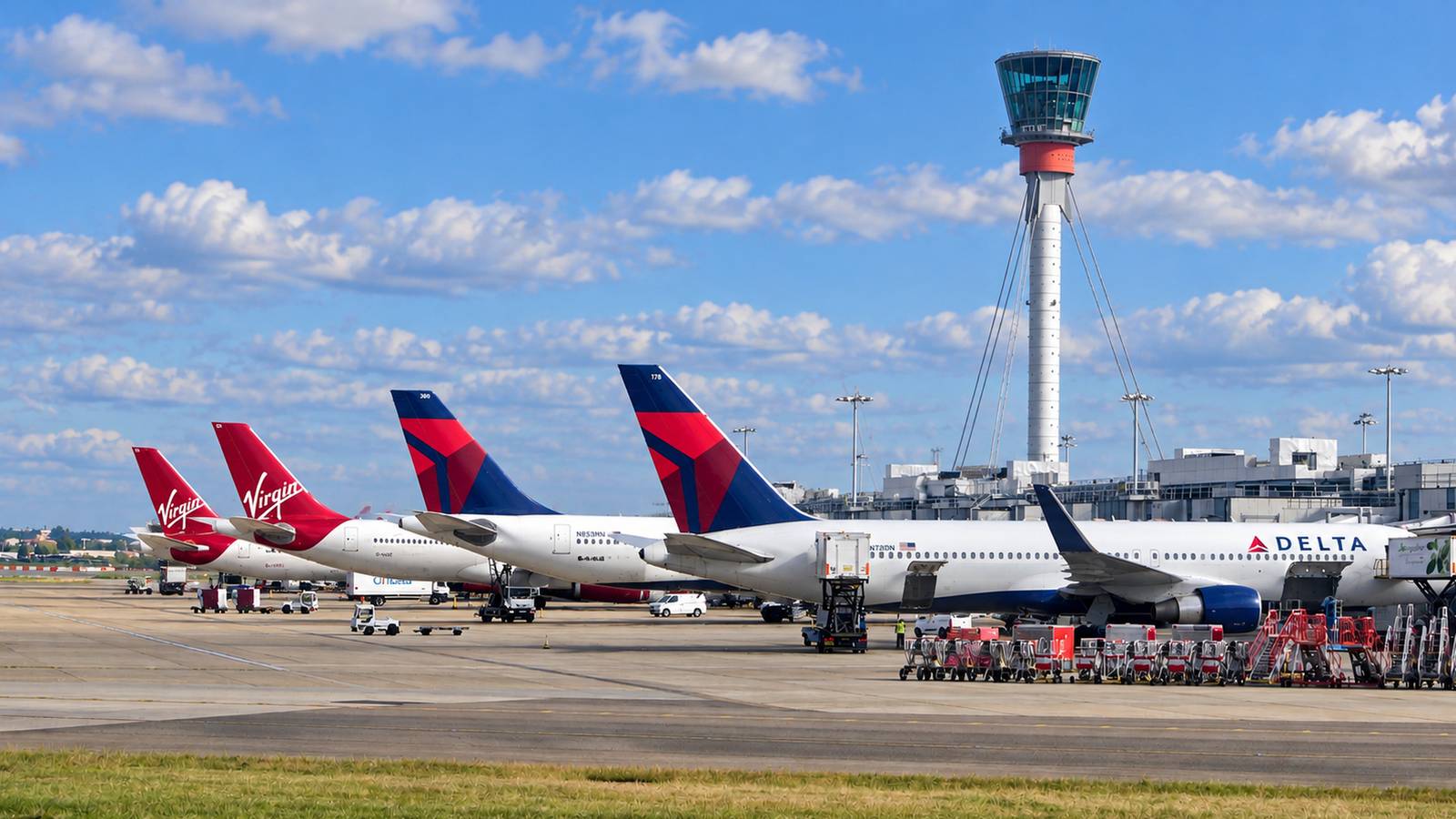
Published Oct 27, 2026, 2:49 PM EDT Paul has had a career of 25+ years focused on the international technology sector, which has taken him to over 100 countries. Along the way, he developed a deep love for aviation, with a travel bucket list measured by aircraft types flown rather than destinations reached. Now he brings that avgeek passion, along with the journalism experience he accumulated early in his career, to write insightful pieces for Simple Flying. London Heathrow Airport (LHR) has sparked a furious response from Virgin Atlantic after ordering joint venture partner Delta Air Lines to relocate from Terminal 3 to Terminal 4 in 2028. Sky News reports that the decision follows a major review of terminal occupancy, with Virgin warning that separating the airlines could increase fares and undermine competition. The two carriers have shared Terminal 3 since 2016, building an integrated transatlantic operation offering convenient connections and premium facilities. Meanwhile, British Airways and American Airlines benefit from substantial co-location at Terminal 5, raising questions about whether Heathrow's decision creates an uneven competitive playing field. Why Heathrow's Decision Has Sparked Fury Credit: Markus Mainka I Shutterstock Heathrow's terminals accommodate several competing alliances. British Airways and American Airlines primarily operate from Terminal 5 (although American does also operate from Terminal 3), while Virgin and Delta have shared Terminal 3 for the past decade. Interestingly, the bulk of fellow SkyTeam members, such as Air France and KLM, operate from Terminal 4. So the move is interesting as it clearly disrupts the Virgin-Delta partnership, but yet places Delta with a wider array of alliance partners. The immediate impact of moving Delta is that it would complicate connections, potentially increasing transfer times and requiring additional security screening. It would also disrupt the extensive shared check-in and screening facilities at Terminal 3, while premium passengers would lose convenient access to Virgin's Terminal 3 Clubhouse, Upper Class Wing, and Revivals Lounge. While alternatives for Delta passengers exist at Terminal 4 — notably the new Air France lounge and the SkyTeam Plaza Premium Lounge — it certainly narrows the choices for Delta passengers. Virgin CEO Corneel Koster was quick to attack the move, warning that separating the airlines would weaken their joint venture, thereby putting a finger on the scale of competition with the British Airways-American Airlines joint venture, and ultimately harming consumers: "If implemented in 2028, Heathrow's decision to separate Delta Air Lines from Virgin Atlantic would create friction for customers, weaken competition, and reduce choice. As all other airports seek to co-locate joint venture partners, Heathrow has chosen to split ours after more than a decade together." Heathrow Defends Its Terminal Shake-Up Credit: Markus Mainka | Shutterstock Heathrow holds a different view. The airport maintains that its proposals will improve capacity, reduce congestion, and accommodate growth, all vital ingredients for the future success of one of the world's busiest hubs. A Heathrow spokesperson told Sky News: "As demand at Heathrow continues to grow, these small number of moves will unlock more capacity across terminals, reduce congestion, improve the flow of passengers, and help keep costs down." Heathrow maintains that airlines representing 81% of passengers support the plan. However, given that the BA-AA joint venture represents nearly 70% of all Heathrow-US traffic, it is hardly surprising that it would come out in support of a change that is damaging to its largest competitor. As a result, a source speaking to Sky News described the move as "one monopoly reinforcing another monopoly." There is also a historical irony. Heathrow's previous occupancy review in 2014 concluded that Delta could move from Terminal 4 and consolidate with Virgin in Terminal 3, a process that it completed in September 2016. Both the airport and the airlines explicitly celebrated the operational advantages at the time, making the proposed reversal particularly controversial. Year Heathrow Terminal Change Significance 2008 Terminal 5 opens BA consolidates its hub 2009 Original T2 closes Preparations for replacement 2014 New T2 opens Star Alliance consolidation 2014 Delta begins T4–T3 moves Virgin co-location begins 2015 Terminal 1 closes Four-terminal operation 2016 Delta completes T3 move Shared Virgin-Delta operation 2022 American expands into T5 Closer BA integration 2028 Delta moves to T4 (planned) JV partners separated Nevertheless, Heathrow must balance the requirements of approximately 80 airlines operating within constrained infrastructure. Its argument centers on airport-wide efficiency rather than individual partnerships. Whether those benefits outweigh the inconvenience imposed on Virgin and Delta passengers remains disputed, particularly given Heathrow's limited capacity and continuing expansion challenges. Can Virgin And Delta Fight Back? Credit: Ceri Breeze | Shutterstock Virgin has made it clear that it intends to challenge the decision. Koster says it is considering "all available options," which would potentially involve the Civil Aviation Authority (CAA), Competition and Markets Authority (CMA), or the courts. He said: "A level playing field for UK-based carriers and their partners is vital for consumers and the UK economy. Given Heathrow's significant market power, and the expected impact on UK long-haul competition, we will consider all available options to challenge this outcome." There is precedent for regulatory disputes, and Virgin and Delta appealed Heathrow's airport charges in 2023. However, those proceedings concerned pricing rather than terminal allocation, meaning no equivalent automatic appeal mechanism has been established. Negotiation likely offers the first and most practical solution. Virgin could seek to retain Delta at Terminal 3, move alongside it to Terminal 4, or negotiate improved transfers and replacement lounge access. Potential Response Possible Approach Main limitation Negotiate Retain Delta at T3 Heathrow must agree CAA complaint Seek regulatory scrutiny Powers may be limited CMA intervention Raise competition concerns No automatic appeal Legal action Challenge contractual or legal grounds Costly; uncertain basis Move Virgin to T4 Preserve co-location Lose established T3 facilities Passenger protections Improve transfers and lounges Separation remains Delta has yet to comment publicly on the decision, although it is likely to share Virgin Atlantic's frustration at the prospect of dismantling more than a decade of close cooperation at Heathrow. With the relocation not scheduled until 2028, however, the partners have time to challenge the decision, negotiate a compromise or develop alternative arrangements. Given the commercial stakes and Virgin's determination to fight the move, this dispute looks far from over.
Heathrow Sparks Fury As Delta Forced To Move From Shared Virgin Atlantic Terminal
Full Article
Original Source
Read the full article at Simpleflying →KhanList aggregates and links to publicly available news content. We do not host full articles from third-party sources. Always verify important information with original sources.