
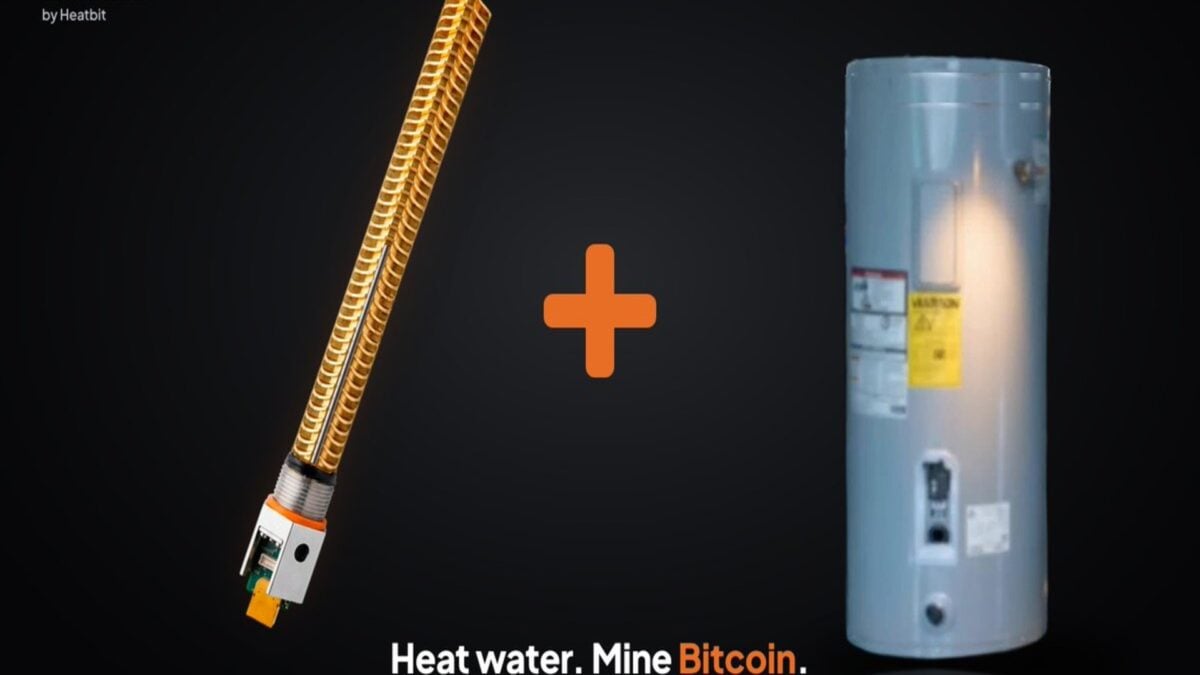
Heatbit has spent the past few years selling space heaters and air purifiers that also mine bitcoin, earning a CES Innovation Award along the way and drawing reviews from outlets like Wired and The New York Times. The Delaware-based company, founded around 2020 by Alex Busarov, is now taking the same idea into the utility closet with Bitwater, a replacement heating element that screws into the electric water tanks already found in many households and uses bitcoin-mining chips to generate the heat. Introducing Bitwater: the water heater element that mines Bitcoin. It screws into the electric tank you already have. Physically decentralized mining that runs no matter what 🧵 Heat water. Mine Bitcoin. Same tank. pic.twitter.com/pRdxPbmpXM — Heatbit (@heatbit_com) October 22, 2026 According to Heatbit, Bitwater replaces the resistance wire in a standard electric water-heater element with twenty Bitmain BM1370 mining chips. The company advertises up to 34 terahashes per second (TH/s), power draw of up to 600 watts, and mining efficiency starting at 12 joules per terahash. Additionally, the tank water cools the chips directly, eliminating the need for noisy fans. Heatbit says Bitwater fits most 30- to 80-gallon electric tank water heaters in the United States and Canada that use a compatible one-inch screw-in element port, including models from A. O. Smith, Rheem, Bradford White, Whirlpool, and GE. A companion app also shows water temperature, hashrate, and earnings, and bitcoin revenue generated through either pooled or solo mining go to an address the user controls. Refundable preorders for the first production run at a price of $899, with shipments targeted for the first quarter of 2027. Does This Make Any Sense? Of course, the key economic question is whether the $899 device can provide the same hot-water service at a lower effective lifetime cost than a conventional element. In their announcement thread about Bitwater on X, Heatbit said it tested Bitwater during the winter season in households of four and five people in New York and Florida, but they did not share detailed results of those tests. However, they did claim that the costs of water heating stays the same when Bitwater is swapped in for a previously-used element. Notably, both conventional resistance elements and mining chips ultimately convert nearly all of their consumed electricity into heat. But that does not necessarily mean Bitwater will generate savings for its users. The economics also depend on the initial cost of the element, household hot-water demand, control settings, uptime, the alternative heater’s performance, electricity tariffs, hardware life, and bitcoin-mining conditions. Reviews of earlier Heatbit space heaters by Wired and The New York Times raised questions about whether the hardware actually led to real savings, with Wired’s Matthew Korfhage pointing to higher upfront costs as the real issue: “But here’s the problem with that math. I’d also need to pay at least $1,500 upfront (the current discounted price of the Maxi Pro) before I get access to these savings. This is about $1,350 more than the best space heaters I’ve tested. It’s also around $900 or $1,000 more than a combination purifier–heater from Dyson. So your money-saving math needs to take this upfront cost into account.” Even a relatively expensive conventional replacement water-heater element typically costs less than $30, so the roughly $870 price gap means mining revenue would need to recoup a substantial upfront premium for the Bitwater to make financial sense. Answering the top 3 questions about Bitwater: 3. How much Bitcoin will Bitwater mine? It depends on your hot water usage and mining conditions.Someone asked @grok to do the math. We'll let it speak for itself 👇Of course, estimates aren't guarantees. Actual results will vary. pic.twitter.com/mnPvKvkkok — Heatbit (@heatbit_com) October 23, 2026 Heatbit has not published its own Bitcoin earnings forecast, but it shared an estimate from xAI’s Grok of roughly $1 to $1.25 per day. At 80% uptime, that would equate to approximately $292 to $365 in annual gross mining revenue. It should be noted that these figures are based on a particular, temporary hashprice snapshot. A conventional water-heater element typically lasts around six to ten years, but whether Bitwater can deliver a worthwhile return over a similar period remains unclear. The $899 price could theoretically be recouped in roughly three years (and offer real savings after that), but that calculation assumes mining revenue holds steady, which is far from guaranteed as Bitcoin network difficulty, market conditions, and block rewards change over time. Bitcoin-mining hardware has already been used in heat-related projects at industrial and residential scales for years. MARA Holdings, formerly Marathon Digital Holdings, has deployed two bitcoin-mining heat-recycling projects in Finland that supply heat to district-heating networks serving communities with nearly 80,000 residents. Other companies and hobbyists have explored using mining heat in buildings and greenhouses, but the economics depend on whether the heat is useful when it is produced, the cost of delivering it, and the alternative sources of heat that are already available. Also Good for Bitcoin? Heatbit and others have also argued that Bitwater could benefit the Bitcoin network itself by distributing hashrate across more independent households instead of concentrating it among large mining companies. Mining centralization is seen as a legitimate concern for Bitcoin, as 51% attacks can enable serious disruptions, including reordering or censoring transactions. Some have warned that miners could become the next focus of enforcement efforts after the recent prosecution of privacy-focused wallet developers. Keonne Rodriguez, who was a co-founder of Samourai Wallet and is currently serving a five-year prison sentence associated with his work there, has argued that, when the government’s arguments against Samourai Wallet are taken to their logical conclusion, miners are the parties effectively performing money transmission by choosing which transactions to include in blocks. Bitheat That said, Bitwater’s potential positive effect on decentralization would depend on whether household hashrate is material relative to the greater network. Heatbit says homes use roughly 300 terawatt-hours a year heating water, while the entire Bitcoin network currently consumes around 170 terawatt-hours. Notably, Bitcoin’s network hashrate growth has slowed over the past year or so as large miners have shifted their infrastructure towards artificial intelligence (AI) applications. Bitcoin Mining’s Other Problem Bitcoin mining’s energy use has drawn seemingly–endless climate-related criticism over the years due to the reality that additional electricity demand can cause fossil-fuel power plants to ramp up their efforts. Indeed, these criticisms have even come from within the crypto industry itself. Ripple co-founder Chris Larsen notoriously committed millions of dollars to a Greenpeace campaign meant to push Bitcoin developers to move away from proof-of-work, an effort many Bitcoin proponents viewed as an unwarranted attack from a much more centralized alternative with dubious credibility. In recent years, the debate over Bitcoin’s environmental impact has become more nuanced. Studies published in ACS Sustainable Chemistry & Engineering and the Journal of Cleaner Production, for example, have explored how mining could help finance renewable-energy projects and make landfill methane mitigation more economically viable. That said, a 2025 study published in Nature Communications also estimated that, between mid-2022 and mid-2023, 34 large U.S. bitcoin mines’ electricity consumption prompted additional generation from power plants that were 85% fossil-fuel-powered. Meanwhile, media analysis by Perception suggests that negative environmental coverage of Bitcoin declined in 2025. The use of bitcoin miners in applications like Bitwater is also thought to be helpful here, as the bitcoin-mining chips are using energy already used for heating applications rather than increasing demand on the grid in the aggregate. Of course, there are also those who will continue to say any energy use by Bitcoin is a waste and a net negative for the environment. Whether Bitwater and similar devices meaningfully affect mining decentralization or overall energy use will depend on real-world adoption, measured performance, net earnings over the product’s lifespan, and how much hashrate ends up in homes rather than corporate facilities.
Heatbit Says Your Water Heater Should Be Mining Bitcoin, and Now It Can
Full Article
Original Source
Read the full article at Gizmodo →KhanList aggregates and links to publicly available news content. We do not host full articles from third-party sources. Always verify important information with original sources.