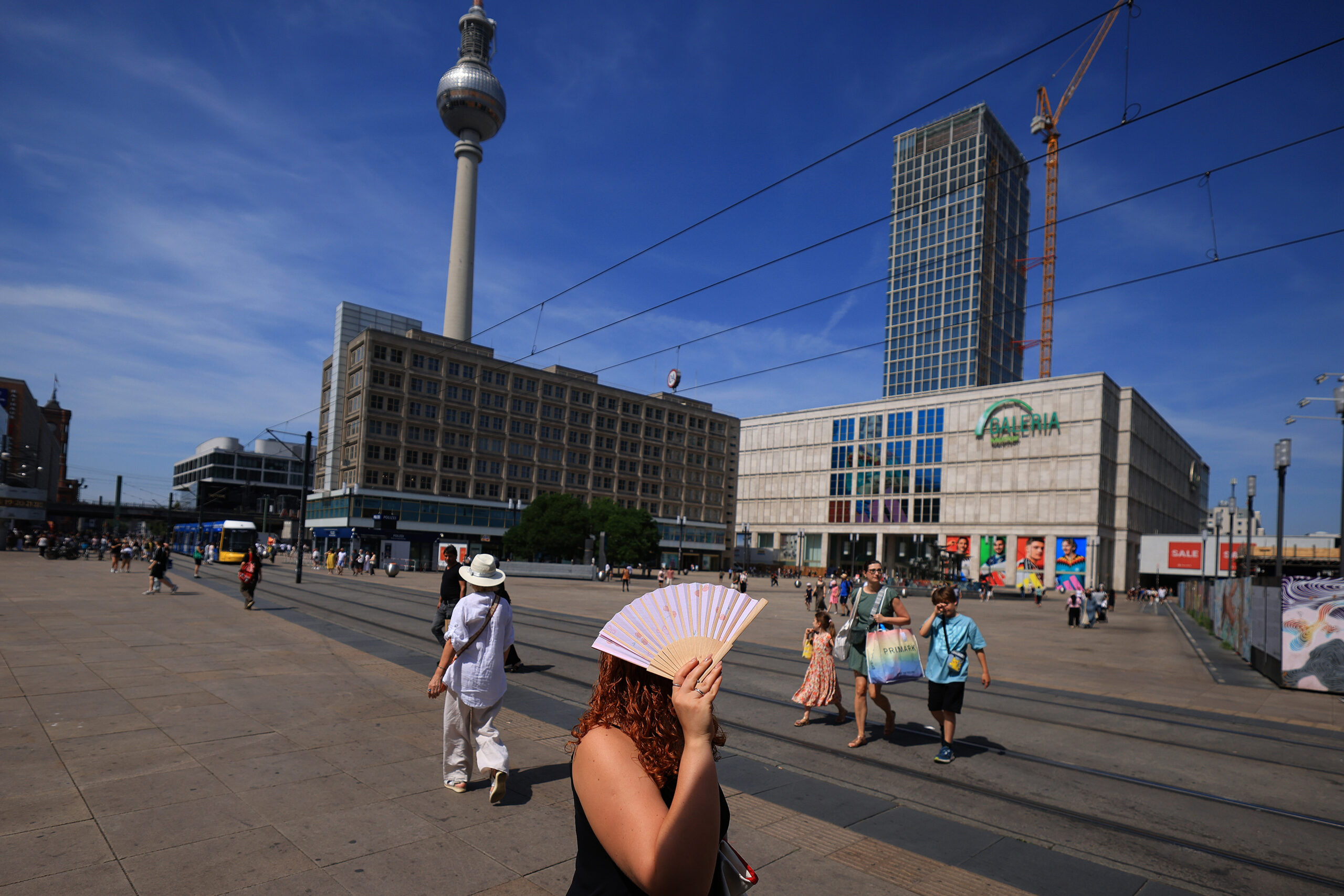
Europe’s status as the planet’s fastest-warming continent is becoming a serious drag on its economic prospects. The region, where temperatures are rising at a pace that’s roughly twice the global average, can no longer afford to ignore the economic impact of global warming, according to economists interviewed by Bloomberg. They say governments will need to invest billions of euros in the years ahead to protect citizens from increasingly dangerous heat waves that are already cutting productivity, hurting industry and resulting in significant numbers of deaths. This summer’s heat waves should be a “wake-up call for all European policymakers,” Carsten Brzeski, global head of macro at ING Group NV, said in an interview. The temperature extremes have “really gripped all of Europe.” Read more: Nearly All of Europe Had Above-Average Heat Last Year, as Climate Records Toppled The economist, who spends most of his time forecasting key macro-economic measures such as inflation and gross domestic product, says the thermometer has now “become a leading indicator” that people like him need to track. The European Commission this year estimated that EU member states should be spending close to €70 billion ($80 billion) each year through 2050 to adapt to the fallout from rising temperatures. Allianz SE, Europe’s largest primary insurer, recently published heat-impact simulations showing that Germany, the biggest EU economy, faces economic losses through 2030 of about $130 billion. For France, the amount is $240 billion. The Allianz figures, which are extrapolations based on the estimated cost of heat waves between 2014 and 2024, surprised the economists doing the analysis, says Hazem Krichene, a senior economist on climate at Allianz. They knew there’d be an economic impact, but Krichene says he and his team “didn’t expect it to be so huge.” Europe’s housing and infrastructure is mostly built to shield it from the effects of cold weather. But increasingly, for a few months every year, that infrastructure needs to be able to withstand extreme heat too. Fabric and wooden shutters shield a home during hot weather in Palma de Mallorca, Spain; photo credit: Andrey Rudakov/Bloomberg “In two or three decades, you have this very rapid shift” in temperatures, Krichene said. “And you end up having urban infrastructure which is not very well adapted to heat.” Heat creates a feedback loop in which expected returns on capital decline, investments fall and productive capacity is reduced, Allianz’s research found. That leads to a stagflationary environment, which can quickly become a nightmare for policymakers trying to maintain stability in Europe’s biggest economies. “What we show in our analysis is that if you do nothing you will have a fiscal cost,” Krichene said. “The awareness is there, but how to materialize this into concrete action, this is what we’ll see in coming months.” Part of the challenge in Europe is that northern countries with colder climates will face more benign economic trajectories as temperatures rise, while the region’s biggest economies — Germany, France, Italy and Spain — risk meaningful economic setbacks, Allianz’s analysis found. Inside the euro zone, which spans from Finland to Greece, that poses an “acute” dilemma for the European Central Bank, it said. Brzeski notes that the ECB has already published estimates showing that heat waves and drought could push up food inflation by some 0.4 to 0.9 percentage points, an effect that has the potential to double over the next 30 years. And an analysis of the summer of 2025, co-authored by the ECB, shows that the European economy lost 0.3% of output, a figure that could swell to an accumulated 0.8% by 2029. In the UK, the latest heat waves have exposed major shortcomings in the country’s infrastructure. London Mayor Sadiq Khan said in June the city will need to turn to private investors to help fund the cost of rising temperatures. Just protecting the most vulnerable London homes from extreme heat will cost somewhere between £9 billion and £45 billion, Khan said. Commuters during heat wave conditions in the City of London. Photographer: Jose Sarmento Matos/Bloomberg The UK’s June heat wave cost an estimated £2.36 billion, according to Verdant, a London think tank. Its calculation takes into account reduced productivity, as higher temperatures make it harder to work and result in heat-induced failures in infrastructure and equipment. The ferocity of the latest heat waves is even forcing some of Europe’s traditional climate skeptics to backtrack. France’s Rassamblement National, whose leader and presidential candidate Marine Le Pen once dismissed a UN-backed IPCC climate report as “very, very alarmist,” has since acknowledged the need to take such science seriously. “We need to have the capacity to react, because we’ve had reports for a long time, specifically those from the IPCC, that talk about global warming,” Sébastien Chenu, a lawmaker for the party, told French broadcaster TF1. “That really strikes me.” Last year, France spent €1.7 billion on climate adaptation, according to an analysis by the Institute for Climate Economics in Paris. The figure doesn’t take into account the tens of billions of euros spent on heat-related upgrades of transport infrastructure and energy systems, as well as public health policy and civil protection resources. Vivian Depoues, the institute’s research lead on adaptation to climate change, says the resources exist to tackle the challenges ahead. “We have all the tools and technical knowledge to do it,” he said. It’s “much more about how we prioritize objectives.” The cost of inaction, meanwhile, is more than just economic. So far this summer, heat waves have already killed more than 13,000 people in Europe, according to estimates published by national authorities. ING’s Brzeski says what Europe is going through now should be “the wake-up heat wave.” It should convince everyone that “climate change is for real,” he said. Top photograph: A woman covers her face from the sun during heat wave temperatures in Berlin, in June 2026; photo credit: Krisztian Bocsi/Bloomberg Related: Drones, AI and White Paint: Europe Races to Protect Infrastructure From Heat Western Europe Records Hottest June on Record, EU Scientists Say Banks’ Exposure to Heat-Related Losses Faces Scrutiny in EU Europe’s Climate Adaptation Efforts Have Lagged its Net-Zero Drive Climate Change Keeps Adding to List of Uninsurable Assets, Allianz Executive Says Topics Europe
Heat Morphs Into a Major Economic Shock for an Unprepared Europe
Full Article
Original Source
Read the full article at Insurancejournal →KhanList aggregates and links to publicly available news content. We do not host full articles from third-party sources. Always verify important information with original sources.