
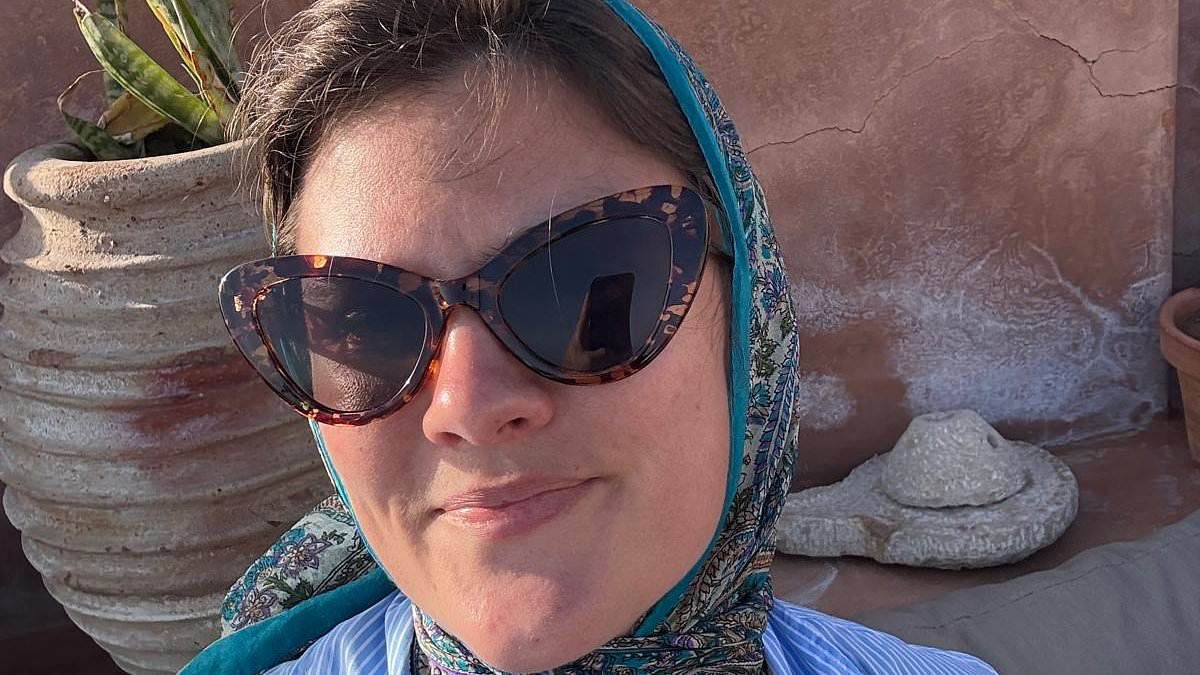
An interior designer who ditched her life in Amsterdam to live in a cave in Sicily after a difficult break-up reveals how her unusual new home 'saved' her - despite tackling humidity, dust and insects on a daily basis. Shalise Barnes, 30, bought the 85-square metre property sight unseen for £47,255 (€55,000) in June 2026, initially planning to 'flip it' and rent it out.But, after seeing the cave in person, she 'fell in love' with the space and decided to move in permanently. She has since transformed the space into a dream abode, with plush furniture, bookshelves and soft lighting, creating a cosy home for herself, her dog and three cats.Complete with electricity, running water, a kitchen, bathroom and upstairs bedroom, the property costs Shalise just £129-a-month to run. Speaking to PA Real Life, she said: 'The cave regulates its temperature - it's like I'm living inside the earth.'In summer it’s cooler and in winter it's warmer. I’ve got a pellet stove for winter and an air-con unit, but I don’t think I’ll use them often.' Shalise Barnes, 30, bought an 85-square metre cave property sight unseen for £47,255 (€55,000) in June 2026, initially planning to 'flip it' and rent it out But, after seeing the cave in person, she decided to move permanently into the space and has since turned it into a humble abode The unusual property is designed with plush furniture, bookshelves and soft lighting, creating a cosy home for herself, her dog and three cats Shalise had originally viewed the property as another renovation project while working as a property consultant in Sicily, where she had been helping people find the 'right house'. But she had just gone through a bad break-up and was living in Amsterdam at the time, leaving her in need of somewhere to start again.She said: 'I decided to stay for a new start – the house saved me. It gave me a lot of peace and stability in a really difficult time.'The cave had already been converted into a liveable home by its previous owner in 2006, meaning Shalise could focus on its aesthetics rather than carrying out major structural work.From the outside, it looks like a traditional home with a facade and front door, but inside it opens into a large limestone cave, with functioning amenities and fully-furnished rooms.Shalise said: 'It was much larger and the ceilings were higher than I expected. There’s a kitchen and a bathroom with a lot of reclaimed tiles.'Then from the front there’s a facade – it looks like a normal house with a door, but it opens to the cave.'There’s an upstairs area for the bedroom, which is where people might have slept when looking after the animals.'There are a lot of hooks that would’ve been used to keep the farm animals too.' Complete with electricity, running water, a kitchen, bathroom and upstairs bedroom, the property costs Shalise just £129-a-month to run Shortly after securing the property, Shalise stayed up until 2am ordering 'every single piece' of furniture, towels and lighting she needed to make it feel more 'cosy and homely' Pictured: A room inside the cave before Shalise turned it into her dream home Shalise believes the cave was once used to house farm animals before becoming a bakery in the 1900s.The previous owner also discovered old keys and a painting of a patron saint which Shalise believes could be hundreds of years old, and she has kept them on display.Shortly after securing the property, Shalise stayed up until 2am ordering 'every single piece' of furniture, towels and lighting she needed to make it feel more 'cosy and homely'. She explained: 'It was very sparse, so I got bookshelves, soft lighting and some really large plush furniture.' But life underground does come with a set of drawbacks. Shalise explained: 'I have to wake up and open all of the doors and windows to stop it getting humid.'She added: 'The limestone is very soft, so it gets quite dusty in the cave. So I'm cleaning that all the time.'The interior designed has also had to get used to creepy crawlies constantly making themselves at home. 'I've found three scorpions so far - you couldn't live in this house and be afraid of insects, they're like my housemates.' 'I find crickets everywhere and have to shake out my shoes every day.'I always see huge spiders, but I’ve accepted we’re on the same team and I leave the cobwebs, so I get less intruders.' Life underground does come with a set of drawbacks - namely roommates in the name of creepy crawlies, as well as regular bouts of humidity and dust Shalise plans to continue making the cave feel more like home while 'embracing its unusual history and quirks'Shalise, who grew up between the US and Canada, became an interior designer at 20 after studying fine art at university in Paris.She has since transformed properties around the world, from penthouse apartments to 400-year-old buildings, through her business Artemis Interior Design.Her latest project has attracted huge attention online, amassing more than 65,000 Instagram followers and one TikTok video of the cave racking up more than 2.9 million views.But Shalise has also faced 'plenty of criticism', with trolls warning that she could 'die of lung cancer', that the cave could flood or that it was full of mould.She added: 'People have even said living in a cave is going to let demons into my house!'I just try to laugh about it, but there are so many misconceptions - people think it's dangerous or that people could get into my house.'Despite the criticism, Shalise plans to continue making the cave feel more like home while 'embracing its unusual history and quirks'.
Heartbroken woman who moved into a converted CAVE after a break-up reveals her entire monthly bills amount to £129 - but the scorpions and spiders are a downside
Full Article
Original Source
Read the full article at Dailymail →KhanList aggregates and links to publicly available news content. We do not host full articles from third-party sources. Always verify important information with original sources.