
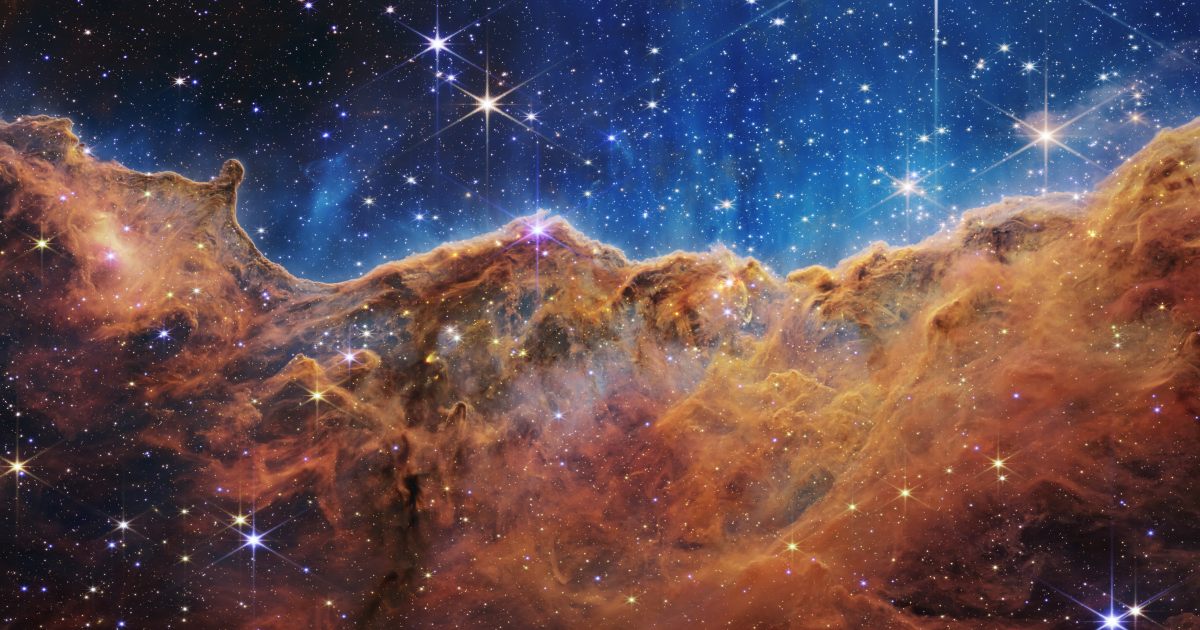
Towering walls of gas and dust rise in the Carina Nebula’s “Cosmic Cliffs,” captured in infrared by the James Webb Space Telescope. Chandra’s new sonification pairs this view with X-ray data that reveal young stars hidden inside the dust, turning their glow to music. Credit: NASA/ESA/CSA/STScI Every image of the cosmos is a translation of data. The X-rays collected by NASA’s Chandra X-ray Observatory and the infrared light gathered by the James Webb Space Telescope (JWST) are invisible to our eyes, so astronomers assign them colors we can see. Even optical observations, from Hubble to backyard astrophotographers, translate, too, often assigning or enhancing color based on emission in various filters. Sonification does the same for the ears, turning an object’s brightness, color, and position into pitch, volume, and tone. The idea dates back at least to the Geiger counter, invented in 1908, whose clicks intensify as radiation climbs. In 2020, the Chandra X-ray Center launched A Universe of Sound, NASA’s first ongoing program to sonify astronomical data. Our ears are acutely sensitive to shifts in pitch, and researchers in fields ranging from astronomy to volcanology have found that listening to data can reveal patterns a visual plot might hide. Sonification also opens the cosmos to people who are blind or have low vision, for whom a processed image offers little. RELATED: Listen to the universe: How sonification turns data into sound Four stellar nurseries sonified On November 17, Chandra released four new sonifications, each built on a region where stars are forming right now. Young, massive stars blast out X-rays in fierce winds and outbursts, and studying those nurseries helps astronomers reconstruct how stars — the Sun included — got their start. Each piece pairs Chandra’s X-ray data with views from other NASA telescopes. Each sonification plays as a short video. A line sweeps across the image, and whatever it crosses becomes sound. Most of the regions also come in three versions — Chandra’s X-rays alone, the companion telescope’s data alone, and the full composite. Try a single layer first, then the composite, and you’ll start to hear which sounds are associated with which kind of light. Rho Ophiuchi At around 400 light-years away, the Rho Ophiuchi cloud complex is the closest star-forming region of the four. This crowded region is filled with a wide variety of stars. Chandra’s X-ray data identifies individual newborn stars, while JWST maps the other stars, gas, and dust around them. The X-rays ring out as bright, shimmering notes. Meanwhile, the clouds of dust and gas provide shifting ethereal chords, and individual stars land as crisp, percussive pings. Listen for the hush partway through — that’s a stretch of dark dust that hides almost all light. Orion Nebula About 1,310 light-years away and just below Orion’s Belt, the Orion Nebula is often visible to the naked eye and shows up in even the smallest telescope on a dark night. Chandra reveals more than 1,000 young stars here, each one sparkling in the sonification. Around them, the nebula’s diffuse X-ray glow holds steady as a ringing whistle. JWST’s infrared view of the dust and gas is audible as bent, warbling strings and a synthesized harp, reaching a crescendo in the nebula’s densest region before fading out. Carina Nebula’s “Cosmic Cliffs” Roughly 7,670 light-years away lies the ridge of gas and dust that became one of JWST’s most famous images when it was released in 2022. Chandra sees the scene differently, cutting through the dust to the hidden infant stars within it. Each of those stars plays as a quick stab, while the region’s faint X-ray glow draws out droning, unhurried notes — all played on an actual cello by musician Johnny Mok. JWST’s towering cliffs are a steady drone underneath, with new instruments chiming in briefly to denote a star or one of the cliffline’s jagged peaks. M82 Some 12 million light-years away in Ursa Major, M82 is the only object in the album beyond our galaxy. This starburst galaxy is building stars many times faster than the Milky Way. Its newborn giants burn out and explode quickly, venting superheated gas plumes that shine brightly in Chandra’s X-rays. Here, Chandra’s data joins Hubble’s visible-light view and infrared from JWST and the retired Spitzer Space Telescope. X-rays sit at the very top of the register, with the region’s busy center whooshing like moving air, filling most of the audible spectrum. It is punctuated by sharp, short stings from brighter newborn stars. The infrared rumbles below as a low hum interrupted by picked notes, and visible light fills the middle with a variety of sounds, including sweeping chords that rise and fall with optical brightness. The Chandra sonifications come from a team led by visualization scientist Kimberly Arcand of the Chandra X-ray Center, working with astrophysicist Matt Russo and musician Andrew Santaguida of the SYSTEM Sounds project and consultant Christine Malec, a blind astronomer and musician. You can hear all four at the Chandra release page, and find the program’s full back catalog at chandra.si.edu/sound. Bonus: Drift through Rubin’s sky Where Chandra’s new album is composed by others, Skysynth lets you become the composer. Built by the same SYSTEM Sounds duo of Russo and Santaguida for the NSF–DOE Vera C. Rubin Observatory’s SkyViewer app, it lets you roam Rubin’s ultra-wide view of the southern sky — press Play to coast, or steer with your arrow keys or by dragging with the mouse. Galaxies crossing the center of the screen strum a harp and stars ring a glockenspiel, with color setting the pitch and brightness the volume. Try it at skyviewer.app/skysynth. Brooks Mendenhall is a staff writer at Astronomy, based in Chattanooga, Tennessee, fueled by an unending curiosity about the universe. A former classroom teacher, he has a knack for breaking down complex concepts for a wide audience.
Hear stars being born in Chandra’s new sonifications
Full Article
Original Source
Read the full article at Astronomy →KhanList aggregates and links to publicly available news content. We do not host full articles from third-party sources. Always verify important information with original sources.