
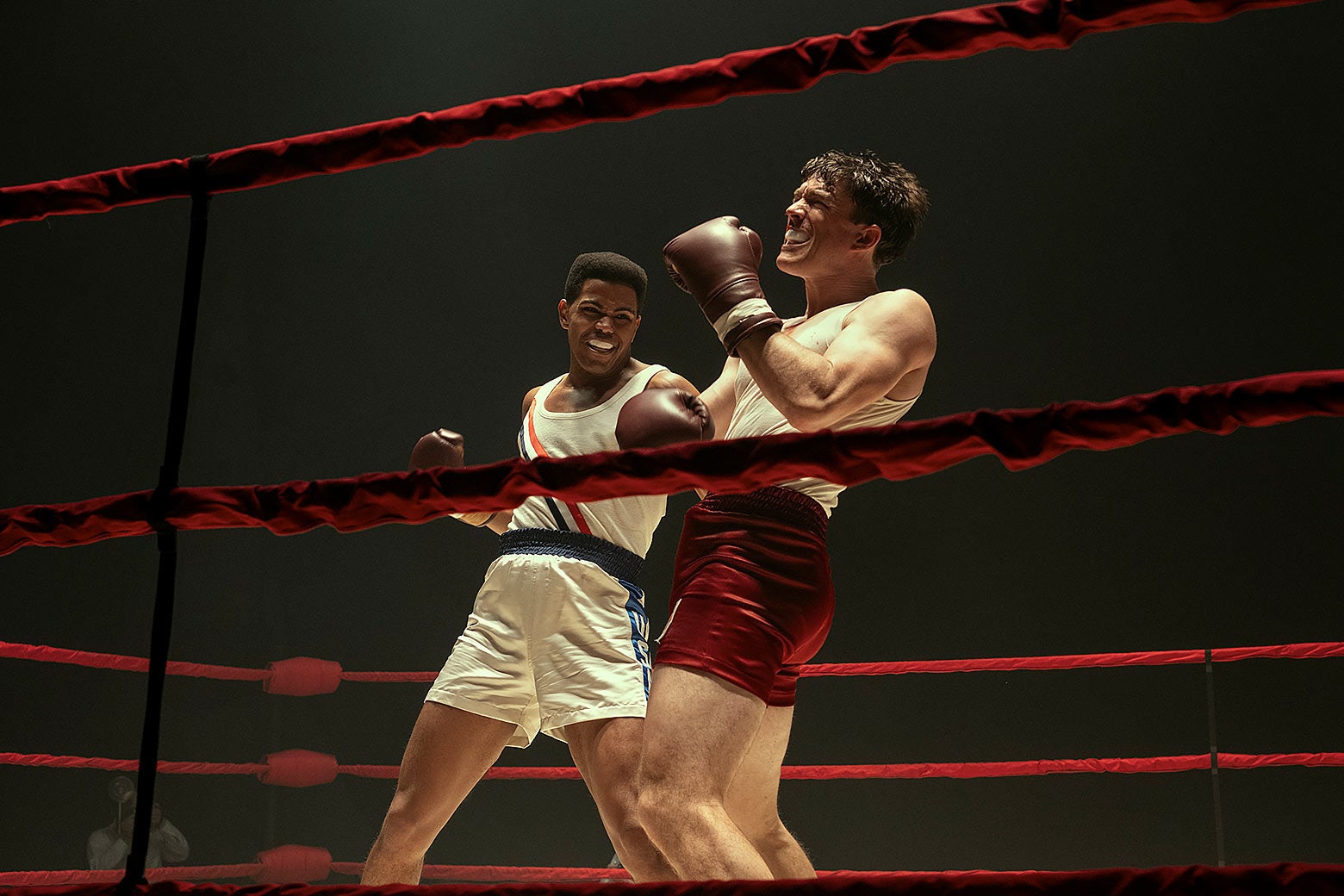
Television The Great Muhammad Ali Amazon’s new show, the surprisingly compelling The Greatest, captures the sports icon’s charmed rise. Prime Video Sign up for the Slatest to get the most insightful analysis, criticism, and advice out there, delivered to your inbox daily. The title of the new Prime Video biographical drama series about Muhammad Ali, The Greatest, also serves as the mantra for the protagonist, who repeatedly declares that he’s the greatest and then, minutes into the first of eight episodes, confirms it by winning the gold medal in light-heavyweight boxing at the 1960 Rome Olympics. Shortly afterward, Ali’s younger brother recounts (for the viewer, really) how Ali, born Cassius Clay, has been saying all his life that he was destined for greatness, and now it’s come true. The viewer understands that this is not the usual boxing story of a scrappy underdog who, Rocky- or Creed-like, has to claw his way to the top, or of the bums and tomato cans of Fat City (1972), languishing at the bottom to supply easy knockouts for the real stars. This is a story of a world-historical talent finding his deserved place at the top of the mountain, early and without all that much adversity. That presents a unique challenge for the writers and producers of The Greatest, a group that includes Ali’s widow Lonnie, A-lister Michael B. Jordan, and, through Roc Nation, rapper Jay-Z. Conflict and suspense are the engines of narrative, and “greatest boxer who ever lived quickly becomes champion” is sort of a “dog bites man” situation. But it’s a testament to the show’s craftsmanship that it still manages to be consistently compelling despite this anticlimactic quality. One reason is that it’s visually sumptuous, with mint-condition period automobiles, historically correct zip-up polo shirts, pastel-colored rotary-dial phones, and vintage issues of Jet magazine on display in every scene, as well as on-location drone shots of Ali at the Colosseum in Italy. (An advantage of making TV for Amazon is that they can’t claim to be strapped for cash.) The other is the performance of the show’s lead, newcomer Jaalen Best, who’s a one-in-a-billion doppelganger for Ali. Until I looked up photos of Best, I wondered if they’d used A.I. to enhance his resemblance to Ali, but he actually looks like that. Best’s casting received an endorsement from Lonnie, who said that Ali himself would’ve approved of Best, and also praised Best’s, uh, qualifications. Best has said he spent years studying Ali and training in the ring, and he embodies the man to a degree that’s eerie; even the boxing scenes are convincing. Without him, the show couldn’t have been made at all; with him, its absolute floor is “good to very good.” The show also wrings drama from the people around Ali—not only the dehydrated-looking white businessmen all vying to get rich off the newly minted champion, but also his father, Cassius “Cash” Clay Sr., portrayed by Omari Hardwick as almost a rival of his son’s, jealous and resentful of Cassius Jr.’s success. Cassius Sr. is a frustrated man, a sign painter who was never able to receive the artistic training that he believes would’ve turned him into a real artist. Like many thwarted men, one of the ways he compensated was to turn his home into a one-man authoritarian regime, alternately scolding, bullying, cajoling, and sometimes abusing his wife and sons. Hardwick plays him as a man who knows he’s doing wrong but can’t quite stop himself; early in the series, when he finally tells his son he’s proud of him, just saying it seems to cause him physical pain, and his further wince when his distracted son barely acknowledges the words almost makes you feel bad for him. For a show about boxing, there’s surprisingly little of it. Ali’s early string of victories as a professional were so one-sided that they’re shown only in montage form, 19 fights reduced to a minute or two of screentime. But Ali faced plenty of adversity outside the ring. As a Black man in 1960s Louisville, Kentucky, he was subject to racism both overt and casual, even after he rose to stardom. In Thomas Hauser’s 2005 book Muhammad Ali: The Lost Legacy, trainer Angelo Dundee (played excellently on the show by Giovanni Ribisi; if we still made serious movies, Ribisi would be his generation’s Christopher Walken) says that he was puzzled that so many people hated Ali’s constant talk, as those same people used to complain that Joe Louis didn’t talk enough. The truth was, even for many Americans who might not have been hiding white hoods in the back of their closets, Ali would’ve rubbed them the wrong way no matter what he did, in much the same way that today’s star athletes are told to “shut up and dribble,” and then are told they don’t dribble right, either. We see some of this in the first episode of The Greatest, when a rich old white lady lasciviously fingers Ali’s gold medal and then immediately mistakes Ali’s father for a waiter, calling him “boy” and ordering him to fetch her a drink. For a while, Ali thinks his gold medal, which he never takes off, exempts him from this kind of treatment. Then he tries to sit at the counter at a local restaurant and is ejected by the white manager. Afterward, Ali throws his gold medal into the river. (In a 2019 memoir biography by Ali’s brother Rahaman Ali, Rahaman said this long-standing legend was actually a lie, and that Ali just misplaced the medal.) Still, on television and in stories, it works as a symbolic act, something for which the real Ali had an acute sense, and it foreshadows the next chapter of Ali’s story: his embrace of the Nation of Islam, his rejection of his “slave name” in favor of “Muhammad Ali,” and his refusal to register for the military draft, an act that transformed him almost overnight into one of the most hated men in America. Unfortunately, we don’t get to see Ali’s reversal of fortune in The Greatest. While the Nation of Islam (and Malcolm X, portrayed by Michael Ealy with a sort of pensive fatalism) is a major midseason presence, and we eventually get to the name change, these episodes end with Ali at the apex of his early career. Knowing that the next part is when it gets really interesting can, from a certain angle, cast this season as more of a prelude, a setup for a twist that we may have to wait a year or two to see play out, if at all. (The Greatest is supposedly a limited series, but, as we’ve seen time and time again, limited is limited until a series gets renewed.) Is now the right time for a Muhammad Ali biopic? There was a resurgence of interest in Ali back in the ’90s; the 1996 documentary When We Were Kings, about the famous 1974 Ali–Foreman fight in Zaire, won the Oscar for Best Documentary Feature. (Ali and George Foreman both came onstage to accept the award; Foreman, incredibly, had won the unified heavyweight title three years earlier.) Ali lit the flame at the opening of the 1996 Olympics in Atlanta; two years later, David Remnick’s Ali biography King of the World became a bestseller; it was followed by Michael Mann’s largely memory-holed film Ali (2001), which covered a lot of the same ground as When We Were Kings, only worse, and starred Will Smith in the prime of his prime. This glut of Ali remembrances was, in part, the natural conclusion of a generational cycle of once starstruck children reassessing the heroes of their youth. (This is your warning now to brace for the next decade’s barrage of Aaron Sorkin–esque Obama bios.) But there was also a deeper cultural resonance to that second wave of adulation, with Ali, notably, being lauded more for his moral stature than for his athletic accomplishments. His refusal to be drafted in 1967 cost him nearly four years of his prime; a 21st-century equivalent would be if LeBron James had been banned from the NBA during his peak Miami years for taking a knee during the national anthem. This late-life canonization might have been a subtle rebuke to ’90s superstars like Michael Jordan who, when asked about political matters, demurred by saying “Republicans buy sneakers too.” There’s no denying that Ali’s stand against the Man dovetailed nicely with the ’90s anti-corporate, anti-sellout ethos. But the ’90s were 30 years ago, and the pendulum has swung fully to the other end. Today, everyone is desperate to sell out, and no one wants to defy the Man; they’re buying online courses on how to become the Man. It’s not immediately clear where Ali or what he represents fits in 2026. That’s not to minimize Ali’s legacy; he’s one of the very few genuinely heroic figures that America has ever produced, and one of the few people I admit I’m unable to view cynically. But fame, especially when it’s posthumous, is as much a matter of timing as merit. Ali’s onetime biographer Hauser compared him to Forrest Gump, and Ferdie Pacheco, his former personal physician, often told an anecdote about how the young, pre-championship Ali, installed by his trainer in a low-rent Miami hotel full of pimps, petty thieves, and ripoff artists, so delighted his neighbors that they protected instead of preyed on him. I’m not sure what that quality is: not quite innocence, but maybe guilelessness? Purity? Whatever one calls it, it’s not the type of thing that’s in vogue, much less revered, today. One can easily imagine many Americans hearing that hotel story and deriding the thieves and pimps for being suckers and leaving money on the table. This is an era of hustlers and antiheroes. For better or worse, Ali, with his unshakable convictions and charmed rise, feels like he belongs to a different era. Amazon Sports TV Muhammad Ali
He Was the Greatest Boxer of All Time. Amazon’s New Show Captures That Magic.
Full Article
Original Source
Read the full article at Slate →KhanList aggregates and links to publicly available news content. We do not host full articles from third-party sources. Always verify important information with original sources.