
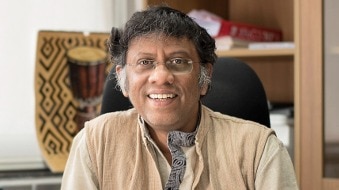
Rajesh Gopakumar, the IIT-JEE 1987 AIR 1, chose Physics at IIT Kanpur over engineering. That decision had taken him to Princeton and later took him back to India to lead India's top research institute in Bengaluru.Rajesh Gopakumar, the AIR 1 in the 1987 IIT-JEE, did something that very few top rank holders would even think of doing. Instead of choosing Computer Science or another sought-after engineering branch, he decided to study Physics. The decision surprised his batchmates and many people around him. But Gopakumar remained firm in his choice, believing that his passion lay in understanding the fundamental laws of nature rather than pursuing the most lucrative career path.Nearly four decades later, that decision has proved to be one of the defining moments of his life.Today, Rajesh Gopakumar is among the world's leading theoretical physicists. His discoveries are taught and discussed across universities around the globe, and his work has significantly influenced modern theoretical physics.Over the years, he has received several prestigious scientific honours, becoming an inspiration for countless Indian students who aspire to build careers in research. The career path that he chose was not the most popular one, but it gave him a much larger purpose. Instead of chasing conventional success, Gopakumar devoted his life to answering some of the deepest questions in physics.FROM IIT KANPUR TO PRINCETONBorn in Kolkata in 1967, Rajesh Gopakumar displayed an exceptional curiosity from a young age. Rather than limiting himself to textbook knowledge, he was always interested in understanding the principles behind scientific ideas. His fascination with discovering something new eventually led him towards theoretical physics and scientific research. After securing AIR 1 in the IIT-JEE 1987 examination, Gopakumar chose the five-year Integrated MSc programme in Physics at IIT Kanpur.At a time when engineering branches were considered the obvious choice for top rankers, his decision stood out. IIT Kanpur's strong academic culture and emphasis on fundamental sciences gave him the environment he was looking for.After completing his MSc, Gopakumar moved to Princeton University in the United States to pursue his PhD in Physics under renowned physicist David Gross. Years later, Gross went on to receive the Nobel Prize in Physics, making Gopakumar's doctoral training even more remarkable.Following his PhD, he joined Harvard University as a Research Associate, where he continued working on some of the most challenging problems in string theory and quantum field theory. His research during this period earned him recognition within the global physics community.One of Gopakumar's most celebrated contributions came through the Gopakumar-Vafa duality, developed with Harvard physicist Cumrun Vafa.The remarkable work established a deep connection between gauge theories and string theory, opening new directions in theoretical physics. Another landmark achievement was the Gopakumar-Gross relation, which further strengthened the understanding of large-N gauge theories.These discoveries remain influential and continue to be studied by physicists around the world.RETURN TO INDIA AND LEADING TOP RESEARCH INSTITUTEDespite having opportunities to continue his career at some of the world's finest institutions, Gopakumar made another remarkable decision. In 2001, he chose to return to India.He joined the Harish-Chandra Research Institute in Allahabad (now Prayagraj), where he served as Associate Professor and later Professor for over 13 years. During this period, he played an important role in strengthening theoretical physics research in India while continuing his internationally acclaimed work.His commitment to Indian science continued when he took over the leadership of the International Centre for Theoretical Sciences (ICTS), a Tata Institute of Fundamental Research (TIFR) centre in Bengaluru.The institute has played a leading role in preparing the next generation of scientific minds in India.The country's recent successes in Olympiads, from Physics to Chemistry, are a result of the contributions that TIFR has made over the years.He first became Senior Professor and Director in 2015 and has been serving as Distinguished Professor and Director since 2023.Under his leadership, ICTS has evolved into one of India's premier centres for theoretical sciences, bringing together researchers in theoretical physics, mathematics, theoretical computer science and quantitative biology.Alongside his administrative responsibilities, Gopakumar continues his own research in string theory, mentoring young scientists and contributing to some of the most fundamental questions in modern physics.His scientific excellence has earned him several of the highest honours in the field. He was elected a Fellow of the Indian Academy of Sciences and the Indian National Science Academy. In 2013, he received the prestigious Shanti Swarup Bhatnagar Prize for Science and Technology, India's highest science award for researchers below the age of 45.He has also been honoured with the Infosys Prize in Physical Sciences, recognising his pioneering contributions to theoretical physics.- EndsPublished By: Rishab ChauhanPublished On: Jul 27, 2026 19:09 IST
He was IIT-JEE AIR 1 in 1987, rejected CS, now leads a top research institute
Full Article
Original Source
Read the full article at Indiatoday →KhanList aggregates and links to publicly available news content. We do not host full articles from third-party sources. Always verify important information with original sources.