
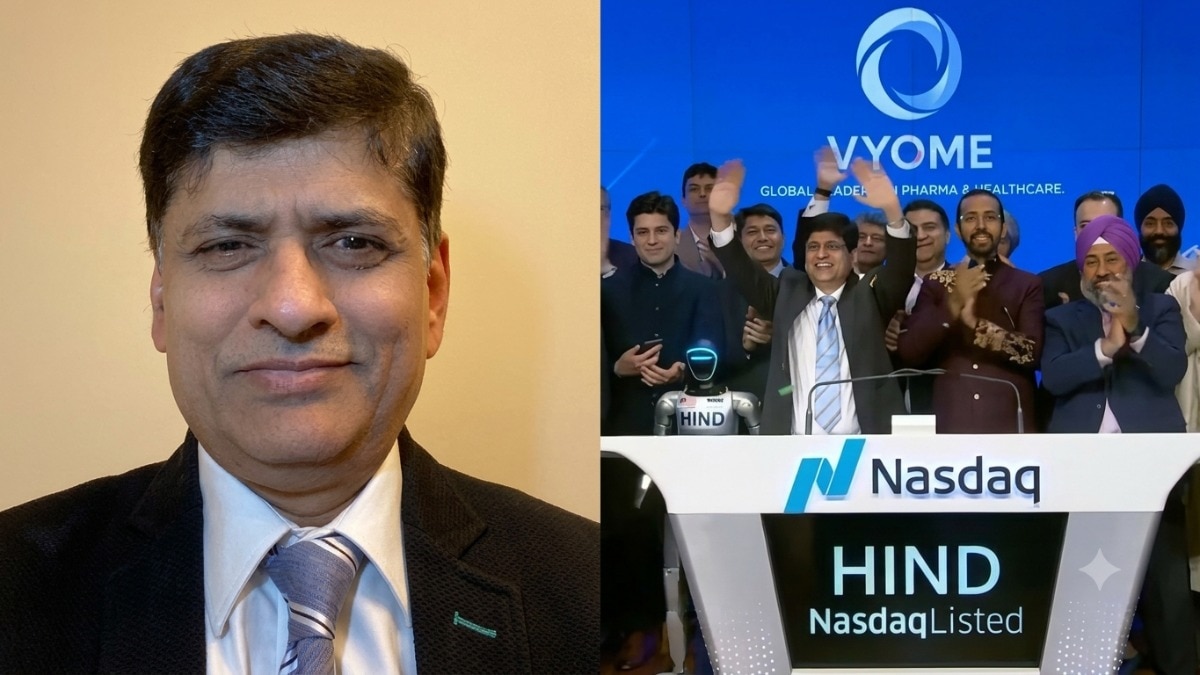
Mathematics was one of Venkat Nelabhotla's favourite subjects as a child. Growing up in Ongole, Andhra Pradesh, he enjoyed solving problems, but getting the right answer was not enough. He wanted to know why it worked and whether there was another way to solve it.There was no career blueprint behind that curiosity. Nelabhotla grew up in a middle-class family, studied in Telugu-medium government schools and did not imagine that he would one day lead a Nasdaq-listed biotechnology company.Yet his career took him from engineering at MNNIT Allahabad to IIM Ahmedabad, through consumer goods, pharmaceuticals and vaccines, and eventually into entrepreneurship.Today, he is the Co-Founder and CEO of Vyome Holdings, a biotechnology and pharmaceutical company with a market capitalisation of approximately $12.07 million, or around Rs 115.05 crore, based on the figures available for this story. Ask him about the journey, and he does not point to one defining breakthrough. Instead, he returns to something that began long before business school or boardrooms: the willingness to keep learning.THE FIRST BIG ADJUSTMENT WAS LANGUAGEAt MNNIT Allahabad, Nelabhotla found himself in a different academic and cultural environment from the one he had known in Ongole. English was an adjustment. So was becoming conscious of his background in a competitive national institution. “When you have studied entirely in Telugu and suddenly move into a competitive national institution, you become conscious of language and sometimes of your own background,” he says.His response was practical. He read more, listened carefully, participated and kept learning. He did not treat the gap as proof that he lacked ability.“Language is a tool. It is not a measure of intelligence, capability or potential.”It is a distinction he has carried into his working life. Moving into a new industry or country means entering a space where others may know more than you do. His approach has remained much the same: ask questions, learn the context and build your own understanding. Venkat Nelabhotla in his college years HE DID NOT STAY IN ONE INDUSTRYConsumer goods, pharmaceuticals, vaccines and biotechnology might seem like very different worlds. Nelabhotla's career has taken him through all of them, with stints at organisations including CavinKare, Shantha Biotechnics, Aurobindo Pharma and Emami.Each move meant getting to grips with a different business. Shantha Biotechnics, in particular, brought science, business and healthcare together in a way that shaped his thinking about India's potential.“I think India could do much more than manufacture products efficiently. We could build globally relevant healthcare businesses and innovation from India,” he says.Eventually, he moved from professional management to entrepreneurship. The change was not simply a new job title. It meant moving from making decisions within an established organisation to building something with no guarantee of success.“You have to imagine what could exist, build the team, find the capital, solve problems continuously and remain with it through setbacks,” he says.That is the uncertainty of entrepreneurship as he experienced it. Capital is limited, science takes time and not every idea succeeds. Persistence matters, but so does recognising when an assumption needs to change.THE CAREER LESSON HE STILL FOLLOWSNelabhotla does not single out one failure as the turning point in his life. His bigger realisation was that formal education provides only the beginning of a much longer learning process.“Learning does not stop when formal education ends. In fact, some of the most important learning begins after that.”That is particularly true in biotechnology, where scientific evidence, technology and assumptions can change. A leader must be willing to revise a decision when the facts change, rather than defend an earlier view simply because it was once correct. Venkat Nelabhotla with his family For Nelabhotla, resilience is not about pushing ahead regardless of the circumstances. It is about knowing when to persist, when to question yourself and when to change direction.The principle also explains why he has continued exploring subjects beyond his immediate work. He remains interested in mathematics and science, including areas unrelated to his daily responsibilities.NO MASTER PLAN AT 18The boy in the Telugu-medium classroom in Ongole did not have a plan to attend IIM Ahmedabad, build businesses across industries, become an entrepreneur and lead a Nasdaq-listed company.Nelabhotla is comfortable with that uncertainty. He does not believe young people need to know exactly where they will end up before they have even begun.“There is no need to have your entire life mapped out at eighteen or twenty. I certainly did not.”His advice is to focus on the work in front of you, keep expanding your horizons and remain open to changing direction.“Your circumstances may influence your starting point, but they need not determine your destination.”His journey did not begin with a plan to lead a Nasdaq-listed company. It began in a government school classroom, with an interest in mathematics and a willingness to learn.Sometimes, that is enough to start with.- Ends
He studied in a Telugu-medium govt school. Now, he heads a Nasdaq-listed biotech firm
Full Article
Original Source
Read the full article at Indiatoday →KhanList aggregates and links to publicly available news content. We do not host full articles from third-party sources. Always verify important information with original sources.