
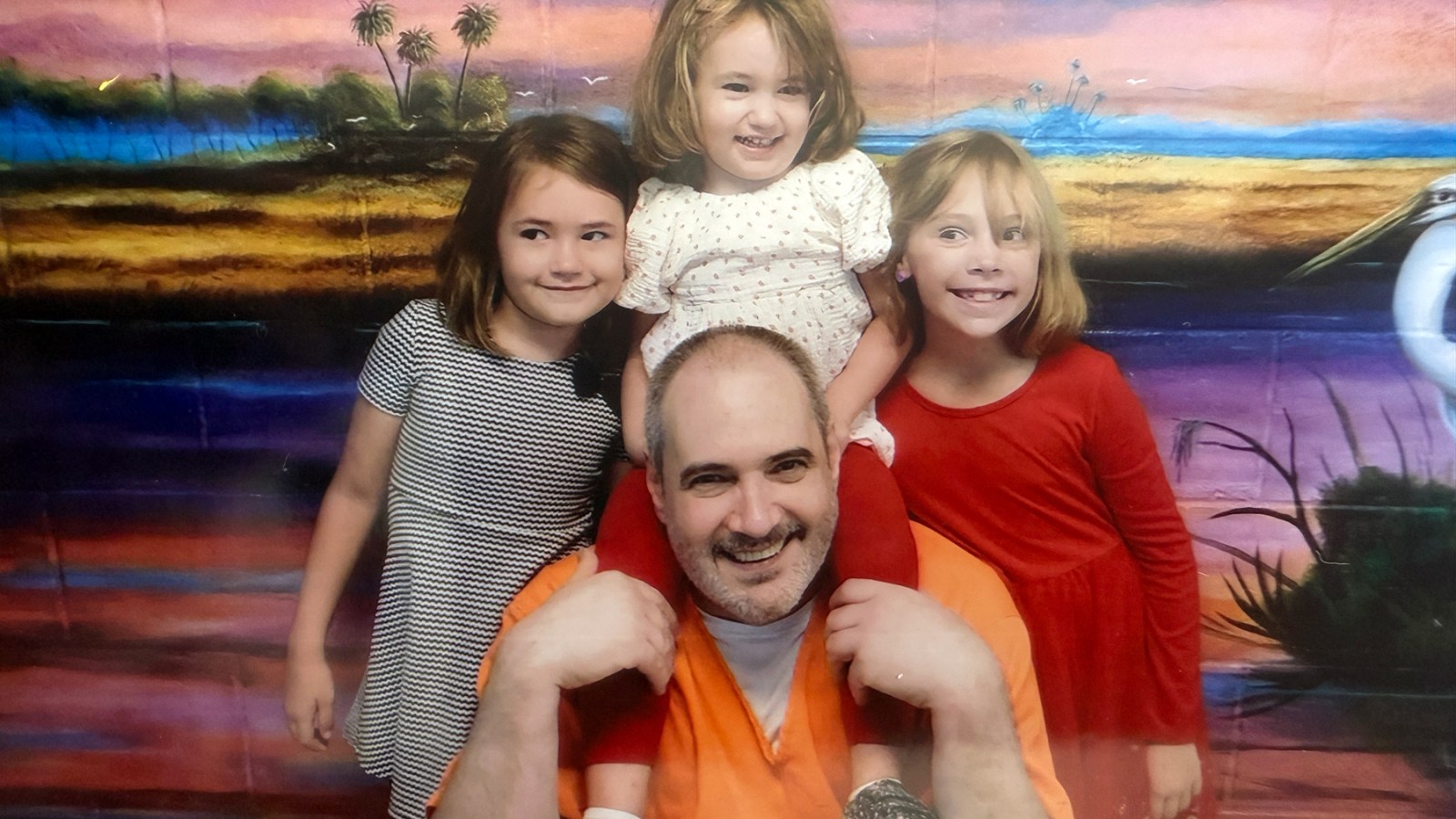
Governor Ron DeSantis has overseen a historic run of executions in his state. Samuel Jason Derrick, 59, may be next Shawn Derrick’s first memories of his father aren’t about the man himself, but the trials of visiting him. “I remember having to go through a strip search when I was still in diapers at the state prison,” he says. “I have very early memories of running around the visiting park with my dad and playing tag. He still does it with my girls.” The reality of why his father, Samuel Jason Derrick, who goes by his middle name, is incarcerated at the Union Correctional Institution in Raiford, Florida, wasn’t clear to Shawn until he was in grade school. “All the other kids were talking about their parents: ‘What does your dad do? What does your mom do?’ I told my teacher that my dad was in prison,” says Shawn, now 39. “My mother had told me that my dad wrecked a car, and that he was in prison forever. I remember my teacher saying, ‘Oh, honey, people don’t go to jail forever for wrecking cars.’” In fact, Jason Derrick, 59, was sentenced to death for the 1987 stabbing murder of shopkeeper Rama Sharma, a crime he maintains he did not commit. And, despite DNA evidence and several new witnesses who allege that another man confessed to the crime, he’s currently in the cross-hairs of Florida’s historic execution spree — and his family is wracked with worry. Over the past two years, Florida has executed 37 people, and given the opacity with which Governor Ron DeSantis issues these death warrants, and Florida’s high levels of exoneration, supporters and family members like Shawn are concerned that innocent men could fall through the cracks. Moreover, critics are concerned by what the decision-making process is in the state for who gets the needle. “I believe that our governor is a smart man,” says Shawn. “I’m a Republican, and I don’t understand how anybody with objective common sense can look at this case and still think that my father’s guilty.” Death in Florida Florida’s death row has historically been a fraught place. Back in 2016, the U.S. Supreme Court ruled Florida’s capital sentencing statute to be unconstitutional. At that point, the law required the jury to make a sentencing recommendation and the judge would then decide whether the defendant would get death. Over the last 10 years, Florida has amended this sentencing statute three times. As of April 2023, to hand down a death sentence, the jury must unanimously agree on at least one aggravating factor (making the crime worthy of death the penalty), and at least eight out of 12 jurors must vote for execution. Only Florida and Alabama do not require a full jury to decide on the death penalty. Editor’s picks Death penalty critics say this anomaly is responsible for the high number of exonerees in Florida. There have been 30 since 1973, according to the Death Penalty Information Center, the most in any state. “Florida allows non-unanimous jury verdicts to send someone to death row, and so what we see is that juries will say, ‘We’ll convict him, but I’m not convinced enough that he’s guilty that I’m going to send him to death row,’” says Grace Hanna, executive director of the nonprofit Floridians for Alternatives to the Death Penalty. “So a few jurors will vote for life, but here in Florida, that is enough to send someone to death row.” Due in part to these less rigorous standards, critics claim, Florida had the most executions of any U.S. state in 2025, 19, and is on track to beat that number in 2026. As of October, the state has executed 18 people, with two on the same day in July — a first in Florida history. That’s up from just one in 2024 and six in 2023. Critics attribute the uptick in deaths to Ron DeSantis, who as Florida governor has the unique ability to sign — or withdraw — death warrants for inmates who have completed their direct appeals. Despite being in office since 2019, DeSantis has ratcheted up the number of executions in 2025 and 2026, for reasons yet unclear. Related Content “This is all down to Governor DeSantis. These are his decisions,” says Robin Maher, executive director of the Death Penalty Information Center. “He has refused to share information about why he has scheduled so many executions this year, or even information about why he is selecting these prisoners this year.” The Governor’s Role In response to a detailed set of questions about how and why DeSantis decides when an inmate is going to be executed, his communications director Alex Lanfranconi replied: “My advice to those who are seeking to avoid the death penalty in Florida would be to not murder people.” That list of questions also included queries about why so many elderly people have been executed this year, including 80-year-old Dominick Occhicone, who is the oldest person to have been executed in Florida. He’d been on death row since 1987. Death penalty critics like Hanna see no logic in executing elderly or infirm people, as they pose little threat to society. “He could have remained there for the rest of his natural life, held accountable without requiring anyone to participate in his killing,” says Hanna. “His aging and the relationships he built over those decades should have mattered, but Florida’s rush to execute as many people as possible means that there’s no room for individualized consideration or mercy. We should be asking what purpose was served by executing an elderly man who could safely remain incarcerated.” As of this week, DeSantis has also ordered the execution of 14 veterans, including Vietnam vet Williams Reeves Jr., who was put to death on Oct. 20. His former lawyer, Chance Myer, alleges the 77-year-old killed a Florida cop in 1986 during a PTSD flashback. “We trained William to kill on our behalf when he was a teenager,” he says. “We trained him to kill reflexively. Yet we treat his crime as if it was just purely a product of free will.” DeSantis only halted one execution over his nearly eight years in office: that of William Lee Thompson. Thompson’s lawyers argued that he is suffering from dementia and thus killing him would be cruel and unusual; DeSantis stayed his death and gave no comment as to why, including when Rolling Stone asked directly. “He was in dire health, and was actually taken from a prison hospital to death watch,” says Melanie Verdecia, attorney and author of the blog Tracking Florida’s Death Penalty. Verdecia didn’t work on Thompson’s case initially, but recently stepped in to represent him. “Myself and a co-counsel filed a federal lawsuit for him, claiming a civil rights violation based on the lack of adequate medical care while he was on death watch.” Even Verdecia doesn’t understand why her client was spared, while other inmates were not. “DeSantis never really said what the turning point was in 2025 to start executing at this pace,” she says. “I surmise that it has something to do with his run for the White House and the direction from the Trump administration on carrying out the death penalty as aggressively as possible, but DeSantis has never expressly made that connection.” “I can’t tell you what’s motivating Governor DeSantis. But his record gives us every reason to question whether politics is influencing these decisions,” adds Aramis Ayala, executive director at Fair and Just Prosecution and former Florida State Attorney. DeSantis previously removed Ayala from a high-profile murder case due to her opposition to the death penalty. “Governor DeSantis has never been shy about using, and at times abusing, the power of his office to make a political point. The question is whether human lives have now become part of that calculation. And if they have, that’s shameful.” If DeSantis is gunning for the presidency, his fervor for the death penalty puts him in line with President Donald Trump, who has been a fan of the death penalty for decades. He ended his first administration with a killing surge that saw 13 federal inmates executed. “He had a particular affinity for the firing squad, because it seemed more dramatic, rather than how we do it, putting a syringe in people and putting them to sleep,” a former White House official told us in 2023. “He was big on the idea of executing large numbers of drug dealers and drug lords because he’d say, ‘These people don’t care about anything,’ and that they run their drug empire and their deals from prison anyways, and then they get back out on the street, get all their money again, and keep committing crimes … and therefore, they need to be eradicated, not jailed.” Trump’s Department of Justice announced its intention to bring the firing squad back to federal prisons earlier this year, before Defense Secretary Pete Hegseth announced that the execution of Nidal Hasan, the Fort Hood shooter, would be livestreamed in December. Trump quickly walked that idea back when it was met with outcry from both sides. Jason and Shawn Derrick, 2004 Courtesy of Shawn Derrick Innocent People Executed? Still, people like Shawn Derrick are worried that their family members’ blood will trail DeSantis on his possible road to the White House. Shawn is pro-death penalty, but is convinced his father is innocent — and he’s not alone. Jason Derrick was arrested for the June 25, 1987 murder of Rama Sharma outside his Florida convenience store after a friend of Derrick’s told police he’d admitted to the killing. After a lengthy police interrogation, 20-year-old Jason initially confessed, but has since maintained his innocence. Lawyers for Derrick have been fighting for a new trial, alleging that he confessed under duress (he was told he would never see his son Shawn again). They also claim that six witnesses alleged that another man, Michael “Craze” Keesling — who was dating Derrick’s sister at the time — confessed to them that he had killed Sharma, with whom he’d clashed more than once. There’s also the absence of physical evidence: In 2008, the Innocence Project discovered that the DNA found under Sharma’s nails didn’t belong to Derrick. Keesling died in 2009, and his DNA was never tested. Trending Stories Still, the Supreme Court of Florida rejected Derrick’s request for a new trial earlier this month, arguing that these new statements would be inadmissible hearsay. “We’re obviously deeply disappointed,” says his lawyer, Julie Morley. “We truly believe in Jason’s innocence, and we’re not going to stop fighting, trying to prove that Jason is innocent.” The team plans to file for a rehearing, and, perhaps take Derrick’s case to the U.S. Supreme Court. In the meantime, Shawn and his family are left in agony — Derrick doesn’t have a death date yet, but DeSantis could hand one down any moment, with no warning. “I’ve had the burden of understanding it since probably about six or seven years old — what was going to happen to my father,” Shawn says. “My girls still don’t fully grasp that he’s on death row and that one day the state might kill him, and so we we wrestle a lot with this balance between them being so close to him that it destroys them, or keeping them just far enough away that they can balance that loss when or if it happens.”
He Says He’s Innocent. Florida’s Execution Spree May Kill Him, Anyway
Full Article
Original Source
Read the full article at Rollingstone →KhanList aggregates and links to publicly available news content. We do not host full articles from third-party sources. Always verify important information with original sources.