
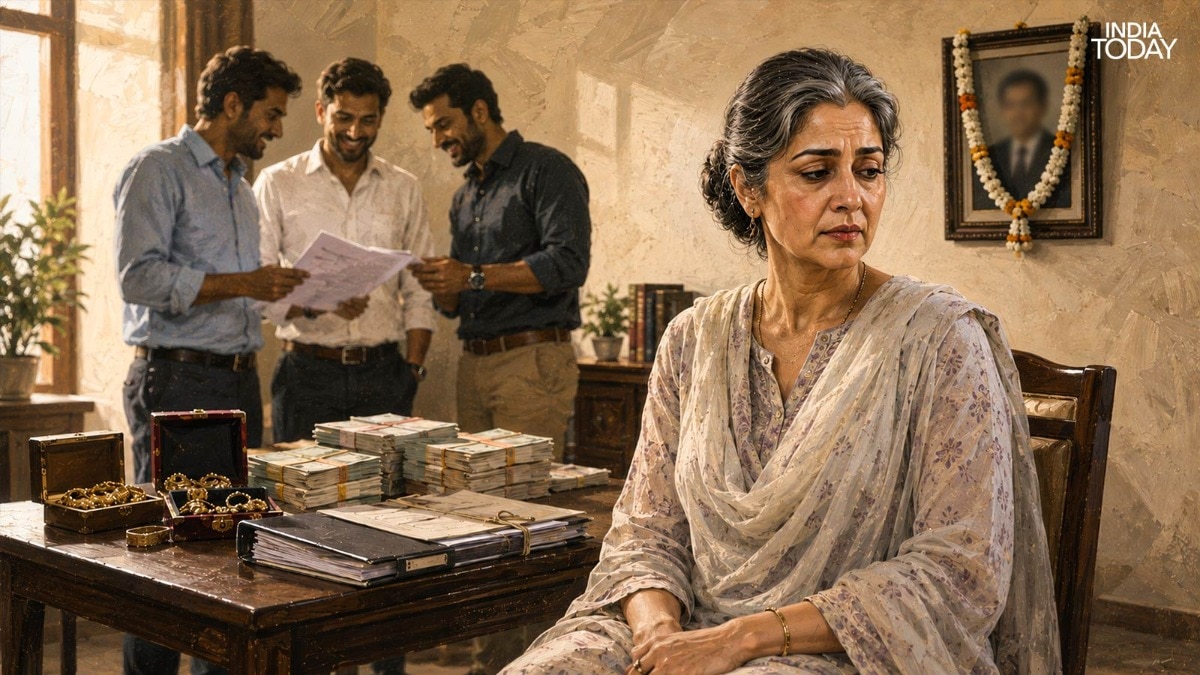
Once, Anuradha's purse was always full. Today, at 66, she waits for her sons to give her Rs 1,000 a month to meet her everyday expenses.This is the real-life story of Anuradha (name changed), a widow from Jaipur, whose life went from abundance to financial dependence after her husband's sudden death.There was a time when money was never a concern in her household. Her husband was a crorepati businessman who owned several properties across the city, rented out shops and also lent money on interest.Anuradha lived like a queen. She was always decked out in gold jewellery, had maids to run the household and rarely had to think twice before spending. Her purse was usually full of cash. In fact, she was often the one giving money to others. Neighbours and relatives affectionately called her “Sethani”.Then, one day, her husband suffered a massive heart attack and died. With him went something Anuradha had never realised she needed, i.e., a clear understanding of the family's finances.She knew her husband had built considerable wealth. What she did not know was where that wealth was held, how it was invested or what documents would be needed to access it.As long as he was around, that gap did not seem important.His death made it impossible to ignore.Today, the woman who once lived surrounded by wealth depends on her sons for Rs 1,000 a month.Anuradha's story is a stark reminder that financial security is not just about how much wealth a family has. It is also about whether both spouses know where that wealth is, how to access it and what happens to it when one of them is gone.WHEN “MY HUSBAND HANDLES THE MONEY” SEEMS LIKE ENOUGHFor many couples, particularly from an older generation, finances followed a familiar division of responsibility: the husband earned and managed the money, while the wife took care of the home and children.Anuradha's marriage followed that pattern.Her husband ran the business, managed investments and looked after the family's properties. She trusted him completely and never felt the need to get involved in the details.The family enjoyed the wealth he created. The couple had three sons and spared no expense on their education and upbringing. While many parents paid school fees month by month or term by term, Anuradha's husband would pay an entire year's fees at once.As the boys grew older, he bought them houses and helped establish their businesses.From the outside, the family appeared financially secure.But beneath that comfort was a blind spot: Anuradha did not know the family's complete financial picture.She did not know the extent of her husband's investments, where his assets were held or where important financial documents were kept.As long as he was alive, it did not matter.Until suddenly, he wasn't.WHEN THE WEALTH SUDDENLY BECAME A MYSTERYWhen her husband died, Anuradha lost the person who had always handled the family's money. What she was left with was grief — and very little knowledge of the financial empire he had built.She did not know the extent of his investments, where his financial assets were held or which documents were needed to access them. There was no consolidated record she could turn to, leaving her dependent on others to navigate the paperwork.Her sons brought her documents to sign, telling her they were required to complete formalities relating to their father's assets.She signed them.She trusted her children, just as she had trusted her husband.Later, she says, she discovered that her sons had taken control of the wealth their father had accumulated over decades.The woman who had once lived with financial abundance was now dependent on her children for money to meet her everyday needs.And that is what makes Anuradha's story more than a family tragedy. It exposes a financial vulnerability that can remain invisible in a marriage for years: when one spouse knows everything about the money and the other knows almost nothing.WHEN ONE SPOUSE HANDLES ALL THE MONEY Trust is essential in a marriage. But trust should not mean financial dependence.The first safeguard is simple: both spouses should know what the family owns, where the assets are held and where the important documents are kept.Karan Kalra, Managing Partner and Co-Head, Private Client Practice, Bombay Law Chambers, says documenting assets and related information is important at every stage of life.“Duly documenting assets and all related information should be done by everyone at any stage in life. It becomes extremely challenging to even identify a deceased’s assets if this is not done,” Kalra said.The problem becomes even more complicated when there is no Will.If a person dies intestate, or without a Will, the assets devolve according to the applicable personal law. In the case of a married Hindu man, Kalra explains, half of his assets would, at the first instance, devolve upon his living wife and the other half among his living children equally.But knowing who is legally entitled to an asset does not necessarily make accessing it easy. Banks, depositories, mutual funds and other institutions have their own procedures for establishing the legal heirs and processing claims.For a surviving spouse unfamiliar with the family's finances, the paperwork can be daunting at a time when grief is already overwhelming.A WILL, NOMINATIONS AND ONE CLEAR FINANCIAL RECORDA Will should not be treated as something to be written only in old age or when illness strikes. Estate planning is best done while a person is healthy and able to make clear decisions.“A duly executed Will solves this issue efficiently,” Kalra said, adding that nominations for financial assets should also be kept in place and aligned with the Will to avoid complications during succession.A power of attorney, meanwhile, is not a substitute for a Will because it becomes ineffective after the person's death.For couples, the message is simple: do not leave your spouse to discover your financial life after you are gone.KEEP YOUR SPOUSE FINANCIALLY INFORMED Both spouses do not need to become experts in stocks, mutual funds, taxation or property.But both should know the broad contours of the family's financial life.Aakash Bansal, Co-Founder and CEO, MIDASX, recommends maintaining a consolidated record covering bank accounts, investments, insurance, loans, property documents, tax records, nominations and Wills.Just as important, both spouses should know where these documents are stored and how to access them.“A secure digital folder can help keep everything organised,” Bansal said. “The objective is to ensure the surviving spouse can understand the family’s financial position and take necessary decisions without depending entirely on others.”That means knowing which banks the family uses, where investments are held, what properties are owned, which insurance policies exist and where important documents are kept.The goal is not to make both partners financial experts.It is to make sure that one spouse is never completely in the dark.WHAT IF SOMETHING HAS ALREADY GONE WRONG?For a surviving spouse who discovers that assets may have been transferred or documents signed without their full understanding, the first instinct may be to act immediately.Bansal says the first step should instead be to understand exactly what has happened.“The first step is to understand exactly what has happened before taking any financial decision,” he said.Relevant documents, bank statements and transaction records should be collected. Independent legal and financial advice may then be sought to examine ownership, nominations, succession rights and the validity of any documents or transfers.The important thing is not to make another financial decision in haste while trying to fix the first one.THE MONEY CONVERSATION COUPLES CANNOT AFFORD TO POSTPONECouples routinely discuss children's education, home loans, retirement and investments.But one conversation often gets postponed: What happens to our wealth if one of us is no longer around?It may feel uncomfortable to discuss death and inheritance when both partners are healthy.But that is precisely when the conversation should happen.“Wealth planning should not begin only when a crisis occurs,” Bansal said. “Both partners should be involved in the process and have clarity on investments, insurance, succession and long term financial goals.”The conversation does not have to begin with complicated estate planning. It can start with something as simple as sitting together and going through the family's bank accounts, investments, properties and insurance policies.Then review the nominations. Make a Will. Organise the documents. And make sure both partners know where everything is kept.It is not about anticipating tragedy. It is about making sure tragedy does not turn into financial chaos.THE RS 1,000 LESSONAnuradha's story began with abundance. It ended with Rs 1,000 a month.But the real tragedy is not the amount she receives today.It is that a woman who spent decades living in financial comfort was left without the knowledge needed to understand and protect the wealth her husband had built.Her husband spent a lifetime accumulating assets. Anuradha spent that lifetime trusting him to manage them.The trust was never the problem. The financial silence was.For couples, the lesson is not to question each other's financial decisions. It is to make sure that one spouse is never completely dependent on the other for financial knowledge.Know where the money is. Know what you own and what you owe. Know where the documents are. Keep nominations updated. Make a Will while you are healthy.And, above all, make sure your spouse can step into your financial life if you are no longer there to guide them.Because wealth is only truly secure when the person you leave behind knows how to find it, access it and protect it.- EndsPublished By: Jasmine anandPublished On: Aug 24, 2026 08:00 IST
He left behind crores. She got Rs 1,000 a month: A money lesson for couples
Full Article
Original Source
Read the full article at Indiatoday →KhanList aggregates and links to publicly available news content. We do not host full articles from third-party sources. Always verify important information with original sources.