
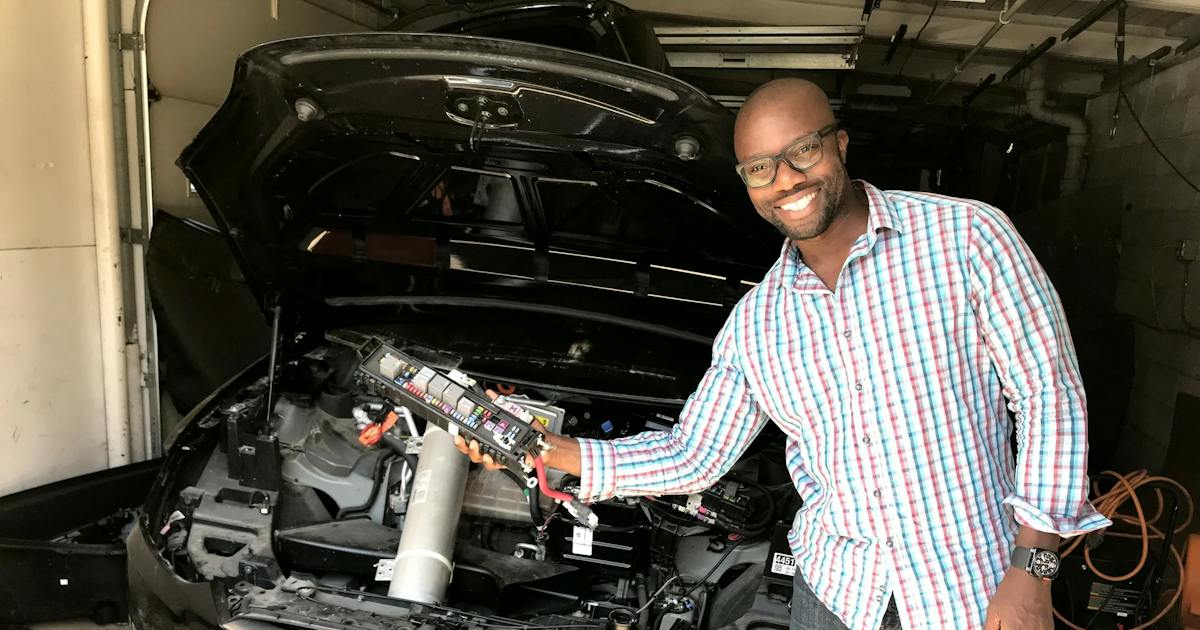
More than a decade ago, when Teslas were still new, Rich Benoit bought one for about $14,000 at auction. It was cheap because it had been flooded. He wanted to try to fix it, and he spent the better part of a year going through it and making repairs. He reached out to Tesla about buying replacement parts.“They literally just said no,” he said. “I thought it was going to be a lot easier: ‘Hey, I’ll just buy a battery, put a battery in, put a new motor in, you know, buy some new interior parts.’ They literally said no. I’ve never seen anything like that before, and I think that’s what started the journey for me.”Benoit’s professional background was in I.T., but this launched a new career in fixing electric cars, and he also runs a now 10-year-old YouTube channel with co-founder Carl Hewitt about his work, called Rich Rebuilds. He says nearly every electric vehicle company has responded the same way Tesla did. So his new career intersected quickly with the right-to-repair movement, which argues that companies shouldn’t be allowed to refuse access to the information and equipment people need to make repairs on the products they’ve purchased.At least nine states have passed right-to-repair laws—most of them blue, along with Texas and Kansas—and every state has debated similar laws that would require at least some manufacturers to provide the tools people need to make repairs on their products. A federal bill is sitting in the House, waiting for potential consideration in the lame-duck session, but it’s unlikely to rise to the top of Congress’s long to-do list. For Benoit, though, this is about much more than just fixing cars. “This kind of encompasses a larger overarching theory that the corporations own what you have,” he said. “You don’t own anything. You just rent it.”The right-to-repair movement started about the same time Benoit got involved, when mechanics, electronics geeks, farmers, homeowners, and others began noticing that their often-expensive appliances and equipment didn’t come with manuals they could refer to so that they could understand even the basics of a product’s build and operation, but relied increasingly on digital technology that they couldn’t access.It meant that third-party repairers couldn’t even diagnose problems or fix the most minor breaks. Owners had to make a trip to an authorized dealer anytime something needed work, which cost more time and money than it should have. It also meant owners couldn’t shop around for the best deals or use their most trusted repair shops.In the case of Benoit’s flooded Tesla, the company offered to connect him to its sales department rather than helping him fix the car he’d already bought. He ended up buying a crashed Tesla to pilfer it for parts.This trend has caused a groundswell of anger that has persisted and grown in this new, digitized millennium. Estimates are that the proprietary hold companies have on making repairs to their products costs the average individual household hundreds of dollars annually but adds up to nearly $50 billion a year across the entire economy, especially when accounting for the fact that many consumers simply throw out old electronics like cell phones and buy new ones rather than bother with repairs.There are a growing number of consumers who want to do something about the issue, however. The Rich Rebuilds channel has almost two million subscribers and gets many millions of views. On it, he tackles a range of seemingly unfixable problems on different makes and builds of electric cars. “The average person that’s buying a car nowadays doesn’t really have to worry about this too much. If you’re buying a car, you buy it brand new, if you do everything the company wants you to do, generally you’re fine,” he said.But the more control companies take over products, the more they try to push the boundaries, he said. “As time goes on, companies effectively get more bold as to how much control they can have over you,” he said. That includes adding on subscription services to even use the technology included in new cars, making functions simply inoperable if buyers don’t continue to pay the fees.Almost every existing state law targets only part of the problem, usually because the legislation gets whittled down by interest groups as it makes its way through state chambers. Local tractor dealers, for example, see it as a competitive advantage when they are the only ones who can repair the products they sell, and so they advocate for carve-outs. “Really, the policy should apply universally,” said Nathan Proctor, senior director of the advocacy group U.S. PIRG’s Campaign for the Right to Repair. “I think it’s an unfair and deceptive practice to sell somebody something and then withhold their ability to fix it … [but] there’s a political reality of, how many lobbyists can you pick a fight with at the same time?”Right-to-repair is one of those seemingly small issues that, if dealt with, could actually have a huge impact on people’s lives and the overall economy, especially for small repair shops and independent retailers. Democratic Representative Marie Gluesenkamp-Perez, who represents a relatively conservative district in Washington and owns an auto repair shop with her husband, has made it a signature issue, and has signed on to co-sponsor the Repair Act, which would apply to automakers, with a Florida Republican, Representative Neal Dunn. Gluesenkamp-Perez has also joined with other lawmakers to establish a right to repair for U.S. military service members and on agricultural equipment electronics. More recently, Republican Senator Josh Hawley has also joined with Democratic Senator Ray Luján to introduce a right-to-repair act for cars.“Right to repair was a big reason I ran for Congress in the first place,” Representative Gluesenkamp-Perez said in a emailed statement. “It’s about a respect for the trades and working people, bringing down costs, and countering the enshittification trend. Big corporations have made their money encroaching further and further into our economic agency. Democrats need to show the muscle to stand up to the interests of big corporations and assert that Americans have the right to be owners and stewards of the things we buy.”These kinds of measures get bipartisan approval from voters, as well. But corporations, which usually don’t want to see any new regulation of any kind, fight right-to-repair laws on intellectual property and product safety grounds. Their lobbying keeps these issues from coming to the foreground.Proctor thinks it’s unlikely that there will be meaningful national legislation on right-to-repair anytime soon, which is why it makes sense to go state by state. Many current federal laws around consumer rights could already prevent some of the worst practices if they were enforced, but once the digital economy took over, too many companies found loopholes or relied on regulation being too complicated. It’s a difficult battle to take on, and Proctor says he understands why many policymakers don’t pick up the issue.But there’s a political opportunity for a candidate who promises to fix it. “There is this thing that’s kind of bubbling on the edges of politics, which is like, actually, if you just really focus on things that annoy people and they see as problems that you would assume that actually government could do something about, and then you get those things fixed, that’s actually pretty popular,” Proctor said.Right-to-repair is already a live issue for some unlikely bedfellows—farmers, DIY enthusiasts, health care workers who deal with lifesaving equipment with proprietary software, and the people who watch the Rich Rebuilds YouTube channel, for example—but breaking through the noise is always a challenge.For Benoit, it may already be too late; electronics are too ingrained in our lives. “Now that we have discovered software, a lot of the time the software isn’t really being used for good,” he said. “It’s software that’s designed to extract as much money from you as possible.”
He Had the Know-How to Fix His Tesla. But Telsa Told Him He Couldn’t.
Full Article
Original Source
Read the full article at Newrepublic →KhanList aggregates and links to publicly available news content. We do not host full articles from third-party sources. Always verify important information with original sources.