
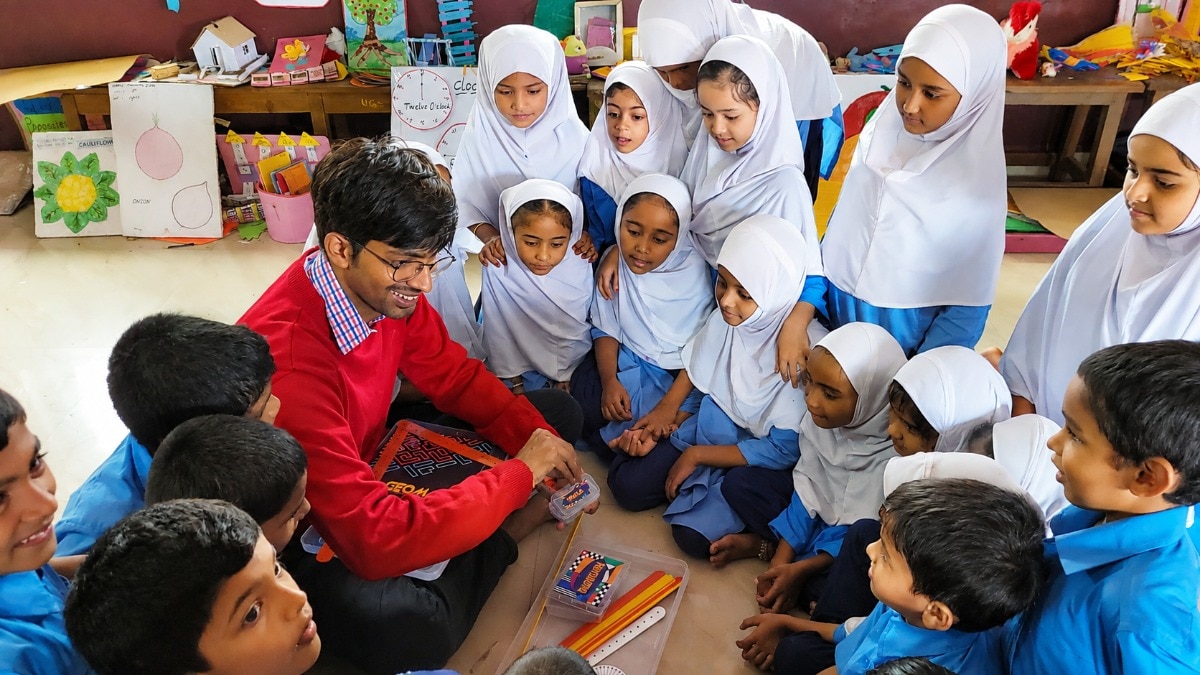
A broken toy sparked his curiosity. Years later, that same curiosity has helped Akshay J Mashelkar create learning tools that have reached over 20,000 students across India. Fresh from receiving a national honour from President Droupadi Murmu, he explains why children do not hate maths. They hate how it is taught.A broken toy sparked his curiosity. Years later, that same curiosity has helped Akshay J Mashelkar create learning tools that have reached over 20,000 students across India. Long before Akshay J Mashelkar was honoured by President Droupadi Murmu at Rashtrapati Bhavan for his innovations making science and maths easier to understand for government school students, he was a curious child in Sirsi, Karnataka, with a habit that drove many parents crazy."If a toy stopped working, I would open it. If there was an old radio, cassette player, television or some discarded electrical device at home, I wanted to dismantle it and see what was inside," Mashelkar says.He laughs that he could not always put everything back together. But every broken toy, every opened radio and every dismantled gadget answered another question that fascinated him as a child -- How does this work?Growing up in a government school ecosystem with limited laboratories and learning resources, curiosity became his greatest teacher. It eventually drew him towards physics, then teaching, and later research at RV University, where his doctoral work explores ‘Games with Purpose’, an interdisciplinary approach that combines education, technology and design to make mathematics easier to understand.Looking back, he believes his childhood shaped his entire philosophy of education. "We often give children answers before giving them an opportunity to explore the question," Mashelkar says.That thought has guided a journey that has now taken his innovations to more than 250 schools, over 20,000 students and around 2,000 teachers, earning him the Grassroots Innovator Recognition 2026, selected by Niti Aayog and awarded by the President.Currently the founder and CEO of Experimindlabs, his work includes patented geometry tools, robotics kits, DIY electronics and smart laboratories developed for government schools.THE LESSON HE LEARNT FROM HIS MOTHERThe turning point in Mashelkar’s life did not happen inside a university laboratory, but rather, in his mother's classroom.His mother, Latha Ramakrishna Bhandari, taught mathematics in a government school. Watching her interact with students, he noticed something that stayed with him for years."I repeatedly saw students approaching mathematics with anxiety even before trying to solve a problem. Somewhere along the way, many children had already convinced themselves, 'Maths is difficult. I am not good at it'," says the young teacher.But he also saw that the fear disappeared when concepts were explained patiently and logically. And that changed the questions he began asking."Instead of asking, 'Why is this student unable to learn mathematics?' I began asking, 'Can we change the way the concept is being communicated?'" Mashelkar explains.Later, as a physics teacher and researcher, that simple shift in thinking became the foundation of his work. "Physics gave me explanations for many of the things I had always wondered about," he says.His goal was no longer to help children score more marks. It was to help them genuinely understand what they were learning -- "Can we help a student not just know something, but actually understand how and why it works?"WHY HE TURNED MATHS INTO A GAMEAsk Mashelkar what is wrong with mathematics education and his answer comes quickly: "We introduce memorisation very early."Children memorise multiplication tables, formulas and equations long before they understand why they work.That is why he started experimenting with games, educational toys and tactile learning experiences.His best-known innovation, Geomagic, is a hands-on mathematics kit that combines physical models with digital activities, allowing children to build, manipulate and visualise geometric concepts instead of memorising them.The kit turns abstract ideas into something kids can touch and test. Instead of memorising a theorem, children can physically rearrange shapes, test patterns and see why a mathematical rule works.The classroom response surprised even him."Children who would hesitate when asked a maths question on the blackboard became completely involved when the same concept appeared as part of a challenge," he says.When students played together, they practised mathematical operations repeatedly without feeling they were studying. That convinced him he was on the right track."Children do not necessarily dislike mathematics. They often dislike the way mathematics is introduced to them," Mashelkar says.His ambition is to move learning from memorisation to understanding: "Move mathematics from memorisation to experience. From 'remember the answer' to 'discover the answer.'"MORE THAN NUMBERSToday, Mashelkar's work has reached thousands of children, but he says the numbers matter less than the stories behind them.Former students still call him years after leaving school. "They say, 'Sir, we still remember the way you taught us. It changed the way we understood the subject’," he happily recalls.Teachers, too, tell him that children who rarely participated in class suddenly become eager to answer questions and experiment.His biggest takeaway after working with thousands of learners is simple. "When you change the learning environment, the same child whom we may have considered weak can suddenly surprise us."THE BIGGEST CHALLENGE WAS NOT INVENTINGOne might assume building educational innovations is the hardest part.But Mashelkar disagrees. "Getting innovation into classrooms was harder."In the early years, he funded much of the work himself while teaching, building one prototype at a time and refining it inside classrooms.Even after the products were ready, government schools often lacked the money to adopt them. Teachers, already burdened with administrative work, were understandably cautious about adding something new.That experience changed his design philosophy. "An educational innovation cannot only be innovative. It must also be simple for the teacher to use," he says.There were days when progress felt painfully slow."But I think an innovator has a strange habit. One difficult day may make you question everything, and the next morning another idea makes you start all over again," he adds.TALENT IS EVERYWHERE. OPPORTUNITY IS NOT.After spending more than a decade working with rural government schools, Mashelkar believes one misconception refuses to die.Many people assume children studying in these schools are less capable than their counterparts in elite private institutions."My experience has been almost the opposite," he says.He says rural students often display remarkable curiosity, creativity and logical thinking when they are given the chance to build and experiment.The real obstacle is access.Sometimes it is access to teaching tools, other times, it is language."A child may understand a scientific idea perfectly when it is explained in Kannada or another familiar regional language, but struggle when the same concept is suddenly presented using unfamiliar English terminology," he says.For Mashelkar, language should never become a measure of intelligence.His conclusion is one every policymaker should remember: "Talent is distributed everywhere. Opportunity is not."WHY HE CHOSE CLASSROOMS OVER CONVENTIONAL RESEARCHAkshay Mashelkar could have pursued a more traditional academic path focused on research papers or opportunities abroad. Instead, he chose government schools. And the reason is deeply personal.The problems of rural education, he says, were never abstract research questions, but problems he had grown up seeing.Working directly with children also changed how he thinks about innovation. "A technically perfect solution is not necessarily an educationally useful solution," he says.Children offer the most honest feedback imaginable. "If they do not understand your innovation, they will show you. If something interests them, their curiosity becomes visible immediately."Then comes perhaps the most powerful lesson he has learnt -- "A child does not care how sophisticated your research is. The child asks a much more fundamental question: 'Does this help me understand?'"For Mashelkar, that is the true purpose of research. Not simply publishing papers, but creating something that reaches a classroom and changes the way a child learns.WHAT HE WANTS EVERY CHILD TO FEELReceiving the President's recognition is a proud moment, but Akshay Mashelkar insists it is only the beginning.He hopes to take Geomagic and several other educational innovations to many more schools in India and beyond.If he could redesign mathematics education, he would introduce more games, more hands-on learning and better teaching tools that make abstract ideas visible without increasing teachers' workload.Ultimately, though, his dream is much simpler. He wants children to stop fearing mathematics.Instead of walking into class worried about marks or mistakes, he hopes they walk in excited to learn.As he puts it, "A child should not enter a mathematics class wondering, 'Will I get the answer right?' The child should enter wondering, 'What am I going to discover today?'"For a man who began by taking apart broken toys to understand how they worked, it is a fitting mission.After all, his life's work has never really been about mathematics. It has always been about helping children discover the joy of asking, "How does this work?"- EndsPublished On: Aug 17, 2026 08:00 IST
He broke toys as a child, today 20,000 students are learning maths through his games
Full Article
Original Source
Read the full article at Indiatoday →KhanList aggregates and links to publicly available news content. We do not host full articles from third-party sources. Always verify important information with original sources.