
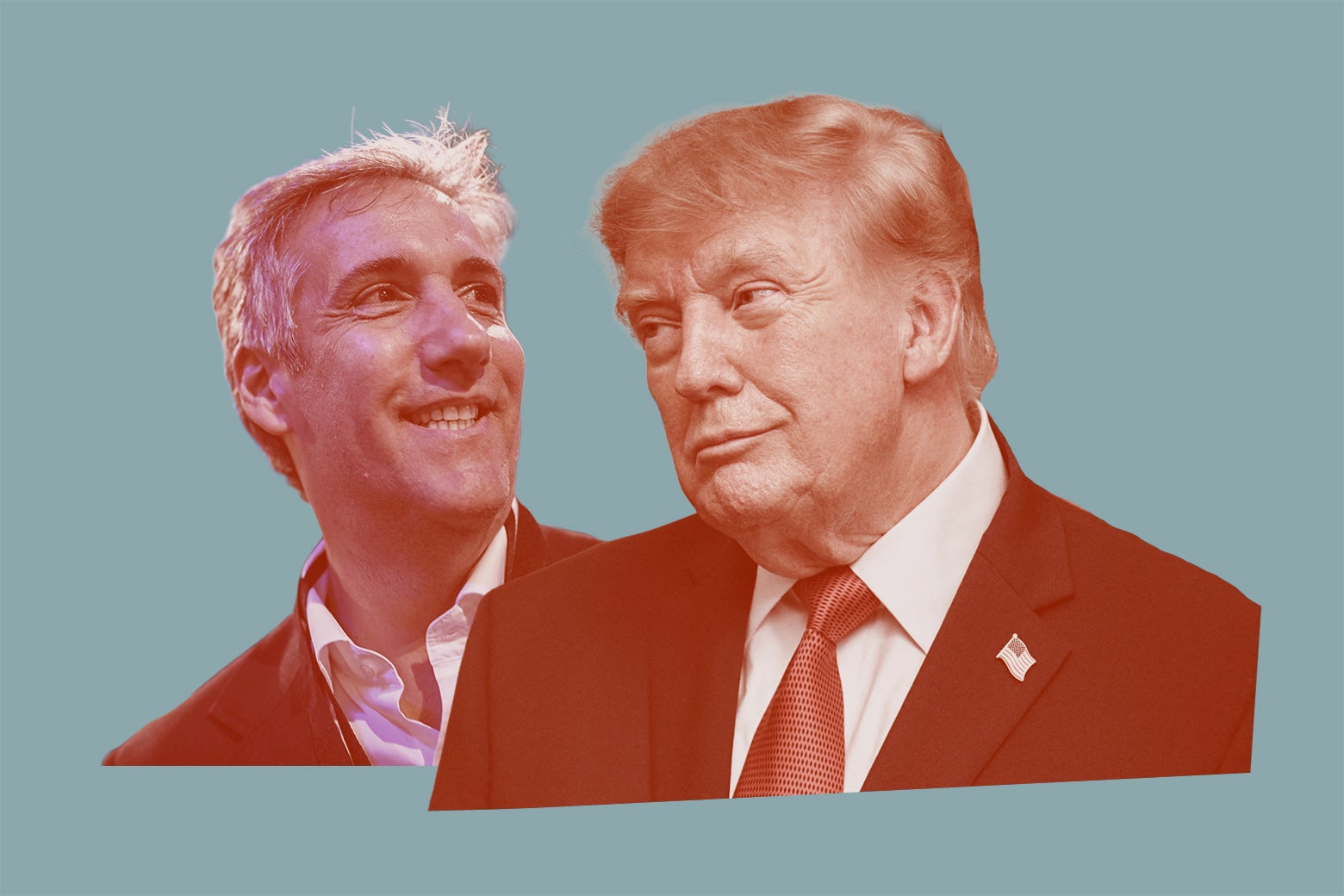
The Slatest The strange but entirely foreseeable saga of Trump’s former fixer. Photo illustration by Slate. Photos by Andrew Harnik/Getty Images and Jim Watson/AFP via Getty Images This story is adapted from the Slatest newsletter. You can sign up here to get it in your inbox every day. Donald Trump and Michael Cohen are friends again. Or at least they aren’t enemies anymore. The rapprochement between the president and his former lawyer, whose excommunication from Trumpworld culminated when Cohen testified for the prosecution at Trump’s 2024 criminal trial, entered a new phase last week when Trump appeared on Cohen’s weekly radio show. The episode, which is titled “Burying the Hatchet” and aired in full Sunday, was a relatively chummy public reunion that dwelled little on the origins of their rift. With the country embroiled in a trade war with Canada and a hot war with Iran, Cohen’s triple-agent performance might understandably register as little more than palace intrigue (or perhaps a court jester’s routine). But it also underscores a dynamic that has powered Trump’s political career from the start—and may help explain why his presidency is currently flailing. Hang on. Remind me who Cohen is and how he ended up on Trump’s bad side. I don’t blame you for blissfully memory-holing this particular subplot. Cohen started with Trump back in 2006, doing legal work for and helping run his businesses. But Cohen also handled tasks better befitting a mob-boss consigliere: paying hush money to women who claimed affairs with Trump, serving as Trump’s self-described on-air “attack dog,” and threatening media outlets that pursued critical stories. When Trump moved into the White House in 2017, Cohen was reportedly disappointed not to land an administration job. But he didn’t turn against the president until the following year, when federal agents raided Cohen’s office and he pleaded guilty to campaign-finance crimes and other charges, saying Trump had ordered the payoffs to help him win the 2016 election. Their relationship reached its nadir when Cohen served as the star witness in the criminal case that convicted Trump over hush money payments to the porn actor Stormy Daniels. That’s a lot of bad blood. So what was Trump and Cohen’s conversation on Sunday like? At times, it seemed as though their boss-fixer relationship had never ended. Cohen fawningly addressed Trump as “sir,” echoed his criticisms of “crazy leftists,” and predicted that future presidents would thank Trump for the ballroom he tore down part of the White House to build. When Trump darkly joked that it’s been hard to make a peace deal with Iran because the U.S. military has killed so many of its leaders, Cohen obligingly guffawed. “The country is doing good,” Trump declared at one point, to which Cohen responded, “Well, thanks to you, sir.” The hatchet burial has been brewing for a while. Trump and Cohen broke the ice during a “brief yet significant” run-in at one of Trump’s golf clubs last summer, the New York Times reported. Earlier this year, he wrote on Substack that he’d felt “pressured and coerced” by Alvin Bragg, the Manhattan district attorney who led the hush-money case, and New York Attorney General Letitia James, who brought a separate civil fraud case against Trump in which Cohen also testified. And this spring, Cohen launched his radio show on WABC, a Trump-aligned station in New York. It sounds like Cohen’s all in on Trump—again. But why now? After his Trump interview ended, Cohen preemptively fulminated against his critics. The “rage-baiters” and “professional outrage merchants,” Cohen inveighed in his punchy New York accent, will “draw conclusions when no conclusions should be drawn. They will manufacture motives where none existed. They will turn a sentence into a manifesto, a disagreement into a declaration of war, and a conversation into some grand psychological profile.” But at the risk of becoming one of those rage-baiting outrage merchants, here’s one theory: Cohen never quite fit in with the anti-Trump crowd he’d fallen into. “I really think he loved working for Trump. I think Trump is like a father figure to him,” Joe Walsh, a former GOP congressman and Trump critic who co-hosted a weekly Substack show with Cohen until earlier this year, told me. “He wants back in the king’s court.” Cohen isn’t the first Trump hanger-on to come back from exile, right? Cohen’s reversal is a particularly dramatic example of a long-standing pattern. Sens. Mitch McConnell and Lindsey Graham, both of whom broke with Trump after the Jan. 6 attack on Congress, backed him again in 2024. Elon Musk blasted the president’s debt-ballooning tax bill last year but now appears to be back in his good graces. J.D. Vance, who likened Trump to Hitler and didn’t vote for him in 2016, is now Trump’s vice president. Many of those converts apparently wanted something only Trump could give—support from his base, favorable treatment from federal regulators, or a future in GOP politics. So what does Cohen want? A pardon, it seems. Cohen already served his three-year prison sentence for campaign-finance crimes and lying to Congress. But presidential clemency, he told MS NOW last year, “would make my life a little easier, going back into real estate, dealing with banks, and so on.” After failing to wheedle a pardon out of Joe Biden, Cohen now says he has a request pending with the Trump administration. He may also want cash. In his interview with Trump, Cohen defended the “anti-weaponization fund” the administration created to compensate supposed victims of Biden-era lawfare. “What about people like me who were weaponized against?” Cohen asked. (The fund attracted criticism even from Republicans, and Attorney General Todd Blanche claims it’s “dead,” so whether Cohen will end up benefiting remains TBD.) OK, but Trump is infamous for banishing people he sees as disloyal. Why would he welcome Cohen back? We’ll see if he does. Despite throwing Cohen a few bones during their conversation, including predicting that he would “go down as a man with courage,” Trump otherwise sounded faintly bored, repeating his usual talking points about the great job he’s done as president and the nefariousness of his political opponents. Yet Trump also stands to benefit from a thaw. “I respect the fact that you recanted everything you said,” he told Cohen, referencing his former fixer’s recent criticisms of Bragg and James. (Cohen hasn’t recanted his testimony, although he didn’t correct Trump on that point.) A New York court nixed the financial penalty James secured against Trump last year, and the president has repeatedly tried to overturn his hush-money conviction. Even if he fails in court, Cohen’s turnabout has muddied the case in the court of public opinion, letting Trump claim vindication. I see why both Trump and Cohen might gain from this. But why does Cohen’s about-face matter otherwise? A uniquely polarizing figure from the start, Trump has lived a political career defined by others’ decisions to get on—or off—his team. The story of the 2016 election was the Republican establishment slowly making its peace with him. In 2020, enough independents, moderate Republicans, and Democrats who’d been unenthused about Hillary Clinton voted for Biden to defeat Trump. And in 2024, a host of figures who’d previously shied away from the president loudly and proudly got on board, from Vance to entertainment figures like Joe Rogan. From Trump’s perspective, the entire country did something similar. Voters didn’t just look past Jan. 6 and Trump’s criminal convictions; they reelected him by the biggest electoral margin he’s ever gotten. Viewed through that lens, the real mystery is less why Cohen ran back to Trump and more what took so long. So is Cohen’s betrayal a sign that the anti-Trump coalition is flagging? The sheen does seem to have come off some former Resistance stars. Rep. Dan Goldman, who helped lead the first effort to impeach Trump, lost his primary in June. Alex Vindman, a key witness in that impeachment inquiry, lost a Senate bid in Florida last week. Trump’s reelection turned paraphernalia that defined his first term (pink pussy hats, Robert Mueller graphic novels, Biden-Harris bumper stickers) into relics. And as Walsh told me, it’s generally gotten harder to make money as a Resistance media figure. “I’m a free-market guy, but there’s not a lot of income in the Never-Trumper world.” But for every Michael Cohen getting on the Trump bus, there appear to be many more Americans getting off. Even a chunk of the voters who enabled Trump’s return seem disenchanted, angry over persistent inflation and a war of choice in Iran. The president’s approval ratings are mired in the 30s, lower in some polls than they were after Jan. 6. Democrats seem poised to retake one or both houses of Congress in November, and Republicans are grumbling behind his back. As one GOP strategist told the Times, “They’ve watched Trump’s numbers be a constant limbo contest of ‘How low can they go?’ ” That’s one of the dangers of transactional relationships. A president whose best friends are the people who need him might one day discover that they no longer do. Tolga Akdoğan Cohen ended his show with some advice that might resonate with this newsletter’s readers: “Tonight, turn off the outrage machine for just a little while. Take a breath, a deep breath. Go hug your kids, go call someone you love, go walk your dog, have a drink, sit on your porch. Do something completely radical in 2026: Enjoy your life without asking the internet for permission.” On that note, my colleagues also recommend: A delicious deep dive on a chicken-finger empire: Raising Cane’s has inspired a near-religious following, with devotees traveling across state lines and camping overnight for store openings, all to worship at the altar of chicken. Slate’s Steffi Cao set out to uncover just how the chain became such a phenomenon—and what its rise reveals about consumer desire, brand loyalty, and the future of American fast food. A cursed girl group? Katseye has never been bigger or more divisive. Now it seems as if one of pop’s hottest acts is on the verge of implosion. Nadira Goffe explains how we got here. A vibe shift on the Billboard charts: Country music is topping the charts like never before. Chris Molanphy thinks he knows why. An accuracy check on that Bourdain biopic: We’ve mentioned here before that Slate’s movie critic loved Tony—but how true is the film, and what liberties did it take with the facts? Ellin Stein examines how it matches up to the real events of Bourdain’s life. Have a great rest of your evening! We’ll see you back here tomorrow.
He Betrayed Trump. Now He’s Back on the Team. Here’s Why It Matters.
Full Article
Original Source
Read the full article at Slate →KhanList aggregates and links to publicly available news content. We do not host full articles from third-party sources. Always verify important information with original sources.