
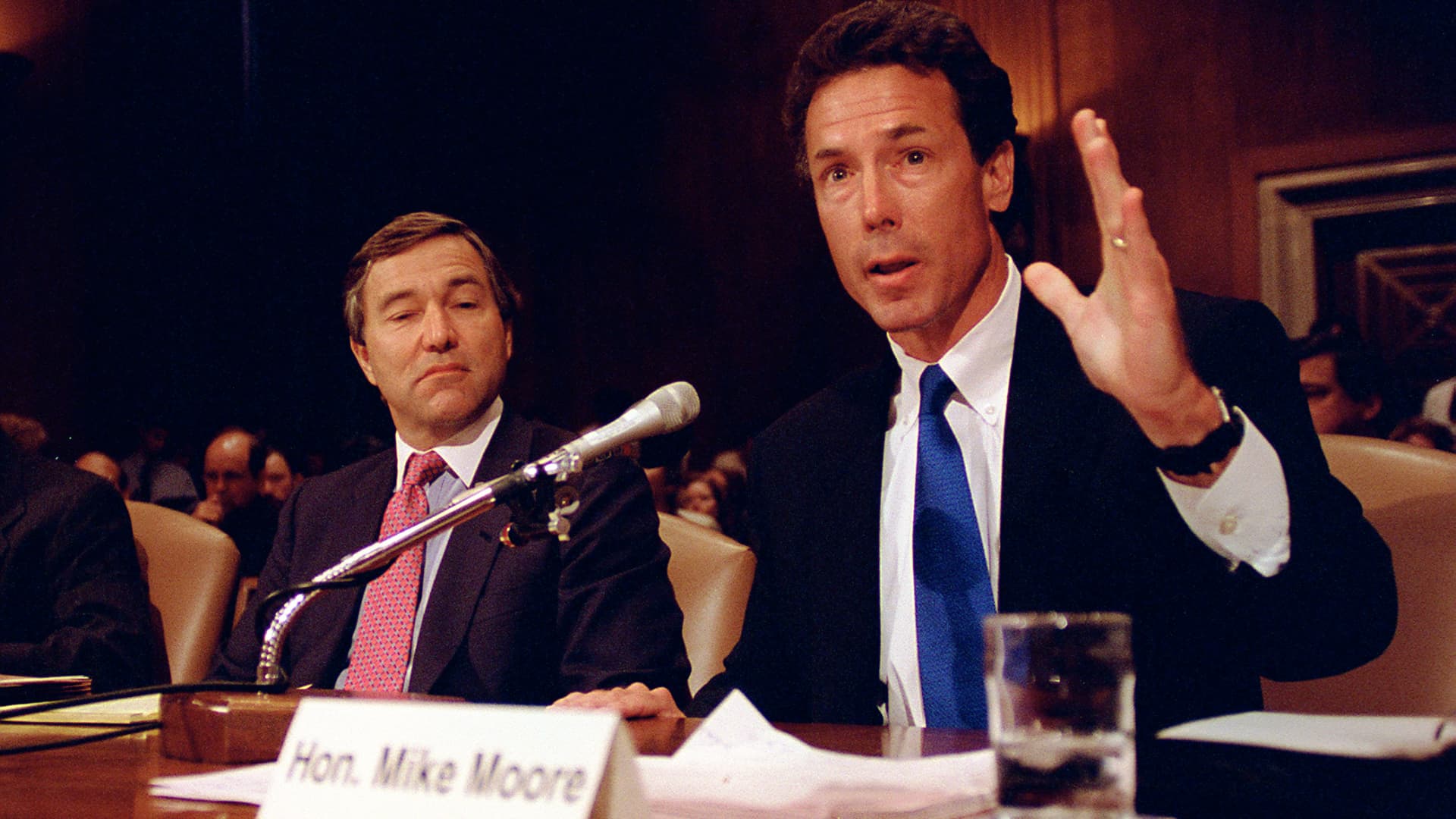
Mike Moore Attorney General from Jackson Mississippi gives his opening remarks during the tobacco hearings, seated next to him is D. Scott Wise, partner, Davis, Polk and Wardwell in New York. Douglas Graham | Cq-roll Call, Inc. | Getty ImagesAs a central figure who helped negotiate the blockbuster $246 billion tobacco master settlement in 1998, Mike Moore sees the writing on the wall for Meta and its social media rivals like TikTok and Google's YouTube.Moore was the Mississippi attorney general leading the charge against Big Tobacco. He's long since retired from public office, but is using his experience to help inform state AGs in the crafting of a potential sweeping settlement with the social media industry, which has been similarly accused of knowingly fostering addiction and harming America's youth. Meta this week agreed to pay almost $17 billion in a landmark settlement with a coalition of state AGs that had sued the company for misrepresenting the extent of child mental health damage caused by Facebook and Instagram. It's by far the biggest deal yet in the massive litigation wave facing social media companies, but experts say the matter is far from over as a bundle of cases remain open. As co-leader of Attention Initiative, a newly created nonprofit, Moore told CNBC he sees the opportunity for a grand settlement that involves a wider swath of companies and impactful remedies, including a permanent national public education fund to "reduce the number of young people who fall prey to the addiction and the many harms it has caused."Meta agreed to changes including daily usage limits and "nighttime blocks" for teenagers who use the company's apps, "enhanced age assurance measures" that would prevent children from using them and the creation of additional tools for parents and guardians. An independent auditor will monitor and report on whether Meta is complying with the settlement's terms over a five-year period. "The settlement with the states is a great first step in helping protect our children from the dangers on social media," Moore said, in his first public comments on the matter. "The attorneys general have done a great job with their investigations and lawsuits in exposing the bad practices of Meta and the social media industry and now providing a template of corrective actions the industry must take."While Moore sees major parallels to the tobacco battle almost three decades ago, the universe of Big Tech and social media presents an array of challenges that may limit the viability of the old playbook. Unlike tobacco, a static product with no real defensible qualities outside of recreation, consumer technology is ever evolving, and the lines between harmfully addictive and beneficial to society can be extremely blurry. "Cigarettes are cigarettes," said Jonathan Caulkins, a professor of public policy at Carnegie Mellon University's Heinz College. By contrast, he said there are stark differences between apps like Facebook and TikTok and, "in the world of AI and social media, it is simply impossible to know what those technologies are going to be doing for good and ill five and 10 and 15 years into the future." Caulkins said he's not convinced that a "single settlement" can resolve all the alleged health-related concerns, given the rapid advancements in technology.Still, Moore said it's important to develop proposed settlement language to ensure that litigators are going after the most significant fixes. In his view, that includes a public education fund, though there are dozens of states along with cities, counties and school districts that will all be pursuing various remedies. The Attention Initiative's goal, he said, is to "make sure everybody hears loud and clear" that "we need a remediation public education program, prevention program, whatever you might want to call it." "It's best done on a national scale rather than piece by piece, city by city, county by county, state by state, which just wastes a lot of money," he said.Adam Mosseri, head of Instagram at Meta Platforms Inc., arrives at the Ronald V. Dellums Federal Building & US Courthouse in Oakland, California, US, on Tuesday, Aug. 25, 2026. Jason Henry | Bloomberg | Getty ImagesThe Meta settlement came just over a week into a federal trial in Oakland, California, that was co-led on the plaintiff side by California AG Rob Bonta. The case was brought in 2023, and accused Meta of violating federal and state laws, including the Children's Online Privacy Protection Act, or COPPA, and various consumer protection statutes.After the agreement was announced, Bonta called it, "a floor conceptually, not a ceiling," and said it "gives notice to others in the industry that we're not done, and we expect similar outcomes from them as well."Meta didn't comment on whether a bigger settlement is in the works to clear its remaining legal hurdles. The company made clear in its statement after the announcement that part of its payout is contingent on YouTube and TikTok implementing similar changes to their services. Google and TikTok didn't respond to requests for comment. Snap, which also faces a number of lawsuits, declined to comment.Assuming 'nothing will change'The Attention Initiative was created by 22-year-old Josh Jacobs. He modeled the Colorado nonprofit in part after the public health group Truth Initiative, which was started as part of the tobacco settlement and is chaired by Moore. Jacobs previously co-founded an online ad and e-commerce startup with college friends and became disenchanted with what he characterized as the social media industry's "perverse incentives of maximizing for engagement over all else." He started researching the similarities between social media and tobacco, an endeavor that led to him cold-calling Moore. He felt the need to take action while the topic is hot. "Most people my age aren't following this trial through the news," Jacobs said. "They're seeing it on social media, and the comments under those posts are almost entirely cynical. The assumption is that nothing will change."Josh Jacobs, Founder of Attention Initiative.Courtesy: Joshua JacobsMany techies, however, are concerned about too much change. It's an industry that's long been concerned about regulations and laws infringing on free speech, and experts say there are nuances that make social media hard to regulate. Age verifications and parental controls come with notorious loopholes. Teenagers in Australia are reportedly using social media apps more now despite a ban late last year, in part because they can use virtual private networks (VPNs) and bypass local laws. Then there's the emergence of artificial intelligence chatbots and companions that create a host of other concerns for underage usage, but that aren't generally considered part of the social media industry. Allison Ball, a former Facebook product leader, previously invested in Jacobs' startup. Now a venture capitalist, Ball said she admires the work Jacobs and Moore are doing but wants them to stay "maniacally focused on what could actually help" instead of advocating for regulations that she believes could have unintended consequences."It's the hardest thing in modern society to get right," Ball said. "Where to limit freedoms and who to hold accountable, that's super difficult for the government to get right."She agreed that education is important but that "it's just not going to solve the whole problem."From tobacco to social mediaAmong those who were deeply engaged in the tobacco case, Moore isn't alone in recognizing the similarities to social media. Lawyers Joe Rice and Steve Berman were two of the key architects of the tobacco settlement and, like Moore, were also heavily involved in opioid-related litigation. Berman speculates that Meta will next settle the school districts case, which stemmed from some 1,200 districts across the country accusing the Facebook parent and other social media companies of spreading intentionally addictive features. "They're going to have to take care of this problem, or they're just going to be litigated forever," Berman said. Rice, whose law firm Motley Rice is involved in multiple social media trials, said that in order for a master settlement to take place, the tech companies have to come together in a way that's unfamiliar to them given how much they compete with one another. "At some point in time, it's possible that the two or three largest platforms can say, 'Look, we should all agree to this,'" he said. "They're not in lockstep right now."Moore said that he's initiated potential master settlement language with AGs, but he declined to comment further. He's enlisting his colleagues at the Truth Initiative to work with Jacobs and representatives from the AGs' offices.Until there's broader resolution, court cases remain on the calendar. Among them is a case involving Snap in New Mexico, where state AG Raul Torrez, a board member with the Truth Initiative, is leading a child-sexual exploitation lawsuit. It's similar to a case that Meta lost in New Mexico earlier this year. The trial there is scheduled for about a year from now.WATCH: Meta's post settlement challenges: Here's what to know.
He beat Big Tobacco. Will the same playbook work against Meta and social media?
Full Article
Original Source
Read the full article at Cnbc →KhanList aggregates and links to publicly available news content. We do not host full articles from third-party sources. Always verify important information with original sources.