
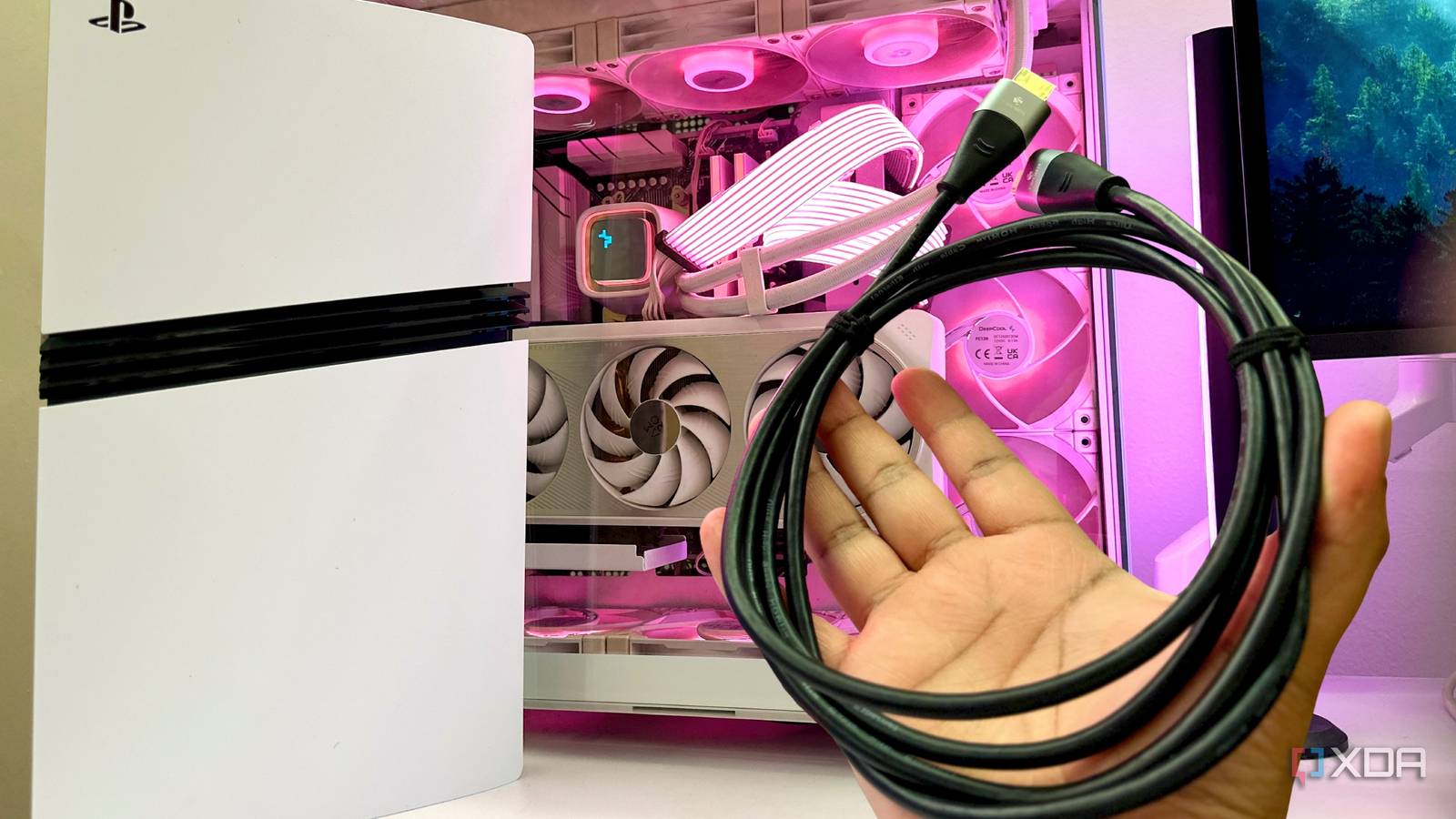
Published Aug 16, 2026, 4:30 PM EDT Gaming has been Samarveer’s greatest passion, and the Literature graduate in him takes immense joy in dissecting games for their themes, messages, and impact. Samarveer holds a deep appreciation of gaming, and considers the platform to be the most immersive and impactful across all media. He can be found engaging with gaming communities online, always ready to debate the finer points of ray tracing or itching to write an 8-page collegiate thesis on any game that impacts him emotionally. At CES 2026, HDMI 2.2 looked every bit like the future — we saw a 500Hz gaming monitor showing off impossibly smooth motion, and the shiny new Ultra96 cables from Elka that sat right beside it made us all want them immediately. For everyone watching, that demo was enough to make them wonder just how far behind their own setups had fallen. Then, the Xbox Series X and the "gaming-optimized" PC driving the entire demo broke the illusion. These devices made one thing clear: HDMI 2.2 may very well be ready to deliver 96Gbps at resolutions never before seen, but the hardware that actually needs all that bandwidth to justify the new standard, barely exists yet. HDMI 2.2 is here — the hardware isn't The cable has already arrived for a future that hasn't Anyone holding their breath for HDMI 2.2 displays shouldn't automatically consider their current HDMI 2.1 device inadequate by any means. The new HDMI 2.2 standard can push more data through the same connection, and 96Gbps certainly opens the door to display configurations that are impossible over HDMI 2.1 — 4K at 480Hz, 8K at 240Hz, and 16K at 60Hz does make HDMI 2.1 feel quaint, after all. Those are impressive numbers, yes, but they form a ceiling that is only useful when something actually has the horsepower to reach it. That's where the timing of it all gets a little strange, to say the least. HDMI 2.2 is already a finished specification, and Ultra96 cables are being certified to carry its maximum bandwidth. But GPUs, game consoles, TVs, and monitors that can meaningfully utilize that 96Gbps bandwidth don't even exist yet. We're effectively getting the infrastructure for a generation of hardware that hasn't fully arrived yet. There aren't even any 4K 480Hz displays on the market right now. That's not to say HDMI 2.2 is completely pointless, either. Quite the opposite, in fact. After all, standards have to arrive before the hardware they enable, otherwise manufacturers would have nothing to build toward. However, that gap here feels unusually large, because 48Gbps HDMI 2.1 already handles most of what today's high-end gaming hardware can throw at it. You don't see any 4K 480Hz monitors or displays on the market today, do you? The source is the real HDMI 2.2 bottleneck Your TV can be ready long before your GPU or console is If you're wondering when it actually makes sense to buy into HDMI 2.2, I'd start watching the source, not the TV. The next generation of GPUs is the obvious first milestone here, and I suppose that whatever Sony and Microsoft eventually ship as the PS6 and Xbox Helix will follow suit. If those platforms do adopt HDMI 2.2, and its expanded gaming and VRR capabilities, that's when the standard will start moving from an impressive brochure specification to something we can actually use in our day-to-day lives. An HDMI 2.2 display cannot manufacture bandwidth that its source simply doesn't provide. You could buy the most advanced 4K 480Hz (none exist) or 8K 120Hz (extremely rare) panel on the market, connect an Ultra96 cable to it, and still be limited by the GPU or the console sitting at the other end. The display is only the destination — the source has to generate and transmit all that data in the first place. For anyone holding their breath, keep an eye on the HDMI ports on next-generation GPUs instead of looking at HDMI 2.2 TVs and monitors. A new monitor could very well arrive tomorrow, but a GPU that is genuinely capable of feeding it could be years down the pipeline. Even the stronger PS5 Pro is capped at a 32Gbps bandwidth, and if the PS4 Pro-to-PS5 Pro trend were to be followed, the PS6 might only support 64Gbps instead of the full 96Gbps bandwidth of HDMI 2.2. If you're planning your next upgrade around HDMI 2.2, don't start with the cable. Instead, start with the device that will actually push those bits through it. Spoiler alert, though: that piece of the puzzle will be the last to arrive. Oh, and the cable mess is coming anyway HDMI 2.2 is about to give USB-C a run for its money HDMI 2.2, for all its new bandwidth numbers, will also be getting annoyingly familiar. Much like the USB-C era, where every cable could look identical to another cable while supporting completely different speeds and charging limits, HDMI 2.2 is setting itself up for a remarkably similar mess. The "Ultra96" feature name can refer to a device supporting 64, 80, or 96Gbps, while the cable itself is certified to support up to 96Gbps. So, even if you do wait until 2027 (or more realistically, 2028), don't assume that buying an HDMI 2.2 cable will solve all your problems. You'll need to pay attention to the actual bandwidth your source and display support, instead of blindly trusting whatever number a retailer has splashed across the product page. Thankfully, official Ultra96 certification labels and QR verification exist, but that's already more homework than "buy HDMI 2.2" makes it sound. Ultra96 HDMI cables feature an official certification label with a scannable QR code on their packaging to ascertain authenticity For now, then, do nothing. Unless you're buying a bleeding-edge display that genuinely needs HDMI 2.2, your HDMI 2.1 setup really isn't holding you back. When source devices begin shipping with HDMI 2.2 in bulk, that would be the signal that the wait is finally over. UGREEN USB-C to HDMI 2.1 Cable UGREEN USB-C to HDMI cable offers upto 8K @ 60Hz resolution followed by 48Gbps transmission. The upgrade cycle has changed Buying the latest connectivity standard might feel like the safest way to future-proof a setup, but HDMI 2.2 is making me question that instinct. The technology is definitely exciting, but being the first to a standard can mean spending more money to solve a problem your hardware won't encounter for years. On the other hand, biding your time can leave you with a far clearer picture of what actually matters. That's definitely the healthiest way to approach HDMI 2.2 right now. Let manufacturers fight over bandwidth records and certification logos, while the early adopters discover which combinations actually work. When the technology becomes genuinely useful, the buying decision should be boring, obvious, and based on what your hardware at the time needs.
HDMI 2.2 cables are here, but the hardware that needs them won't arrive for years
Full Article
Original Source
Read the full article at Xda-developers →KhanList aggregates and links to publicly available news content. We do not host full articles from third-party sources. Always verify important information with original sources.