
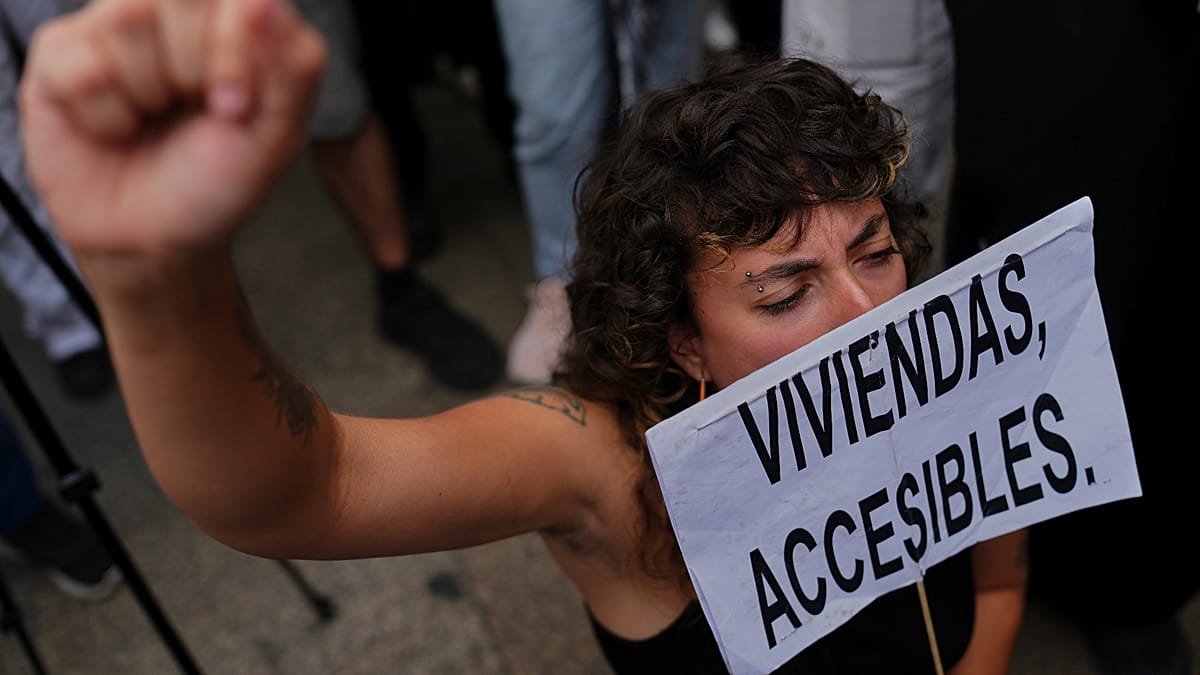
In Spain, having a job no longer guarantees being able to access housing. The increase in property and rental prices in recent years, far outpacing wage growth, makes it difficult both to pay a mortgage and to save up enough for a deposit. ADVERTISEMENT ADVERTISEMENT This is a gap that particularly – though not exclusively – affects young people and low- and middle-income households and that, in recent weeks, has placed access to housing at the centre of social and political debate, to the point that Prime Minister Pedro Sánchez opted to bring forward the general election after failing to secure approval in Congress for a set of urgent measures aimed at addressing the discontent felt on the streets. "The problem is essentially structural," says Rafael Pampillón, professor of Applied Economics at San Pablo-CEU University in Madrid, who acknowledges that the current gap between wages and the high cost of rents and mortgages "makes it harder to access housing" and emphasises that "having money for the deposit is not enough". According to data from the National Statistics Institute (INE), housing prices rose by 84.6% between 2015 and 2025, while average annual gross wages increased by 27.85% between 2015 and 2024, reaching 29,540 euros. Wages agreed in collective bargaining went up by around 27% over the same period. The gap persists today. Housing prices climbed 12.2% year-on-year in the second quarter of 2026, compared with average wage increases of between 3% and 4%, according to figures cited by the Ministry of Labour. Housing is becoming more expensive at a pace that earnings from work cannot keep up with. A recent study by Oxfam Intermón, presented last week, warns that housing costs have pushed the in-work poverty rate up to 15.49%, affecting around 770,000 people across the country. According to the report, one in three working people who rent at market prices falls into poverty after paying the rent. The rate stands at 34.08%, compared with 10.22% among those paying a mortgage and 7.95% among those who own their home outright. "Evictions are the most extreme face of the housing crisis, but not the only one," argues Oxfam Intermón's head of housing, employment and social policies, Alejandro García-Gil. "There is another, less visible reality: people who are working and just about manage to pay for their home every month, but who, once they have done so, do not have enough income left to sustain a decent standard of living." Rent, a cost that makes buying harder The problem is not limited to purchase prices. According to the latest annual report from the Bank of Spain, four in ten households living in rented accommodation face an excessive financial burden, spending more than 40% of their income on rent. In major cities and areas most exposed to tourism, pressure on prices further aggravates these difficulties. "These access problems are compounded by the fact that housing prices have risen more than household income, which has increased the effort required and tightened the conditions for buying a home in Spain to a greater extent than in the large European economies," the document notes. Rent also creates a barrier for those hoping to buy a home. Although in some cases a mortgage instalment could be more affordable than a monthly rent payment, putting together the money needed to qualify for a loan becomes increasingly difficult when a substantial share of wages goes on rent, explains Pampillón, who reiterates that "having money for the deposit is not enough". "A pay packet allows you to meet monthly payments, but buying a home requires a large upfront payment to purchase a flat, for which you need to have built up considerable savings," says the economist, who also holds a doctorate in Economic and Business Sciences from the University of Barcelona and an MBA from IESE. "The longer it takes to save up the deposit, the more years you continue paying rent." With an average home price of around 200,000 euros, a buyer needs approximately 60,000 euros to cover the deposit and the costs associated with the purchase. Without the ability to save, Pampillón adds, family support is often the only way to "break that circle". "Those who do not have it have to travel a much longer road. In this way, family wealth – together with generous pensions – is playing an ever bigger role in shaping children's opportunities," he laments. In this respect, the difficulty of leaving the parental home reflects a growing inequality between those who can draw on family resources and those who depend solely on their wages. Since 2008, the share of households that do not own their home has risen by 45%, according to the National Statistics Institute's Survey of Living Conditions. A structural problem that goes beyond wages The fall in pay during the financial crisis, slower wage recovery and the arrival of investment funds in the property market have all helped widen this gap. On top of that comes a shortage of supply: between 2021 and 2025 an estimated deficit of around 750,000 homes built up, according to the Bank of Spain. In 2025, around 225,000 households were formed, while some 92,000 new homes were completed. Despite the impact of this divide, many experts warn that the mismatch between incomes and housing will not be solved by wage rises alone. "Employment has always been seen as the best tool against poverty, and this analysis shows that having a job is not enough," notes García-Gil, referring to the Oxfam Intermón study. The European Commission is blunt in its assessment of the sector's situation: "The housing sector in Spain faces deeply rooted structural challenges. The Spanish property market shows a severe mismatch between supply and demand, coupled with a lack of a substantial stock of affordable and social housing, including social rental options." Faced with the current situation, the trade unions CC.OO. and UGT have called a 24-hour general strike on 11 November, under the slogan "wages, housing, prices", with which they hope to channel the social discontent generated by this crisis in Spain, especially in the wake of the eviction – and subsequent death – of Maricarmen, an 87-year-old woman who died in early October after being forced out of her home days earlier. "Under the current conditions there is no wage or collective agreement that can allow us to access housing," recently said the UGT general secretary, Pepe Álvarez, speaking to the media. "We cannot continue for much longer with a situation in which it is practically impossible for the vast majority of workers in our country – with the wages we have – to access housing, whether to rent or to buy." Both unions are demanding at least a 7% increase in the statutory minimum wage in 2027, taking it above 1,300 euros in 14 instalments. However, Unai Sordo, the CC.OO. general secretary, acknowledges the limits of wage policies in the face of surging property prices. "There is no wage policy in any country in the world capable of dealing with the outrageous situation of increasing housing prices by 12% year-on-year," the union leader stated in a statement dated 13 October. The organisation proposes allocating at least 1% of annual gross domestic product (GDP) to public housing for a decade and is calling for measures to curb speculation and rein in rising property prices. In this regard, Pampillón also calls for reforms that go far beyond a simple pay rise, which in the end would itself require "more productive companies, investment and jobs that generate greater added value", and he stresses that one of the main problems is that "housing demand is rising much faster than the time it takes to build". "Economic policy must address wages, but above all the supply of housing," the professor argues. "We need to make it easier to build where there is demand: ensure land is available for development, speed up permits, coordinate infrastructure and cut procedures that add costs without providing effective protection." In any case, if there is one point on which all those involved agree – the political class, unions, experts and, more broadly, most of the population – it is that Spain's housing crisis is a structural problem, with few short-term solutions and one that requires much broader long-term planning.
'Having money is not enough': Why a job no longer guarantees access to housing in Spain
Full Article
Original Source
Read the full article at Euronews →KhanList aggregates and links to publicly available news content. We do not host full articles from third-party sources. Always verify important information with original sources.