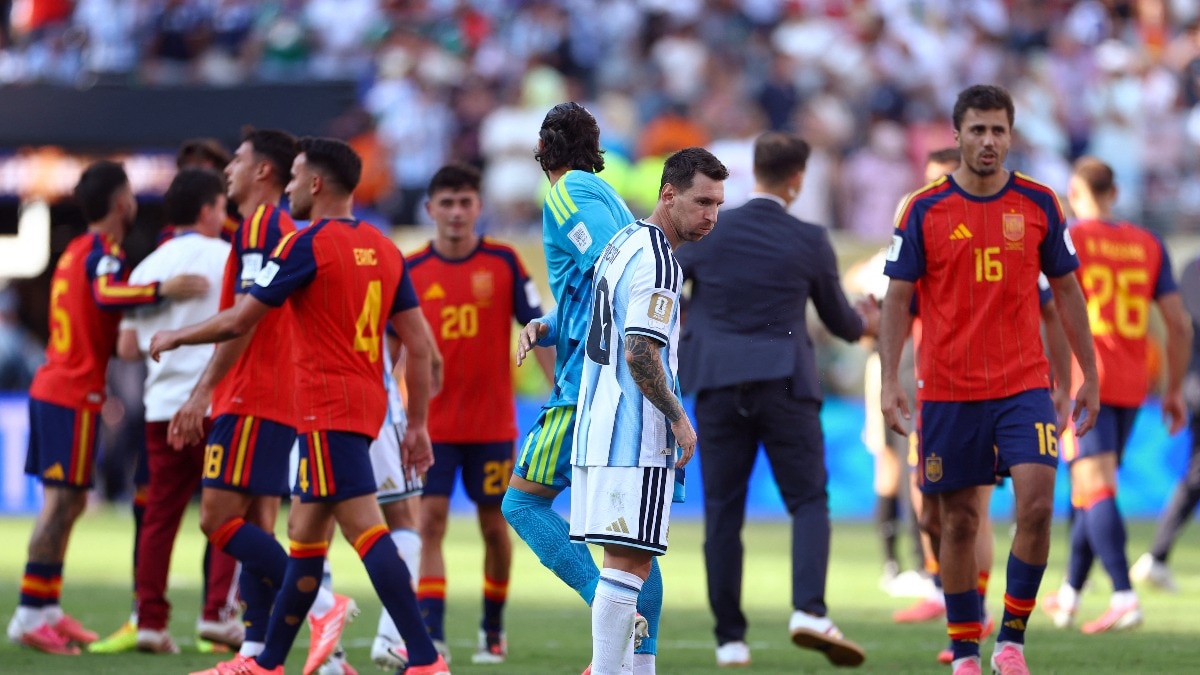
The FIFA World Cup is football's greatest carnival. For four weeks, it gives us everything: last-minute winners, giant killings, penalty shootout heartbreak and moments that live forever. Then comes the final. More often than not, football's biggest match becomes a game of survival. Flair gives way to caution, attacking intent takes a back seat and both teams spend more time trying not to lose than trying to win.Spain's 1-0 victory over Argentina in 2026 was the latest example. After a tournament packed with drama, the final was settled by a single extra-time goal from Ferran Torres against an Argentina side that barely threatened. Lionel Messi's dream of signing off with back-to-back World Cups ended not in a blaze of glory, but in a match that never quite reached the heights of the weeks that came before it.It is becoming a familiar pattern. The World Cup continues to produce unforgettable matches, but the final increasingly struggles to match the excitement of the tournament itself. Since 2002, four finals have gone to extra time, two have been decided on penalties and three have finished 1-0 after 120 minutes. Only France's 4-2 win over Croatia in 2018 and the extraordinary 2022 final between Argentina and France bucked the trend. More often than not, the last match has become a battle of nerves, where avoiding the decisive mistake matters more than producing the decisive moment.Also Read: Did Rodri deserve Golden Ball over Lionel Messi? It is not difficult to see why. By the time two teams reach a World Cup final, there are no secrets left. Every passing move has been studied, every weakness exposed and every set piece rehearsed. The closer the trophy gets, the harder it becomes to take risks. One careless pass or one lapse in concentration can undo a month's work.That is what made the 2022 final so extraordinary. Argentina looked certain to lift the trophy before Kylian Mbappe scored twice in 97 seconds to drag France back into the contest. Lionel Messi restored Argentina's lead in extra time, only for Mbappe to complete his hat-trick and force penalties. It was chaotic, unpredictable and breathtaking from start to finish, breaking almost every trend that had defined World Cup finals over the previous two decades. To understand how that trend has evolved, it is worth revisiting every World Cup final of this century.2002: Brazil 2-0 Germany (Yokohama) Ronaldo scored twice in the final against Germany (Reuters Photo) One of the few finals this century that's remembered for football rather than for caution.Four years after the illness that overshadowed his 1998 final, Ronaldo completed one of the game's great redemption stories, scoring both goals as Brazil lifted a record fifth World Cup. Germany had ridden Oliver Kahn's brilliance all the way to Yokohama, but there was no containing a Brazil side built around Ronaldo, Rivaldo and Ronaldinho. A fitting finish for the tournament's most watchable team.2006: Italy 1-1 France (Italy won 5-3 on penalties, Berlin) Marco Matterazi of Italy with the World Cup (Reuters Photo) This one will always be remembered for a single moment. Zinedine Zidane's headbutt on Marco Materazzi, in the very last match of his career, is one of the defining images in World Cup history. Before that, Zidane had given France the lead with an outrageous chipped penalty, only for Materazzi to equalise with a towering header. Neither side found a winner in the two hours that followed, and Italy held their nerve in the shootout to lift a fourth World Cup while Italian football was still picking through the wreckage of the Calciopoli scandal.2010: Spain 1-0 Netherlands, after extra time (Johannesburg) Andres Iniesta lifts the World Cup in 2010 (Reuters Photo) Few finals have captured the tension of the occasion quite like this one, and for all the wrong reasons, some would say. The football was scrappy, the tackling reckless, and referee Howard Webb dished out a then World Cup record of 14 yellow cards before sending off Netherlands defender John Heitinga in extra time. Nigel de Jong somehow avoided a red card for planting his boot into Xabi Alonso's chest, a decision people are still arguing about today. The breakthrough finally came in the 116th minute, when Andres Iniesta collected Cesc Fabregas' pass and drilled it beyond Maarten Stekelenburg to hand Spain their first World Cup. Not a classic by any stretch, but it never lacked for tension.2014: Germany 1-0 Argentina, after extra time (Rio de Janeiro) Lionel Messi lost the first World Cup final he featured in (Reuters Photo) Four years on, and much the same story. Argentina had the better of the chances in normal time. Gonzalo Higuain dragged one wide when clean through, and Messi curled another just past the far post early in the second half. Germany stayed patient and got their moment eventually. Andre Schurrle's cross was cushioned beautifully on the chest by Mario Gotze, who volleyed home in the 113th minute to beat Sergio Romero. Germany became the first European side to win a World Cup in the Americas, in a tournament remembered just as much for the 7-1 mauling of Brazil as for the final itself.2018: France 4-2 Croatia (Moscow) France's Antoine Griezmann, Paul Pogba and Kylian Mbappe (Reuters Photo) Finally, a final that actually came alive. France went ahead through Mario Mandzukic's own goal, before Ivan Perisic levelled with a fine finish. Antoine Griezmann restored France's lead from the spot after VAR ruled Perisic had handled, and Paul Pogba and Kylian Mbappe then put daylight between the sides before Mandzukic punished a Hugo Lloris blunder to pull one back. Croatia had no way back after that, but the match remains the highest-scoring final since 1966 and one of the most entertaining of the modern era.2022: Argentina 3-3 France (Argentina won 4-2 on penalties, Lusail) Then came the final that tore up the script completely. For the best part of 80 minutes, Argentina were in total control. Messi and Angel Di Maria had them 2-0 up, and France looked out of ideas. Then Kylian Mbappe turned the whole thing on its head. Two goals in 97 seconds dragged France level and forced extra time. Messi thought he'd won it with a 108th-minute strike, only for Mbappe to complete his hat-trick from the penalty spot. Gonzalo Montiel eventually held his nerve in the shootout to hand Argentina a third World Cup, in what many regard as the greatest final the tournament has ever produced. Maybe that's exactly why it stands alone.2026: Spain 1-0 Argentina, after extra time (New Jersey)If Qatar was football at its most chaotic, 2026 dragged things firmly back to boring normal. Spain were in charge from almost the first whistle: well over 60 per cent possession, nearly double Argentina's passes, and a 20-2 advantage in shots by the end. And still it took 106 minutes to find a way through. Ferran Torres eventually got the goal, poking home from close range after yet another spell of Spanish pressure. Emiliano Martnez had kept Argentina in it with save after save, but even he couldn't hold out forever. Argentina, down to ten men after Enzo Fernandez's second yellow, didn't manage a single shot on target all night. Messi, playing what's expected to be his last World Cup match, found precious little room and even less opportunity to change the game. Spain were worthy winners, but the scoreline told a familiar story. Another final decided by a single goal. Another one dragged into extra time before the smallest of moments split the two sides.WHY THIS TREND?Spain's win over Argentina didn't feel unusual. If anything, it felt familiar. The World Cup still gives us four weeks of stunning goals, shock results and unforgettable moments, but once the final arrives, the game often changes. The stakes become so high that both teams stop thinking about putting on a show and start thinking only about lifting the trophy.The trend is difficult to ignore. Four of the last eight World Cup finals have gone beyond 90 minutes, two have been decided on penalties and three have ended 1-0 after extra time. Since 2002, only two finals have truly delivered goals from start to finish: France's 4-2 victory over Croatia in 2018 and Argentina's unforgettable penalty shootout win over France after a 3-3 draw in 2022. Every other final has been a tense, low-scoring affair where chances have come at a premium.Spain's victory over Argentina in 2026 fitted that pattern perfectly. Luis de la Fuente's side dominated from the opening whistle, finishing with 20 shots to Argentina's two, 65 per cent possession and an expected goals (xG) figure of 1.94 compared with Argentina's 0.22. The defending champions failed to register a single shot on target, yet Spain still had to wait until extra time before Ferran Torres finally broke the deadlock. The scoreline suggested a close contest. The match itself told a different story.Caution, however, has never stopped World Cup finals from producing unforgettable moments. Zidane's headbutt in Berlin, Iniesta's winner in Johannesburg, Gotze's chest and volley at the Maracana and Lionel Messi finally lifting the trophy in Lusail are all woven into football history. They stand out because they arrived in matches where every meaningful moment carried enormous weight. When chances are scarce, one piece of brilliance or one lapse in concentration becomes unforgettable. That is what made the 2022 final so extraordinary. Argentina looked certain to lift the trophy before Kylian Mbappe scored twice in 97 seconds to drag France back into the contest. Messi restored Argentina's lead in extra time, only for Mbappe to complete his hat-trick and force penalties. It was chaotic, unpredictable and breathtaking from start to finish. More importantly, it broke almost every trend that had defined World Cup finals for the previous two decades.Perhaps that is the real answer. World Cup finals have not necessarily become boring. They have become contests where winning matters far more than entertaining. Modern football rewards organisation, discipline and control, and nowhere are those qualities more important than in the biggest match of them all.The irony is that the World Cup itself has rarely been more entertaining. Every tournament produces new heroes, unforgettable upsets and matches that are remembered for generations. Yet when only two teams remain, the game almost always slows down. The fear of losing begins to outweigh the desire to entertain.Spain's victory over Argentina in 2026 did not start that trend, nor will it end it. It simply became the latest reminder that the World Cup's greatest drama is often found on the road to the final. By the time the trophy is within touching distance, football's biggest occasion usually becomes its most cautious.And perhaps that is the price of greatness. The World Cup final is not designed to entertain neutrals. It exists to crown a champion.FIFA World Cup | FIFA World Cup Schedule | FIFA World Cup Points Table | Football News - EndsPublished By: Akshay RameshPublished On: Jul 21, 2026 08:40 IST
Have FIFA World Cup finals become boring this century?
Full Article
Original Source
Read the full article at Indiatoday →KhanList aggregates and links to publicly available news content. We do not host full articles from third-party sources. Always verify important information with original sources.