
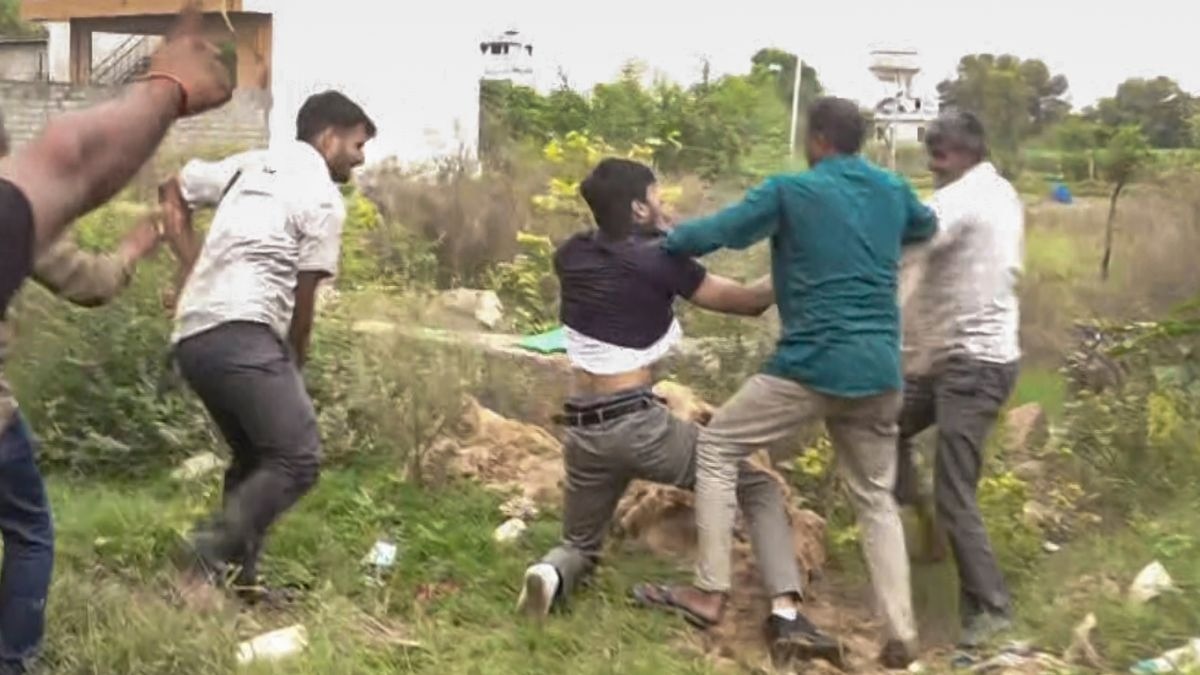
The face-off in Rampura-Kanwarpura village highlights both the CJP's ability to turn a rural grievance into a potent issue and the BJP's anxiety over its new challengerRampura-Kanwarpura in Jaipur district of Rajasthan is a village of about 700 voters, with a predominantly Brahmin population and largely loyal to the ruling BJP. It falls in Bagru assembly constituency, represented since 2023 by Kailash Chand Verma.The 41-year-old Verma first won the seat in 2013, but lost it in 2018. He is a well-educated politician, holding a doctorate in social sciences from the University of Rajasthan.On August 21, Rampura-Kanwarpura was sucked into a media frenzy when the Cockroach Janata Party (CJP) announced that its co-founder and spokesperson Ashutosh Ranka would visit the government school in the village. The tour was billed as part of the CJP’s School Thik Karo campaign, under which the fledgling outfit has called upon activists and the public at large to video-document the condition of village schools in order to hold governments accountable.Rampura-Kanwarpura rests on the boundary of Jaipur Development Authority limits, with a high-rise apartment overlooking some urbanised houses. Yet, many streets have no pucca roads and sewage flows into the open. The village is also home to bowler Ashok Sharma, who made his Indian Premier League (IPL) debut in 2026, claimed a villager. Another villager—an elderly man—insisted that the INDIA TODAY team have tea at his home. A young woman, who had just cleared the CA foundation course, offered the tea. She had completed her bachelor’s degree in commerce from the University Maharani College, travelling by bus for an hour each way from the village to Jaipur and back.The woman appeared to have little interest in why tempers were running high outside her house, located opposite a temple built by villagers. Rs 1.25 crore had reportedly been spent on it. The temple stands between a dilapidated primary school—declared unsafe a year ago—and a makeshift school space provided by Lal Chand Sharma, a farmer who owns two bighas of land and has shifted his livestock to accommodate the students.“If we can build this temple, we do have money left and can donate more to build a new school too,” said a young man, visibly upset over the CJP visit. He remarked: “We do not want any outsider to come here for publicity. We only want the government to fulfil its obligation. Some money has already been sanctioned for repairing and rebuilding the school.”Several villagers had already declared they would not allow the CJP into the area around the school. Some suggested blocking their arrival with tractor-trolleys. Others advised the media to park their cars at a distance in case matters led to any physical confrontation between the villagers and those who had come to document the school.Then the CJP activists arrived, outnumbering the locals who stood to confront them. A local mocked them as “cockroaches”, verbal exchanges followed and then fisticuffs. Someone snatched the mobile phone of Rekha Sharma, a CJP activist, and broke it. She was accompanied by another woman, Shivani Sharma, who said she was an engineer. Locals gathered village women, who escorted these two activists to a safer adjoining area.Several vehicles were targeted. The windscreens of at least 12 vehicles, including an SUV in which some CJP activists had arrived, were smashed with lathis and stones. “I broke four,” claimed one man, showing his bleeding arm.Most activists fled quickly. The agitating locals appear to have been sounded out to resist the entry of CJP activists to the school. A police vehicle and some state intelligence personnel were present at the scene.The 40-year-old school, built on land donated by villagers, has been in poor shape for about five years, with locals themselves undertaking repairs from time to time. In fact, it is estimated that more than 80,000 of the roughly 650,000 schoolrooms in Rajasthan are unsafe while about 1 per cent of the nearly 65,000 schools do not have buildings at all.In Rajasthan, primary schools functioning in sheds or from makeshift spaces is not unusual. Providing children some education closer to home is often considered more important by parents than waiting for a proper building to come up. But the seriousness of the problem became evident last year when a room that had undergone repairs collapsed, killing seven students. It happened in Jhalawar, the assembly constituency of former chief minister Vasundhara Raje.Rains last year led to more collapses and injuries, prompting the Rajasthan High Court to order a survey. The survey brought out shocking figures on the potentially life-threatening conditions in which children in Rajasthan were attending government schooling.The problem has been highlighted by the media for years now. Officials offer an explanation: the Right to Education Act made schooling free and ended the building development funds that schools would use for repairs. Schools now receive just Rs 10,000 a year, an amount insufficient to even keep playgrounds clean.It is a classic case of policymakers failing to understand the grassroots implications of decisions. Yet, the state government too has failed to provide adequate funds for maintaining existing buildings and constructing new ones.Critics argue that it should not have been impossible to provide the roughly Rs 6,000 crore estimated last year to repair and rebuild schools in Rajasthan. The previous Congress government courted criticism for creating expensive showcase projects, including the Rs 1,500 crore Kota riverfront, besides the thousands of crores spent on massive statues and sculptures, road underpasses and buildings that have not always been put to use.Clearly, the priorities have shifted from focusing spending on basic amenities, such as schools, public transport, village and city roads, drains and healthcare. The CJP campaign has shown that social media can bring traction to such basic issues. Is that why the education department had rushed new boards and other material to the Rampura-Kanwarpura school early morning on August 21?By afternoon, education officials had arrived and shifted the school to a better building in the village within a few hours. Later, CJP members alleged that the local police did not provided personnel to facilitate their movement to the school. The police countered that the CJP had neither sought security nor permission for the visit. Eventually, both the CJP and protesting villagers filed police complaints against one another.After the Rampura-Kanwarpura school was declared unsafe, the government had wanted the students to shift to a school 3.5 km away in Beelwa. Not many children could travel that far, so the makeshift space in the former cattle shelter was provided. The number of students subsequently fell sharply.The political context of the CJP campaign has heightened tensions. Rajasthan is scheduled to hold local body elections next month, followed by panchayat elections. BJP workers and some villagers fear CJP activists were using the school issue to establish a foothold and emerge as political rivals.Yet, the entire village was neither opposed to CJP nor supportive of the government. Several villagers quietly said that because of the condition of he school, they had lost their polling booth. Some accused the government of turning a blind eye to their problems.One villager questioned MLA Verma’s claim that he had provided Rs 12 lakh for school repairs and asked why posters claiming the work had been sanctioned were put up on the collapsing school building on the morning of August 21 when the money had actually been sanctioned by the collector.Was the clash on August 21 avoidable? While some CJP activists were shaken and tearful after what they described as severe beatings, the outfit did succeed in forcing the administration on the defensive. It all raises a political question: every time CJP activists are stopped, does the BJP risk inadvertently building up the outfit’s profile? For CJP, there is an equally important lesson: confrontation may generate attention, but it can inflict consequences that go far beyond immediate limelight. Subscribe to India Today Magazine- EndsPublished By: Akshita JollyPublished On: Aug 25, 2026 18:40 IST
Have CJP, BJP learnt their lessons from Rajasthan school clash?
Full Article
Original Source
Read the full article at Indiatoday →KhanList aggregates and links to publicly available news content. We do not host full articles from third-party sources. Always verify important information with original sources.