
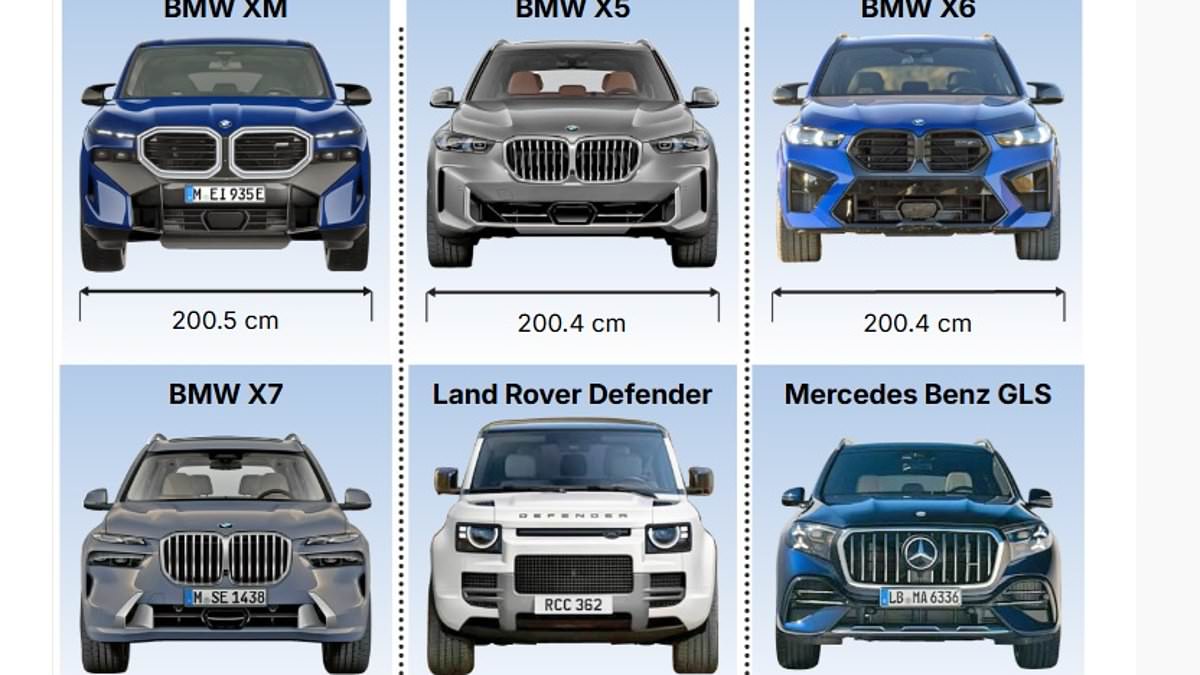
It's happened to every driver. You've parked in a supermarket bay with empty spaces on either side, but by the time you've returned with your shopping, your car is now flanked by two enormous SUVs. And there's simply not enough room to open your door.A recent YouGov poll found that three in five Britons now think SUVs are taking up too much space on our roads.And it's not likely to get better any time soon. Britain's appetite for SUVs has transformed the UK's car parc into a giant 4x4 playground, with the number of SUV models available surging by 543 per cent between 2000 and 2025, according to market research by CarGurus.Some of the biggest are two metres wide, leaving just 20cm either side in a typical parking bay in Britain. But it's not just drivers' obsession with SUVs that's creating this squeeze. Even superminis, some of the smallest motors on the road, are growing in size.Models such as the Volkswagen Polo are almost 20cm wider today than they were in the 1970s, which coincidentally was the last decade in which rules were set for minimum parking-bay dimensions of 2.4 metres wide and 4.8 metres long.Campaigners have dubbed the phenomenon 'carspreading'. And the term has been officially recognised by Collins English Dictionary as 'the tendency of manufacturers to build cars that are longer, wider, and heavier'.It begs the question: are new cars now simply too fat for Britain? This is Money investigates... How fat is the average new car? The average new car on sale today occupies one square metre more space than a new motor sold in 2006, according to Vehicle Data Global (VDG).The same data shows the average vehicle footprint has increased by 12.3 per cent since 2006, rising from 7.67 square metres to 8.61 square metres.VDG found that the rate at which cars are growing in size has doubled over the last decade compared with the period between 2006 and 2016.And while the popularity of SUVs, which accounted for more than half of all car models on sale last year, receives most of the blame for what VDG calls 'the car growth phenomenon', it is not just larger vehicles that are getting bigger.Even superminis are becoming far less mini. Britain's best-selling small car, the Vauxhall Corsa, has grown from a footprint of 6.01 square metres in 1995 to 7.17 square metres in 2026.Similarly, the Volkswagen Golf family hatchback has seen its footprint increase by 12.4 per cent over the same period, expanding from 6.81 square metres in 1995 to 7.66 square metres in 2026.In 2024, green think tank Transport & Environment (T&E) analysed historical UK car-market data and found that the average new model becomes 1cm wider every two years. Then and now: Cars like the evergreen Range Rover have dramatically increased in scale. Today's luxury SUV (right) is a quarter of metre wider than the Seventies original (left) Why are new cars fatter? Three reasons... 1. Stricter crash-safety regulationsThe biggest factor behind the growth in vehicle size is undoubtedly safety and the drive to improve occupant protection.Modern cars require crumple zones, stronger structures, additional airbags and an ever-growing array of safety technology, all of which take up space.Manufacturers must build these features into their vehicles to comply with increasingly stringent regulations, meaning passenger cars of all types, not just SUVs, have expanded to accommodate them.2. The unstoppable rise of the SUVFor decades, 4x4s were seen as agricultural workhorses rather than status symbols.That began to change in 1970 with the launch of the original Range Rover, which combined luxury with genuine off-road capability and showed that such vehicles could be desirable as well as practical.Luxury brands including Lexus, BMW, Mercedes-Benz, Audi and Porsche soon followed suit, though SUVs largely remained the preserve of wealthier buyers.That changed dramatically around the turn of the century as America's love affair with SUVs began to influence motorists in Britain. Then, in 2006, the arrival of the Nissan Qashqai turned the SUV into a mainstream family car and a genuine alternative to the traditional hatchback.Fast forward almost two decades and more than one in three new vehicles joining Britain's roads today are SUVs or jacked-up 'crossovers', offering drivers a higher seating position, improved visibility and a greater sense of security.3. Car industry greedAs well as appealing to buyers' vanity, SUVs have become a major profit generator for manufacturers.While they are often marketed as premium products, the reality is that many two-wheel-drive SUVs are no larger than the hatchbacks on which they are based and frequently use the same engines and underpinnings. Their perceived status, however, allows car makers to charge substantially more.Take the Ford Puma, for example. Britain's best-selling new car for the past three years offers broadly similar practicality to the Fiesta, yet was priced around 10 to 15 per cent higher than its supermini sibling before the Fiesta was axed in 2023.Carspreading is causing a national parking crisis, according to experts. We take a closer look Fat cars are causing a 'parking crisis' While new motors are getting 1cm wider every two years, Britain's streets aren't. And that's creating significant headaches for drivers.In 2024, T&E found that more than half of all new cars sold the previous year were too wide for the average 1.8-metre roadside parking bay.VDG also discovered that four fewer vehicles can now be parked on a typical 200-metre residential street than two decades ago, with capacity falling from 94 vehicles in 2006 to 90 in 2026.The trend is forcing some residents to park further from their homes and contributing to what VDG describes as a growing 'parking crisis'.T&E has also predicted that Britain's towns and cities could see a 10 per cent reduction in roadside parking spaces by 2040 as vehicles continue to grow in size and 'oversized SUVs' become increasingly popular.London alone is forecast to lose around 100,000 parking spaces.As a result, the think tank has warned that expanding vehicle dimensions pose an 'unprecedented threat to urban space' that could 'eliminate vast numbers of parking spaces' over the next decade.'After 25 years of relentless growth, our streets are dominated by oversized SUVs that cities simply weren't designed for,' explained Anna Krajinska, T&E's UK director.'The result is a lose-lose: councils are forced to reshape streets around larger vehicles, sacrificing parking capacity, public space, and safety in the process.'This is a market failure. Without clear standards to limit car size and encourage right-sizing, carspreading will continue unchecked, and cities will keep paying the price.' London alone could lose 100,000 on-street parking spaces within 15 years if new vehicle sizes continue to grow at the same trajectory, T&E cautionsIt's not just public parking spaces that modern SUVs are struggling to fit into.Cars have become so large that many motorists no longer use their garages for their intended purpose.The average single household single garage measures 2.53 metres wide and 5.18 metres long, dimensions that are increasingly unsuitable for many of today's new cars.As a result, 37 per cent of motorists with a garage at home told insurer Churchill that they never use it to store a vehicle.For more than two-fifths of those surveyed, the reason was simple: their car is so large that there is barely enough room to open the doors once it's parked inside.The growing squeeze isn't just causing inconvenience. It's costing drivers money, too.A study by Skoda estimates that Britons spend around £1.5billion a year repairing vehicle damage caused in car parks.Much of the cost comes from paint touch-ups and minor dent repairs resulting from one car door striking another, as larger vehicles leave motorists with ever less room to manoeuvre in tight parking spaces. Vehicle Data Global found that 1 in 22 kerbside parking spaces are lost to longer cars It is believed that restrictions on vehicle sizes could save an estimated 2,500 lives by 2040Does Britain need bigger parking spaces?Britain faces a simple problem: parking-bay guidelines haven't changed for more than 50 years, while cars have continued to grow.The recommended size for a standard public parking bay remains 8ft (2.4m) wide and 16ft (4.8m) long, measurements introduced in the 1970s.However, the British Parking Association says these dimensions are 'neither minimum nor written in tablets of stone', meaning councils and car park operators are free to set their own bay sizes.But if local authorities, supermarkets and private car park companies decide to make spaces bigger, what would that mean for availability?To accommodate today's larger vehicles, the average parking bay would need to increase from 4.8m to 5m in length and from 2.4m to 2.6m in width.The trade-off could be significant. Car retailer Motorpoint estimates that 11 per cent of UK parking bays would need to be removed to create larger spaces.While bigger bays would make parking easier for owners of modern vehicles, they would also come at the cost of an estimated 1.3 million parking spaces nationwide.To put this into perspective, Bluewater shopping centre in Kent would see it's 13,000 available spaces decline by 1,430 to just 11,570. Meadowhall in Sheffield would have to remove 1,320 bays from its 12,000 parking-space facilities, while Westfield London would have to make do with 440 fewer bays in its current 4,000 allocation. Many motorists, however, appear willing to accept that compromise. Motorpoint's own resarch found that almost three-fifths (59 per cent) of the 2,000 drivers surveyed believe parking spaces are now too narrow for modern cars, while a quarter think car parks should be redesigned to make parking easier. HOW MANY PARKING SPACES WOULD MAJOR SHOPPING CENTRES LOSE IF BAY SIZES WERE INCREASED TO ACCOMODATE TODAY'S LARGER VEHICLES? Shopping Centre Location Number of parking spaces Number of parking spaces that could be lost Bluewater Kent 13,000 1,430 Meadowhall Sheffield 12,000 1,320 Metro Centre Gateshead 10,000 1,100 Trafford Centre Manchester 10,000 1,100 Lakeside Essex 9,415 1,035 Merry Hill Dudley 9,209 1,012 Westfield London London 4,000 440 Livingston Livingston 2,116 231 Source: Motorpoint 'Carspreading is putting lives at risk'Campaign group Clean Cities argues that the backlash against ever-larger cars is about far more than parking inconveniences. Safety, it says, is the real concern.The bigger cars become, the greater the danger to pedestrians and cyclists. Research by the Vias Institute found that people struck by larger vehicles while walking or cycling are significantly less likely to survive.Its analysis suggests pedestrians and cyclists are far more likely to be killed if they are hit by an SUV rather than a traditional hatchback or saloon.Research by the London School of Hygiene & Tropical Medicine (LSHTM) and Imperial College London found that vulnerable road users are 44 per cent more likely to die when struck by a 4x4-style vehicle than by a conventional car.More alarming still, the figure rises to 82 per cent for children, the researchers found.The LSHTM analysed data from more than 680,000 road collisions over a 35-year period, during which SUVs surged in popularity.A key factor behind the increased risk is the SUV's greater height. The taller front end means pedestrians and cyclists are struck higher on the body, increasing the likelihood of serious or fatal injuries.The report also noted that SUVs typically feature more upright grilles and squared-off bumpers. This blunter design makes a person more likely to be thrown forwards after impact, increasing the risk of being hit a second time or dragged beneath the vehicle. On behalf of T&E Loughborough University found that for a driver of a Land Rover Defender, the high bonnet blocks their view of children up to 4.5 years T&E's analysis of the new car market found that the average bonnet height of a passenger car sold in the UK has jumped from 77cm in 2010 to 84cm in 2024Caz Conneller, UK campaign manager at Clean Cities, says: 'Carspreading has serious implications for road safety and public space. If cars continue to grow at the current rate there could be 40 per cent more child pedestrian fatalities by 2040, as bigger, heavier cars do more damage in a crash.'A pressing concern is that drivers can't see young children over increasingly high-bonneted cars. This trend for larger cars is dangerously out of control.'Bigger cars aren’t just dangerous - they also cause more havoc on our roads by reducing parking spaces, worsening traffic and clogging up our narrow streets and country lanes.'We need to discourage ever bigger cars with fairer parking policies and stronger regulations on car-size and child-visibility.'It would be great to see the trend move to innovative medium-sized models that still meet family needs without posing risks to vulnerable road users.'The environmental impact of larger motorsLarger cars are not only taking up more space on Britain's roads, they're leaving a bigger environmental footprint, experts warn.A report from the International Energy Agency (IEA) believes SUVs were responsible for 'over 20 per cent of the growth in global energy-related CO2 emissions' in 2023.The agency made the stark claim that: 'If SUVs were a country, they would be the world's fifth largest emitter of CO2.'The report also warned that the shift towards larger, heavier and less fuel-efficient vehicles is increasing demand for energy and raw materials alike.'The trend towards heavier and less fuel-efficient cars increases energy demand, including oil and electricity use, as well as demand for basic metals and critical minerals needed for battery production.,' it said.'Over the course of 2022 and 2023, global oil consumption directly related to SUVs rose by a total of over 600,000 barrels per day, accounting for more than a quarter of the overall annual growth in oil demand,' the report added. If SUVs were a country, they would be the world's fifth largest emitter of carbon dioxide behind China, USA, India and Russia, the IEA says Parisians voted last year to muscle SUVs off the French capital's streets by making them three times more expensive to park, and called on London to follow suit Should the widest cars be taxed more? Ahead of John Healey's inaugural Autumn Budget last month, Tory MPs warned that the Chancellor was considering a new tax on larger vehicles following lobbying from T&E.Under the proposal, buyers of new SUVs, heavier saloons and larger hatchbacks would have faced an additional first-year Vehicle Excise Duty charge, commonly known as a showroom tax.T&E has called for a supplementary levy of £10 per kilogram above specified weight thresholds, set at 1,600kg for new petrol and diesel cars and 2,000kg for electric vehicles.Shadow Secretary of State for Transport Richard Holden told the Daily Mail in October that Labour could even take a vehicle's width into account when calculating any additional tax charge.In the end, however, the proposals failed to materialise.That said, some local authorities are already charging more for larger vehicles.Cardiff Council, for example, imposes a parking-permit surcharge on what it describes as 'oversized and highly polluting vehicles'. Drivers with cars weighing more than 2,400kg pay higher permit fees, while vehicles exceeding 3,500kg are not eligible for permits at all.Elsewhere in Europe, Paris has taken an even tougher approach. Parking charges for SUVs have been trebled as part of a wider effort to discourage their use in the French capital.London Mayor Sadiq Khan has welcomed the Paris policy and said he will monitor its effectiveness closely, fuelling speculation that a similar crackdown on larger vehicles could one day be considered in the capital.
Have cars become too fat for Britain's roads and parking spaces? We investigate the rise of 'carspreading'
Full Article
Original Source
Read the full article at Dailymail →KhanList aggregates and links to publicly available news content. We do not host full articles from third-party sources. Always verify important information with original sources.