
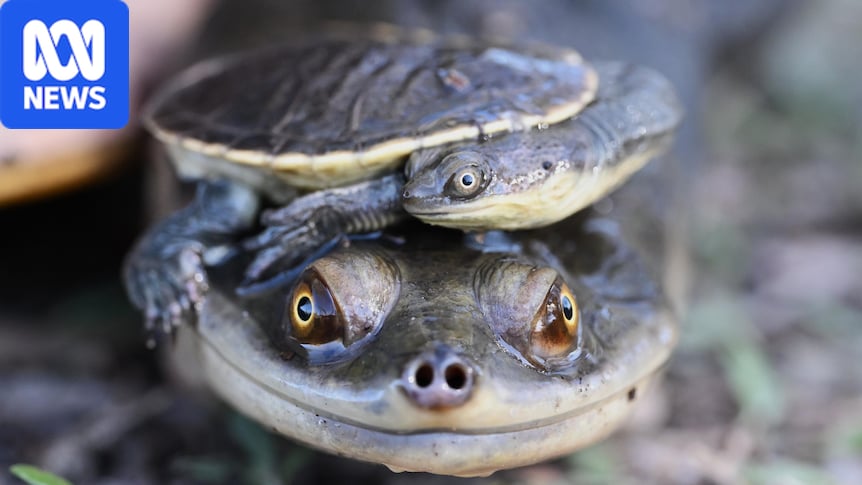
A reptile rescue program intended to give life to a million native turtles over 30 years is closing in on an early milestone.The 1 Million Turtles campaign, launched in 2021, has taken close to 40,000 records from citizen scientists of turtles in the wild across Australia.Meanwhile, more than 3,000 turtles have been rescued from roads and other hazards by community members over the first five years of the project.A further 2,468 turtle nests have been discovered and protected by volunteer citizen scientists.Turtles lay about 20 eggs each year, which has a cumulative effect over many years. (Supplied: 1 Million Turtles)Researchers managing the 1 Million Turtles program suggest the cumulative effect over the next quarter decade may be an additional million or so hatchlings that otherwise may not have been born."At last count, 3,082 turtles have been saved," La Trobe University associate professor in biology James Van Dyke said."If each of those saved turtles lived another 30 years, and half of those had 20 eggs each year, then that could be 900,000 eggs, or close to that million mark we talk about."You can also consider nearly 2,500 nests which have been protected as well so far."To put that into perspective, the average nest has 20 eggs, so that's about 50,000 eggs we've protected already."The rescue of individual turtles is a happy by-product of 1 Million Turtles. which is, at its heart, a research program.James Van Dyke is a co-founder of the 1 Million Turtles citizen science campaign. (Supplied: 1 Million Turtles)Turtle trackingThe program was established by Dr Van Dyke, Western Sydney University ecology emeritus professor Ricky Spencer and University of New England zoology associate professor Deb Bower, and tracks the whereabouts and conservation health of Australian inland turtles, particularly the broad-shelled turtle (Chelodina expansa), eastern long-necked turtle (Chelodina longicollis), and Murray River short-necked turtle (Emydura macquarii).Volunteers are invited to log their turtle discoveries on TurtleSAT, a mobile phone app and online tracking tool, allowing scientists to build a more accurate picture of turtle ecology.A screenshot of the TurtleSAT website showing turtle recordings across Australia. (Supplied: 1 Million Turtles)Most of this citizen science has occurred in Victoria, NSW and South Australia, with another hotspot in and around Perth and Albany."The number is about 38,000 records, which includes live turtles, dead turtles plus their nests," Dr Bower said.Turtle observations tend to be concentrated around adult turtles basking, crossing roads or nesting.Thousands of nests have been saved as part of the 1 Million Turtles project. (Supplied: 1 Million Turtles)Dr Van Dyke said there was a major knowledge gap during one of the most hazardous times in a turtle's life after they hatched.He said this was when they scrambled back into water and lived beneath the surface as "the missing years".They remained largely invisible until they started showing up in research traps at the age of about three years.To cover this gap, 1 Million Turtles has radio-tracked 50 hatchlings, a process that illustrated just how perilous this stage is for them, but also the vital role they play in the broader ecology."Most of those hatching turtles we've radio-tracked get eaten by native birds," Dr Van Dyke said."We know because we find transmitters under trees chewed up and effectively spat out."So, we know hatchlings need more protection, and we want to focus on that, but it also shows hatchlings are a very important food source for native birds like purple swan hens, herons and egrets, along with your ravens and magpies."The eastern long-necked turtle is the most commonly encountered turtle in south-eastern Australia. (Supplied: 1 Million Turtles)Turtle timeNovember is "turtle month" for researchers as adult turtles start to wander in search of new territories and places to lay their eggs.This year's wet spring across south-eastern Australia is especially encouraging, according to Dr Bower."The filling of wetlands is like a pulse of activity," she said."We call it the 'flood pulse concept', where there is a pulse in nutrients and organisms that drives the ecology."More water also means more habitat."A wet spring is great because the females need food and they need more nesting spots."Debbie Bower says a wetter spring means more habitat for native turtles. (Supplied: University of New England)November is also a time when turtles are most likely to stumble onto roads and need rescuing by helpful humans."We've got females coming out to nest this time of the year," Dr Van Dyke said."Most of the year they are swimming around in the water but, when they are full of eggs, they are going to come up on land, dig a hole, put their eggs in it, cover it up and head back into the water."Usually, they do that close to the water — that may be five to 10 metres … but sometimes they will go 100 metres or more."Occasionally, some of them are going to be moving from one wetland to another place, especially if their waterway is drying up."Three heroes in a half-shellThere are an estimated 25 native freshwater turtle species in Australia.While sometimes described as "tortoises" because they have feet rather than flippers, scientifically they are correctly described as turtles.Tortoises represent a separate group, which includes giant land reptiles such as the Galapagos tortoises.Dr Bower said the three most commonly encountered turtles in the Murray-Darling Basin were the eastern long-necked turtle, the broad-shelled turtle and Murray River short-necked turtle.Eastern long-necked turtle (Chelodina longicollis)The eastern long-necked turtle can easily be identified by its odour. (Supplied: 1 Million Turtles)The smallest of the three species, with a shell-length of up to 26cm, a neck that folds into the side of its shell and obvious black markings underneath.This is the one most known as the stinky turtle, having a pungent smell like rotten onion.There are two glands on the sides of their shell that excrete a stinky musk.Murray River short-necked turtle (Emydura macquarii)The Murray River short-necked turtle can resist attempts to help it. (Supplied: 1 Million Turtles)The most lively of the three, with a shell length of up to 36cm.They will actively try to wriggle out of your grasp if you try to help them.As the name suggests, these have the shortest neck of the three, but their necks are still longer than many North American turtles.Broad-shelled turtle (Chelodina expansa)The broad-shelled turtle is a vulnerable species. (Supplied: 1 Million Turtles)The largest of the Murray-Darling Basin turtles, growing up to 40cm (shell) in length.It also has a long, snake-like neck that folds into the side of its shell.The broad-shelled turtle is considered vulnerable in South Australia and threatened in Victoria.
Hatching a plan to ensure Australia's native turtles survive and thrive
Full Article
Original Source
Read the full article at Abc →KhanList aggregates and links to publicly available news content. We do not host full articles from third-party sources. Always verify important information with original sources.