
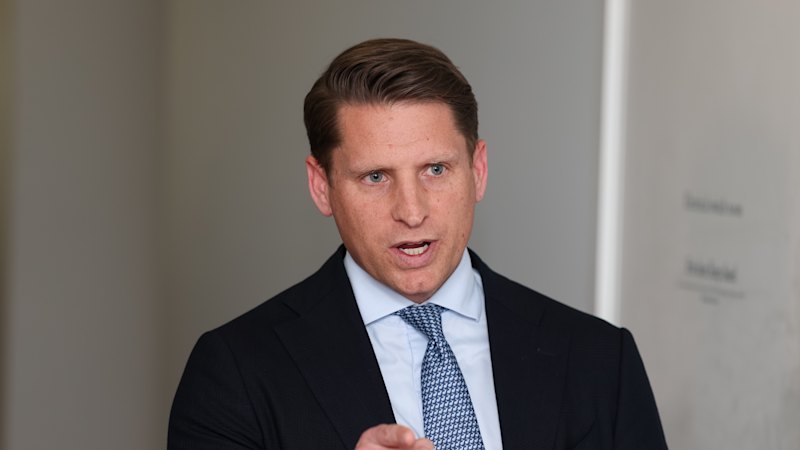
September 14, 2026 — 5:10pmOne of the world’s leading artificial intelligence companies has revealed it wants to train its models in Australia as Coalition frontbencher Andrew Hastie warns the nation will lose its sovereignty unless it makes a deal with the United States on the cutting-edge technology.Hastie called for Australia to harness the AUKUS defence pact to ensure it does not lose out in the AI arms race as fears continue to mount about the economic and social risks of the AI boom.Anthropic chief executive officer Dario Amodei called for AI firms to slow the development of the powerful technology in a dramatic intervention over the weekend, drawing support from fellow tech leaders Elon Musk and Sam Altman but pushback from US President Donald Trump.Andrew Hastie says Australia is losing out in the artificial intelligence “arms race”. Alex Ellinghausen“Without a sovereign AI frontier model here in Australia, we are going to be a supplicant state, not a sovereign state,” Hastie told a conference run by the Australian Strategic Policy Institute on Monday.“People think it’s making memes on ChatGPT. We’re talking about the global order being changed and Australia falling behind.”Hastie said there were two AI “arms races” under way in the world right now: a geopolitical struggle between the US and China, and one between the five American “hyperscalers” (companies with massive cloud computing and storage capacities).“Australia is not in the race,” he lamented.“We need to work on a way to get a hyperscaler Down Under, or multiple hyperscalers to invest in sovereign capability, the same way Ford and General Motors did 100 years ago.”Defence Minister Richard Marles travelled to San Francisco last month in a bid to attract major US AI companies and training infrastructure to Australia.Hastie argued that working with the US was “the pathway to sovereign AI” as he suggested this should be done through AUKUS, a pact more commonly associated with nuclear-powered submarines.Hastie said former prime minister Kevin Rudd was “exactly right” last week when he called for a new era of government intervention in key industries such as AI, biotechnology and high-end manufacturing.OpenAI vice president for global policy Ann O’Leary told the NSW conference the tech giant was “very eager to have a bigger and broader relationship” with Australia, including through training its models.“We are very interested in what this might look like in Australia,” O’Leary said, saying the company was in “deep” conversations with the Albanese government about tech policy.She said the recent revelation that one of the company’s artificial intelligence models broke out of its testing environment and hacked another company was a “wake-up call for the entire industry”.Assistant Technology Minister Andrew Charlton talked up the potential for Australia to generate a new era of prosperity by building as big a proportion of the world’s data centres in Australia and parlaying that into expertise and sovereign industry.He dismissed warnings from top AI executives that the sector needed to slow down, arguing the billionaires had “extremely strong financial incentives” to keep going.“I’m not in favour of leaving it to the companies and I’m not in favour of leaving it to the superpowers,” he said at the same conference.“I take that at face value, but I don’t think we should care very much about what individual executives say or what individual executives claim they want to happen. I think we should care about what is actually happening,” he said.Charlton noted that AI safety was on the agenda for this month’s meeting between US President Donald Trump and Chinese leader Xi Jinping, calling it “an incredibly consequential conversation”.Trump forcefully rejected calls for an AI slowdown ahead of his September 24 meeting with Xi, declaring: “Look, we’re leading China in AI … and, frankly, I want to keep it that way because whoever wins AI wins.“We can put up guardrails, we can do this and that, but I think you have a lot of negative forces that are bringing it up that shouldn’t be bringing it up, and they’re bringing up things that won’t happen.”Democratic senator Chris Coons called for Trump to put AI at the top of the agenda for his Xi meeting, comparing the need for co-operation on the technology to the nuclear arms negotiations that defined Cold War diplomacy.ASPI executive director Justin Bassi argued that any promises from Xi on AI should be treated with scepticism given he famously promised Barack Obama not to militarise the South China Sea before doing so.Cut through the noise of federal politics with news, views and expert analysis. Subscribers can sign up to our weekly Inside Politics newsletter.Matthew Knott is the foreign affairs and national security correspondent for The Sydney Morning Herald and The Age.Connect via X, Facebook or email.Paul Sakkal is Chief Political Correspondent. He previously covered Victorian politics and won a Walkley award and the 2025 Press Gallery Journalist of the Year. Contact him securely on Signal @paulsakkal.14.Connect via X or email.From our partners
Hastie: Australia is losing the AI ‘arms race’, risks becoming supplicant nation
Full Article
Original Source
Read the full article at Smh →KhanList aggregates and links to publicly available news content. We do not host full articles from third-party sources. Always verify important information with original sources.