
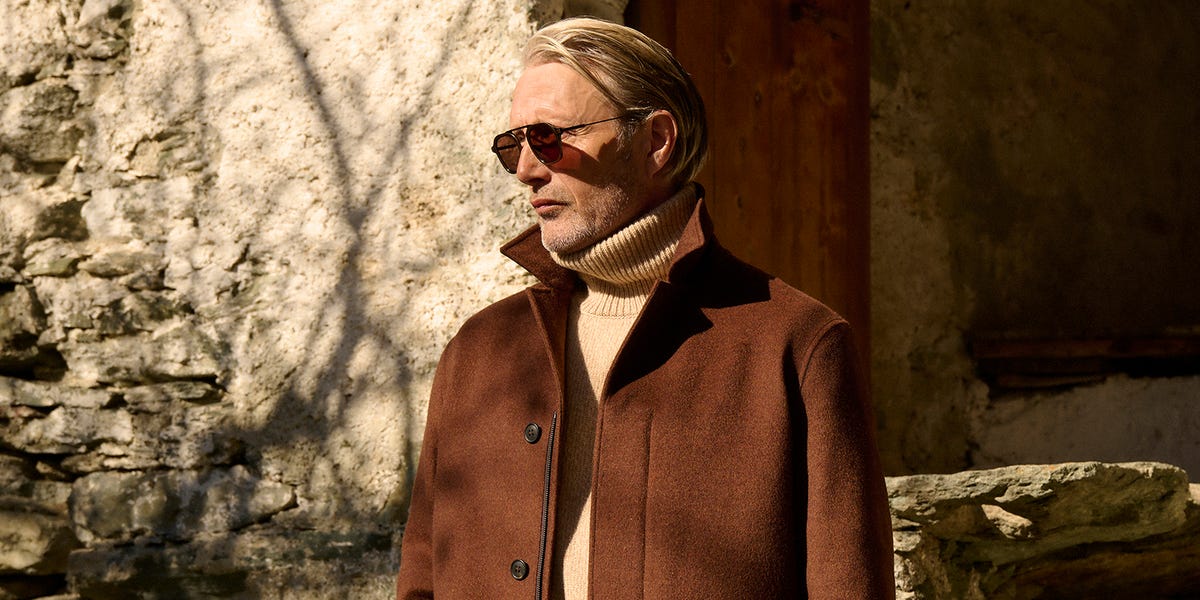
ZegnaPay attention to the world of menswear long enough, and you’ll notice that certain quandaries come up time and again. A favorite among traditionalists and avant-garde types alike is the fate of the suit. It’s been incorrectly declared dead enough times that the handwringing over its demise has largely shifted to questions of its evolving role in the modern guy’s wardrobe: Who wears a suit, and when, and why?According to Alessandro Sartori, the artistic director of Zegna for a little more than a decade now, there’s another question we should all be asking ourselves: What exactly is a suit these days?“Everything we do here is grounded in tailoring techniques and in tailoring fabrics,” Sartori tells me over Zoom from his home in Milan. “But I'm a big believer that a suit doesn't necessarily have to be a combination of the classic top and the classic bottom in the same fabric and color.” It can be comprised of those things, he stresses. But the “modern suit,” as he calls it, can also be an intentional pairing of a different kind of top—a chore coat, an overshirt—with a trouser with a different fabrication. The materials and colors should feel complementary and cohesive but needn’t be perfectly matched.ZegnaLead image and above: Mads Mikkelson wearing the Falcon jacket.“This is not only a way to give a new life to suiting,” he explains, “but to dress men differently—and, at the same time, keep the quality, the craft, and the beautiful fit that a tailored piece has.”The idea is to adapt classic techniques to the realities of getting dressed today. “Many fashion brands offer a nice quality, but is not the handmade quality that we do,” Sartori says. “And there are a lot of brands that are offering beautiful, beautiful quality, but they are quite classic.” Since he started in 2016, Sartori’s overarching project has been to populate the gulf between those two modes of production, making clothes that feel contemporary but are rooted in the top-tier fabrics and handwork that helped Zegna become the powerhouse of Italian fashion that it is today.The latest addition to Sartori’s lineup is a new jacket, the Falcon. It pays homage to the sort of utilitarian jackets Zegna founder Ermenegildo Zegna might have worn while walking the grounds of what is now the Oasi Zegna nature reserve in northern Italy, at the base of the Biellese Alps. (According to company lore, Ermenegildo imagined those walks as being accompanied by the flight of a falcon.)ZegnaZegna artistic director Alessandro Sartori.Sartori acknowledges that the use case, in 2026, might be a little different. “I don't think that people are necessarily using the jacket walking up in the mountains wherever they are,” he says. The Falcon is more about embracing a “sporty-chic attitude” whether you’re stomping around the country or the city and working within the modular framework that the designer has created at Zegna. You can mix and match it with other pieces—both old and new—from the brand, and you can wear it as part of a “modern suit” or on its own.The new design is cut from Zegna’s Oasi Cashmere for lightweight warmth, and Sartori calls it “a great addition to our vocabulary.” Buttoned patch pockets give you somewhere to stash your stuff, a bowling collar can be flipped up to shield against stiff winds, and an internal drawstring can be cinched at the midsection for a little extra protection against the cold. Ultimately, it’s a familiar-looking piece. But it’s exceptional in its construction and materials and its design—a streamlined take on the hunting jackets of yore—is as considered as how it’s made.Zegna“Long-lasting life is a key factor for what we're doing, and I don't mean only quality-wise,” Sartori says. “I also mean design-wise.”The designer, for his part, hopes that the Falcon—alongside other modern classics from the brand—will be the sort of thing that guys wear and reinterpret for years before passing it on to the next generation. And as the brand continues to grow and evolve alongside its customer base, one of his biggest aims is to ensure that each item he introduces remains relevant throughout its (ideally long) lifespan.“It’s like writing a book, and every season I add a chapter,” he says. “Because the story is going on, is moving, with our clients, our community of people, our brand, our family. So many layers are … I don’t want to say ready, but cooking. I see a bright future for the brand, following this principle of walking with our customers and building an indelible aesthetic. I like this approach.”
Has Zegna Cracked the Code to Modern Tailoring?
Full Article
Original Source
Read the full article at Esquire →KhanList aggregates and links to publicly available news content. We do not host full articles from third-party sources. Always verify important information with original sources.