
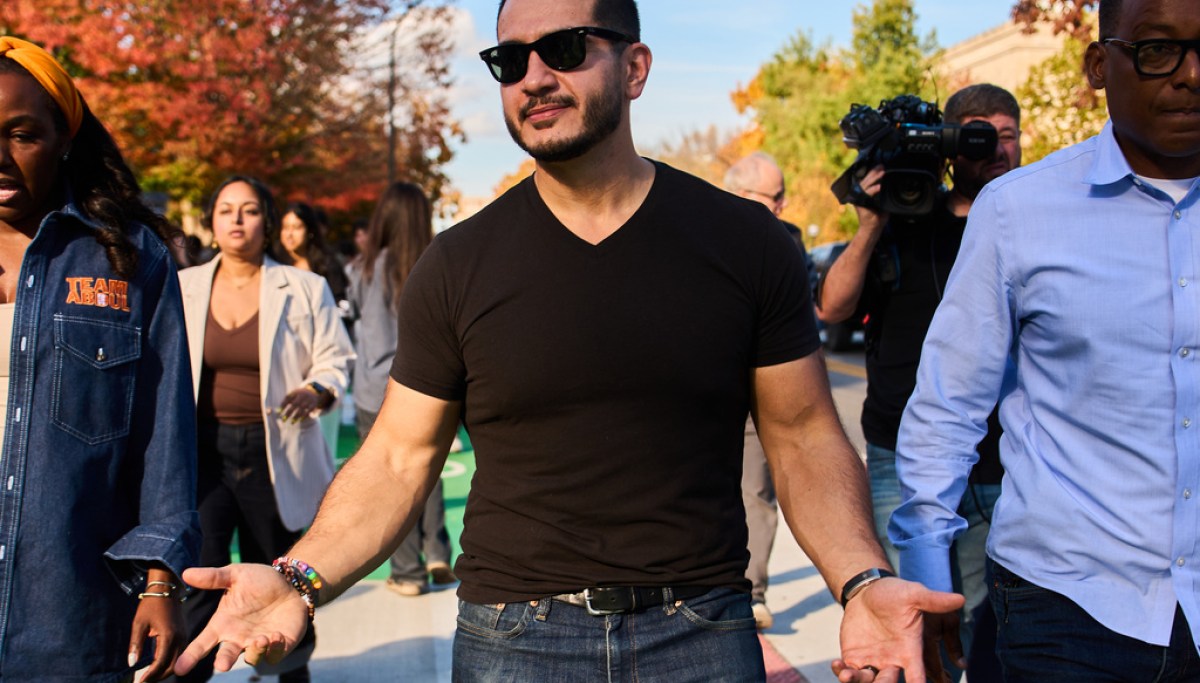
Ordinary Americans, politicians, and pundits alike continue to ponder the unexpected, even astonishing, 2026 midterm results. Among the most striking outcomes: a Texas Senate seat flipped blue by James Talarico, a seminarian who once stated, “God is nonbinary”; Michigan’s Senate seat secured by a pugnacious Abdul el Sayed, whose victory speech to Michiganders opened in Arabic and whose campaign kept deeply polarizing company; and a House seat won by CUNY graduate student Darializa Avila Chevalier, known for her explicit and vulgar anti-American rhetoric.It’s time to ask whether John F. Kennedy’s iconic call to civic duty — “Ask not what your country can do for you; ask what you can do for your country” — still has an audience among young people raised on grievance and entitlement.In the midterm elections, this more diverse generation flipped the Kennedy script, demanding instead what their government could do for them. Electorates chose candidates offering a tempting assortment of taxpayer-funded entitlements. Affordability crises were aggressively linked to capitalism by socialist candidates, while el Sayed audaciously tied high domestic grocery costs to foreign aid for Israel — messaging amplified by a Rebellion PAC advertisement that crossed the line into unabashed antisemitism. While high inflation, anti-war sentiment, and Trump fatigue have been blamed for this sweeping Democratic victory, an accurate postmortem requires digging deeper — straight into institutional transformations that began in the 1960s.As a college professor who has spent decades watching the internal machinery of higher education evolve, I have seen these ideological seeds being planted firsthand. Following the SDS anti-war protests of the 1960s, the revolutionary spirit disappeared “underground” — hidden in plain sight right inside our universities and the media. New generations of America’s best and brightest came of age in a multiethnic and multicultural nation quietly shaped by imported Marxist academics. They impregnated the social studies, even English departments, with brand new concepts explicitly critical of U.S. history, culture, and values. Meanwhile, the organizational structure of universities permitted one-sided “Studies” departments to exist in plain sight, operating right alongside traditional departments which, at least for a time, still hired faculty with diverse opinions.Then came the money trail. In the 1990s, and accelerating sharply in the first decade of the 21st century, universities seeking to augment their dwindling coffers welcomed foreign students primarily from the Middle East. These new entrants brought with them the narratives and the prejudices of their home countries, particularly toward the existence of Israel. More concerning, Qatar, the sole Gulf nation aligned with the Muslim Brotherhood, was allowed to inject billions into U.S. education. That funding played a critical role in embedding Muslim postcolonial narratives not only into universities, via the creation of Middle East departments, but also into K-12 school curricula.It did not take long for Marxist-inspired campus progressives to establish intersectional alliances with newly established chapters of Students for Justice in Palestine, an organization with an explicit political agenda folded in with traditional campus affinity groups. It was the brainchild of Hatem Bazian, who had co-founded American Muslims for Palestine, a group aligned with anti-Zionist, pro-Hamas positions.EVANGELICAL VOTERS LEFT THEIR DISCERNMENT IN 2022This convergence successfully fused domestic grievances with foreign agendas, standardizing an anti-Western, anti-Zionist orthodoxy among the student body. As these students graduated and entered the electorate, the radical theories cultivated on campus matured into an aggressive political reality. The Democratic Socialists of America, combining socialism with an explicit anti-Israel core is the result. Eight of its members won in the midterm elections.The torch has indeed passed to a new generation of Americans, but it is no longer the flame of Kennedy’s civic duty; it is a radical fire explicitly lit to consume the very foundations of the country they were asked to serve.Kim Ezra Shienbaum, Ph.D., is professor emerita of political science at Rutgers-Camden and author of several books including Beyond Jihad: Critical Voices From Inside Islam (contributing editor with Jamal Hasan, Academica Press, 2006).
Has the torch passed to a really new generation of Americans?
Full Article
Original Source
Read the full article at Washingtonexaminer →KhanList aggregates and links to publicly available news content. We do not host full articles from third-party sources. Always verify important information with original sources.