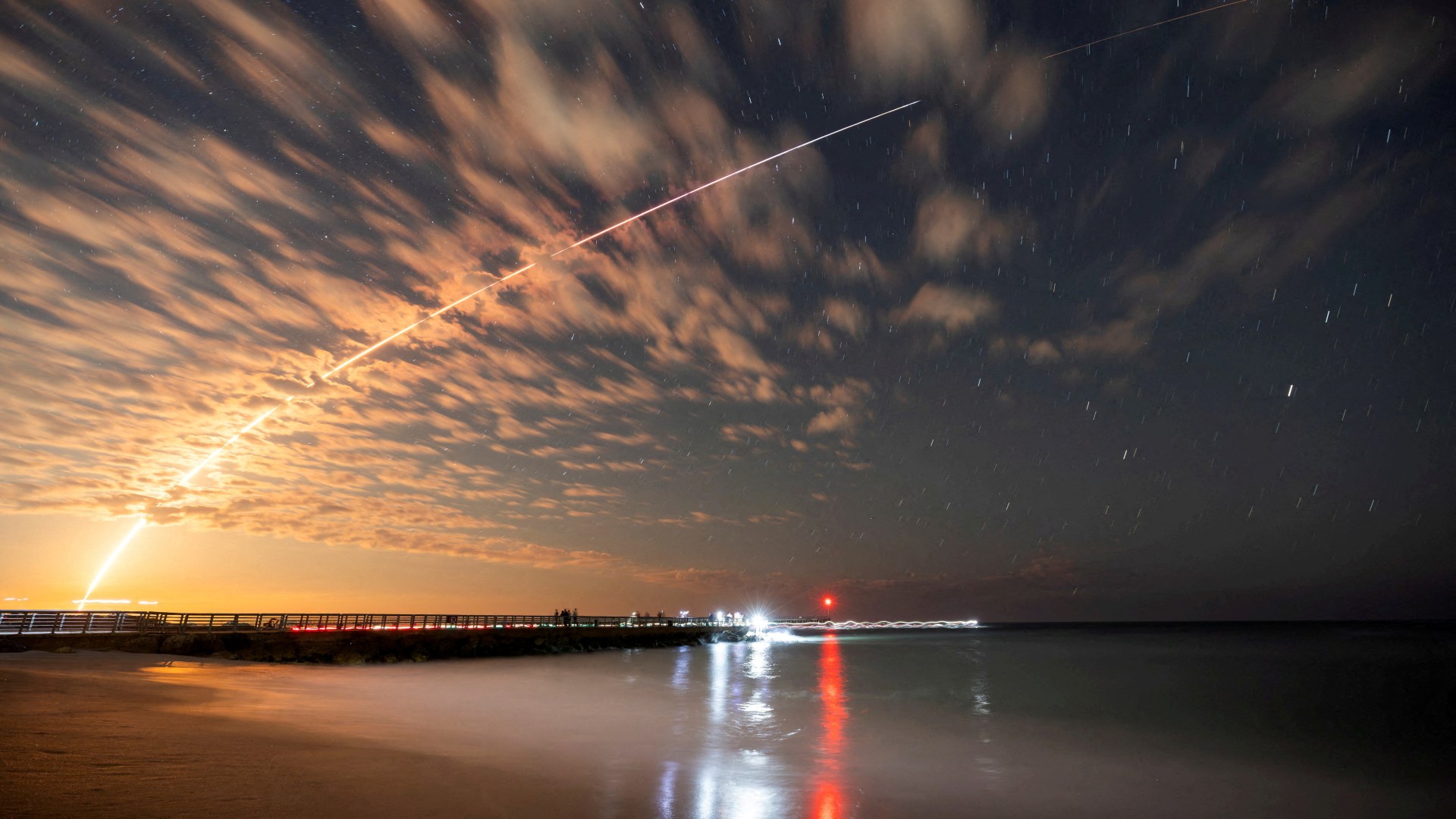
ALMOST four tonnes of SpaceX hardware has slammed into the lunar surface. A disused Falcon 9 rocket stage, which spent over a year drifting through space, “completed” its accidental mission on Wednesday, August 5. The Falcon 9 launched from Florida in January 2025 to send robotic landers to the Moon Credit: Reuters The impact will have created a fresh crater estimated to be roughly 90 feet (27 metres) wide Credit: Reuters Has the SpaceX rocket hit the Moon? The SpaceX rocket stage is expected to have hit the Moon at approximately 7.35am UK time on Wednesday, August 5. Measuring roughly the size of a school bus, the empty upper stage will have crashed into the lunar surface at 5,400mph – more than seven times the speed of sound. Sign up for The Sun newsletter Thank you! The collision is predicted to have occurred near the Einstein Crater, located on the far western edge (or “limb”) of the Moon. Upon impact, the energy will have created a fresh crater estimated to be roughly 90 feet (27 metres) wide and kicked up a cloud of lunar dust which could reach heights of up to 60 miles. Why did the Falcon 9 crash? The rocket did not crash due to a system failure, computer glitch, or explosion. Instead, it was simply abandoned space junk caught in a gravitational tug-of-war. In January 2025, the Falcon 9 launched from Florida to send commercial robotic landers to the Moon – Firefly Aerospace’s Blue Ghost-1 and ispace’s Resilience. While SpaceX famously recovers and reuses the bottom half (the first stage) of its rockets, the upper second stage is single-use. Most read in The Sun Because sending cargo to the Moon requires large amounts of energy, the second stage used up all its remaining fuel during the burn, leaving no propellant to guide it back into Earth‘s atmosphere to safely burn up. Left behind in a high-altitude orbit, the spent booster was left at the mercy of cosmic forces. Over 18 months, gravitational pulls from the Sun, Earth, and Moon slowly pushed the rogue booster onto a collision path. Can you see the crash site from Earth? You cannot see the crash site or the impact with the naked eye or standard binoculars. Even though the Moon is visible in the sky, a 90-foot crater is far too small to spot from 238,000 miles away without advanced scientific instruments. The collision also took place near the Einstein Crater on the Moon’s far western limb, a region that is extremely difficult to observe clearly from Earth due to the Moon’s angle. While professional observatories and astronomers with powerful telescopes may attempt to detect a faint dust plume lit by sunlight, standard backyard telescopes will not reveal the impact. There was also no fiery explosion, as the Moon lacks an atmosphere or oxygen to support combustion. As such, do not expect any images of the crash site to feature fire or smoke;. Will video or photos of the crash be released? Because there are no cameras stationed on the lunar surface, there was no live video of the crash. But clear photographic evidence of the new crater will eventually be released to the public. NASA and international space agencies are using lunar-orbiting satellites like NASA’s Lunar Reconnaissance Orbiter (LRO) and South Korea’s Danuri orbiter to track down the impact site. NASA’s Lunar Reconnaissance Orbiter (LRO), which circles the Moon, regularly maps the lunar terrain and will fly directly over the Einstein Crater region in the coming days. Scientists will compare “before and after” satellite images to locate the fresh crater, measure its precise dimensions, and study the displaced soil. NASA typically processes and releases these high-resolution images within a few days to a couple of weeks following an orbital flyover, once the raw data has been downloaded and processed. The findings will help researchers better understand lunar geology and assess the risks space debris poses to future Moon bases. Comment now
Has the SpaceX rocket hit the moon? Why the Falcon 9 crashed – and what will happen next
Full Article
Original Source
Read the full article at Thesun →KhanList aggregates and links to publicly available news content. We do not host full articles from third-party sources. Always verify important information with original sources.