
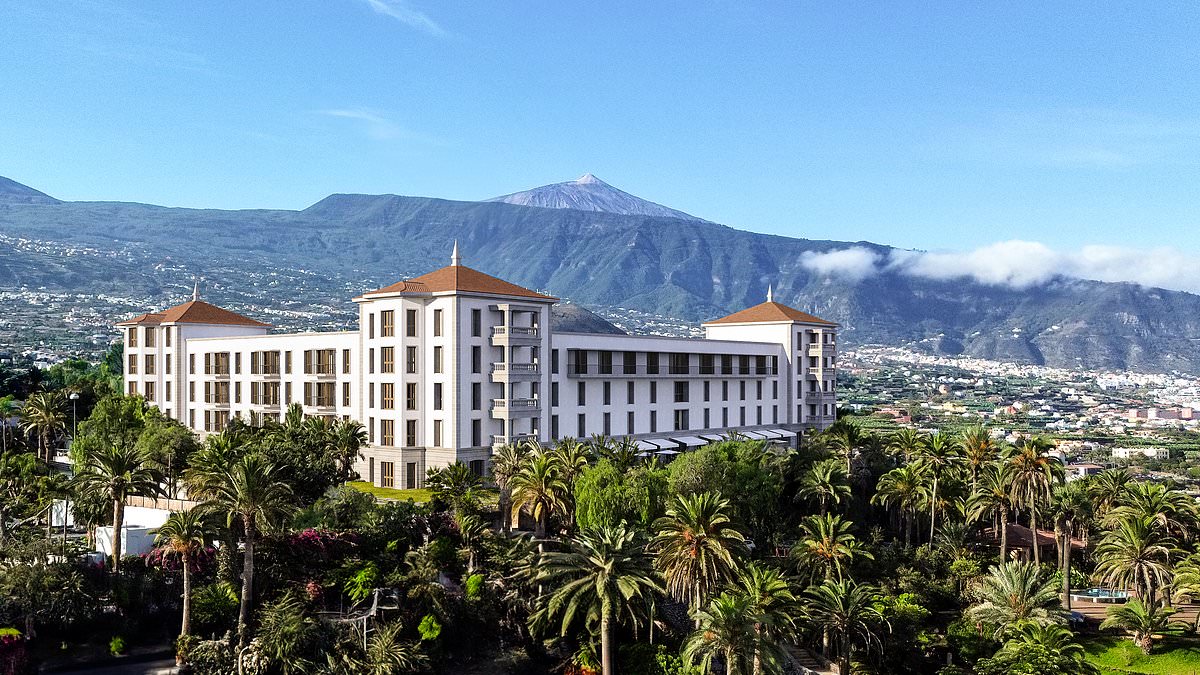
When Dame Agatha Christie checked in to the Gran Hotel Taoro on the northern coast of Tenerife in 1927, it was one of Spain's most upmarket hotels.Opened in 1890 and arguably the country's first luxury hotel, it had put Tenerife on the map and represented the epitome of travel's golden age – the haunt of European royalty and aristocracy, particularly popular with the British.Despite complaining the sand was too black, the sea too rough and the mountain mists depressing – she had been at a low ebb – Dame Agatha nevertheless found the setting inspiring.It was here she wrote the gripping short story The Man From The Sea, and is said to have dreamt up parts of her classic thriller The Mystery Of The Blue Train, featuring Hercule Poirot.And now Gran Hotel Taoro, after a 50-year closure and following a £44million restoration, is back: beautifully refurbished in minimalist style and removed from the coast's hurly-burly on its hilltop. There's a top-quality spa featuring fancy Anne Semonin products, plus three world-class restaurants including Oka by Ricardo Sanz (with Japanese-Mediterranean cuisine and two Michelin stars) and Lava by Erlantz Gorostiza (with local specialities and two Michelin stars). Dame Agatha Christie stayed at Tenerife's Gran Hotel Taoro, one of the country's first luxury hotels, in 1927 The establishment has reopened after a 50-year closure and £44million restorationMeanwhile, the hotel honours Dame Agatha's memory with a reading room soon to be filled with all her works.Previously, the curiously Thai-themed Hotel Botanico had reigned supreme on the north coast, welcoming guests from Bill Clinton and the late Queen Sirikit of Thailand to Michael Jackson and Sylvester Stallone. This elegant setting is the seat of the renowned classical music festival featuring nightly chamber concerts organised by Kirker Holidays.Tenerife, if you know where to look, is turning posher than ever. And the northern hinterland, away from the beaches, is lovely to explore, especially if you make the Gran Hotel Taoro and Hotel Botanico your bases in Puerto de la Cruz (as I do).I make a beeline for the historic centre of Icod de los Vinos, in view of snow-capped Mount Teide, the highest in Spain (12,000ft). The backdrop is pine-clad hills, while fertile terraces planted with banana trees and vines – from which the town takes its name – descend to volcanic rock and black sand beaches.At Plaza de la Pila, locals gossip over morning coffees, with grand 16th-century buildings all around, set on steep, narrow cobbled streets. The imposing facade of St Mark's Church rises to one side, as does a famous 800-year-old dragon tree.Icod de los Vinos is typical of Tenerife's colonial architecture, built after Spain's defeat of the indigenous Guanches in 1496. Although less than 20 miles away, it's a world apart from the golden beaches of imported Sahara sand and the concrete jungle of hotels that scar the island's south-west coast.In the town of La Orotava, manorial houses with stone coats of arms bear witness to the number of Spanish noble families who moved to Tenerife after the conquest by the kingdom of Castile – houses with doors and windows framed with massive carved basalt, and wooden balconies that, my guide Yolanda tells me, were considered status symbols.Churches in La Orotava abound – such as the extraordinary Iglesia de la Concepcion, whose Baroque airy-fairyness is grounded by the ballast of its dark volcanic stone, and adorned with gargoyles. Tenerife, according to Teresa Levonian Cole, 'is turning posher than ever'Grander still is San Cristobal de La Laguna, Tenerife's first capital, 20 miles north-east of Puerto de la Cruz. It's a Unesco World Heritage Site, whose grid system served as a template for Spain's colonial cities in South America – and I am surprised to find screened balconies characteristic of Moorish architecture on old convent walls.Walking through cobbled streets and entering balconied courtyards with towering palm trees, you might be in Andalusia.As we drive up into the mountainous interior, Dame Agatha Christie-style mists descend – not depressing, but mysterious. Pine forests flash past. Then, suddenly, the mists disappear and we are above the 'sea of cloud' that blankets the base of Mount Teide. I could happily spend days in the flora and fauna of the Mount Teide National Park and Tenerife's mountain villages. Masca is one such, reached up a single, tortuous lane to 2,000ft. Not for the faint-hearted, but what views!This remote village, perched perilously on a bluff, is surrounded by canyons and the dramatic crags of the Teno mountains. But now it's lunchtime. We descend into the Orotava Valley to a traditional guachinche (Tenerife bistro) for a delicious meal of grilled goat's cheese and octopus served with famous local 'black' potatoes.Quite a contrast from the refined gourmet food of Oka, where dinner awaits back at Gran Hotel Taoro, but just as delightful.
Has Tenerife gone...posh? With swish hotels, gourmet dining and classical music festivals, this popular Canary Island is shedding its reputation as a budget stop for boozing Brits abroad
Full Article
Original Source
Read the full article at Dailymail →KhanList aggregates and links to publicly available news content. We do not host full articles from third-party sources. Always verify important information with original sources.