
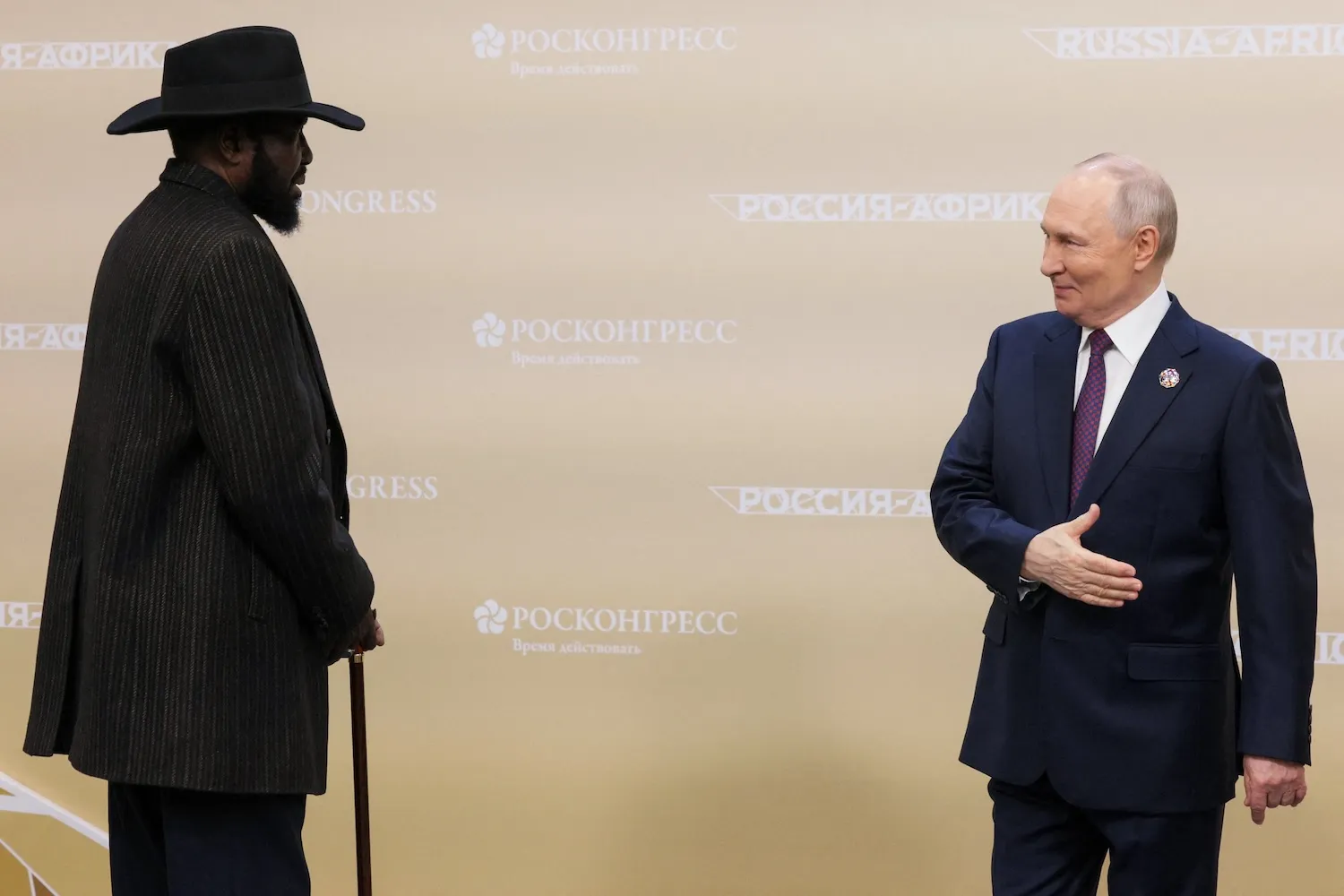
Welcome to Foreign Policy’s Africa Brief. The highlights this week: The third Russia-Africa Summit kicks off in Moscow, fighting breaks out in Ethiopia’s Oromia region, and another East African opposition figure goes missing in Kenya. Only around 22 African leaders are slated to attend the third Russia-Africa Summit in Moscow that began on Wednesday as their citizens demand more action on forced recruitment into Russia’s war in Ukraine. Around 3,000 African nationals from countries such as Kenya, Ghana, and South Africa are estimated to be fighting on the front lines for Russia, often in the most dangerous combat positions. Although some enlisted willingly, many flew to Russia on the promise of civilian jobs in factories or hospitality before being pushed onto the battlefield as “cannon fodder.” The two-day Russia-Africa Summit aims to strengthen trade, energy, and security ties with African nations as Russia seeks to avert the impact of European sanctions. “We are witnessing a multipolar world becoming a reality, a trend that is both objective and irreversible,” Russian President Vladimir Putin said at the opening ceremony. Yet high-level attendance has fallen precipitously since the first summit in 2019, which drew 43 African heads of state. That number dropped to just 17 in 2023 following Russia’s invasion of Ukraine. By comparison, more than 50 attended the last China-Africa summit in 2024. Although Russia has increased engagement across Africa in recent years, its role has largely been limited to a security guarantor, particularly in the Sahel and nations elsewhere dealing with armed conflict, such as Sudan. And low participation in the summit suggests that Russia’s influence across the continent has become increasingly controversial. Notably, the heads of state of the continent’s biggest economies—including South Africa, Nigeria, and Algeria, which is Russia’s biggest African arms buyer—are not attending, though they have sent other officials to lead their delegations, likely in an effort to attract investment. Public backlash against the recruitment of Africans as war fodder has influenced this trend. Other factors include Moscow’s lack of meaningful investment in African countries. Russia’s bilateral trade with Africa reached just over $27 billion last year, compared with $93 billion in India-Africa trade and $348 billion in China-Africa trade. Effectively, African leaders are looking for more than just talk when it comes to investment in the continent. An opinion column in the Nigerian Guardian noted on Tuesday that Moscow has not delivered on many of the investments it pledged nearly a decade ago, including Russian-built nuclear plants. “Security means little when young Nigerians are lured abroad and end up on a frontline they never chose,” another op-ed in Nigerian newspaper Vanguard reads. “Before Nigeria shakes hands and signs papers, Nigerians deserve to know one thing. Will our young people be safe?” Some prominent African leaders are still attending the summit. One notable example is Egyptian President Abdel Fattah al-Sisi. Cairo accounts for one-third of Moscow’s total trade with the African continent, valued at around $10 billion, much of which comes from wheat imports from Russia. Talks between the two nations on the summit’s sidelines are expected to cover not just agriculture, but also energy investments and plans to implement a Russian industrial zone near Egypt’s Suez Canal. Analysts believe that Moscow views Cairo as a strategic gateway into Africa, especially since Egypt is a key member of the African Continental Free Trade Area. At the same time, Russia’s paramilitary contracts through its Africa Corps, the successor to the Wagner Group, continue to expand across vulnerable nations dealing with jihadi insurgencies. Russian military personnel have a significant presence in Mali, Libya, and the Central African Republic, helping prop up governments with questionable legitimacy. The leaders of Sahelian states are attending the summit, and Moscow is expected to expand sales of air defense systems and military support to other nations at the gathering. But ultimately, public sentiment toward Russia has begun to sour across many African countries as families fight for information on their children lured to die in Russia’s war. “Families want to know if their relatives are alive, where they are and when those who died will come home for burial. We hope our leaders will raise this with their Russian counterparts in Moscow,” the Centre for Innovation and Technology, a Zimbabwean media advocacy group, said in a statement. Wednesday, Oct. 28: Health ministers hold an emergency virtual meeting as the Ebola outbreak spreads from the Democratic Republic of the Congo to neighboring nations. Wednesday, Oct. 28, to Thursday, Oct. 29: Putin hosts the third Russia-Africa Summit in Moscow focused on trade, nuclear energy, and food security. Friday, Oct. 30: Zambian Finance Minister Situmbeko Musokotwane presents the country’s 2027 budget. Saturday, Oct. 31: The Summer Youth Olympics begins in Dakar, Senegal. Ethiopia’s other conflicts. Ethiopia’s federal government appears to have stemmed the resurgence of fighting in Tigray, with its appointment of a new interim caretaker administration in the region this month that has promised to hold local elections by April. Yet while conflict may have quieted in Tigray, at least 60 people were killed in two separate attacks in Ethiopia’s Oromia region over the past week, according to the Ethiopian Orthodox Church. Addis Ababa has claimed that these are linked to the same rebel alliance that sparked the recent violence in Tigray, a coalition of armed groups including the Tigray People’s Liberation Front and the Oromo Liberation Army. Meanwhile, nearly 40,000 Ethiopians have fled into northern Kenya following separate deadly clashes between forces from the Oromia and Somali regions and rebel groups this month over border disputes, according to the United Nations migration agency. U.S.-Libya tensions. Libya’s rival administrations have both denounced U.S. President Donald Trump’s remarks at a rally over the weekend, when he referred to “migrants from terror-infested countries like Libya, Yemen, Haiti, Somalia.” Abdul Hamid Dbeibah, the prime minister of Libya’s U.N.-backed Tripoli-based government, condemned Trump’s use of Libyans in what he described as “election debates.” The remarks come at an awkward time for U.S. foreign policy, as Trump’s Africa envoy, Massad Boulos, attempts to negotiate a unified Libya that would benefit U.S. businesses. “We respect the Libyan people and the sacrifices that brave Libyans made fighting ISIS [the Islamic State], the common enemy of both our peoples, but Libya cannot remain a corridor for illegal migration, and this must end now,” Trump later clarified. Kenya’s missing activists. Another East African opposition figure has gone missing in Kenya. According to several rights groups, Tanzanian activist Twaha Mwaipaya was allegedly abducted on Sunday by armed masked men in Kamulu, on the outskirts of Nairobi. Kenyan President William Ruto’s administration has been accused of facilitating such renditions. Ugandan opposition leader Kizza Besigye was kidnapped and transported from Nairobi to Uganda in 2024 and has been in prison since on treason charges. Tanzanian activist Maria Sarungi Tsehai was also briefly detained in Nairobi in 2025; she alleges that her abductors choked her. “Nairobi cannot remain an abduction hub for dictators,” John Heche, the vice chairman of Tanzania’s main opposition Chadema party, said after Mwaipaya’s disappearance. Algerian deployment. On Sunday, Algeria’s parliament approved sending troops to neighboring Niger, marking its first foreign deployment in 50 years as Algiers’s foreign policy shifts to one of more active military engagement in the Sahel, which it considers within its sphere of influence. The deployment’s primary objective will be to safeguard energy investments, specifically oil and gas facilities, from armed groups. Algeria’s state-owned energy giant, Sonatrach, is working with Niger and Nigeria on the Trans-Saharan Gas Pipeline, which will export Nigerian gas to Europe via Niger and Algeria when complete. The Iran War Has Changed the World Forever by Kenneth M. Pollack NATO 3.0 Is a Dangerous Gamble by Rebecca Lissner and Turner Ruggi 5 Foreign-Policy Priorities for Democrats After the Midterms by FP Staff A Nigeria-U.K. spat is escalating over Nigeria’s high-grade lithium deposits amid a legal case at the International Centre for Settlement of Investment Disputes. British firm Jupiter Lithium Ltd. alleges that Abuja unlawfully revoked its mining licenses last year and handed them over to Chinese operators. According to the Telegraph, the firm also claims that former British Prime Minister Tony Blair and his Institute for Global Change, which advised Nigeria for years, may have been involved in Abuja’s decision. Blair and the Nigerian government deny this. Abuja has previously rejected a raw lithium extraction bid from Tesla in favor of Chinese companies that offered to build processing facilities in Nigeria. A $250 million Chinese-built lithium processing plant opened in north-central Nigeria in July. Meanwhile, the United States is pushing for access to Nigeria’s lithium and other minerals. A critical minerals memorandum of understanding that Abuja and Washington signed in September has faced scrutiny and backlash for its lack of transparency. U.N. leadership. As the United Arab Emirates’ minister of state, Lana Nusseibeh, becomes a front-runner in the race to be the next U.N. secretary-general, Nesrine Malik argues in the Guardian that her potential appointment would be an outrage that rewards a country responsible for fueling the ongoing atrocities in Sudan’s civil war. “Appointing a representative widely seen as one of the authors of Sudan’s tragedy to such a prestigious and influential post … is not just another small way in which the business of international affairs is changing,” she writes. “It is a new chapter, one in which a perpetrator and its tribunes are not just not held to account, but crowned.” Tunisian identity. Tunisia, the northernmost country in Africa, has long had a dual geographic identity that changes based on the whims of Europe’s political needs, Saif Eddine Ghobr argues in Africa Is a Country. “When Brussels discusses trade, investment, and political cooperation, Tunisia is a Mediterranean neighbor. When Europe discusses migration, border control, Libya, or the Sahel, Tunisia becomes something else: an African frontier state,” Ghobr writes. However, the African Continental Free Trade Area and projects by the African Development Bank offer Tunisia an alternative path—in Ghobr’s words, one as “an economic actor within Africa,” instead of Europe’s border guard.
Has Russia’s Influence in Africa Peaked?
Full Article
Original Source
Read the full article at Foreignpolicy →KhanList aggregates and links to publicly available news content. We do not host full articles from third-party sources. Always verify important information with original sources.