
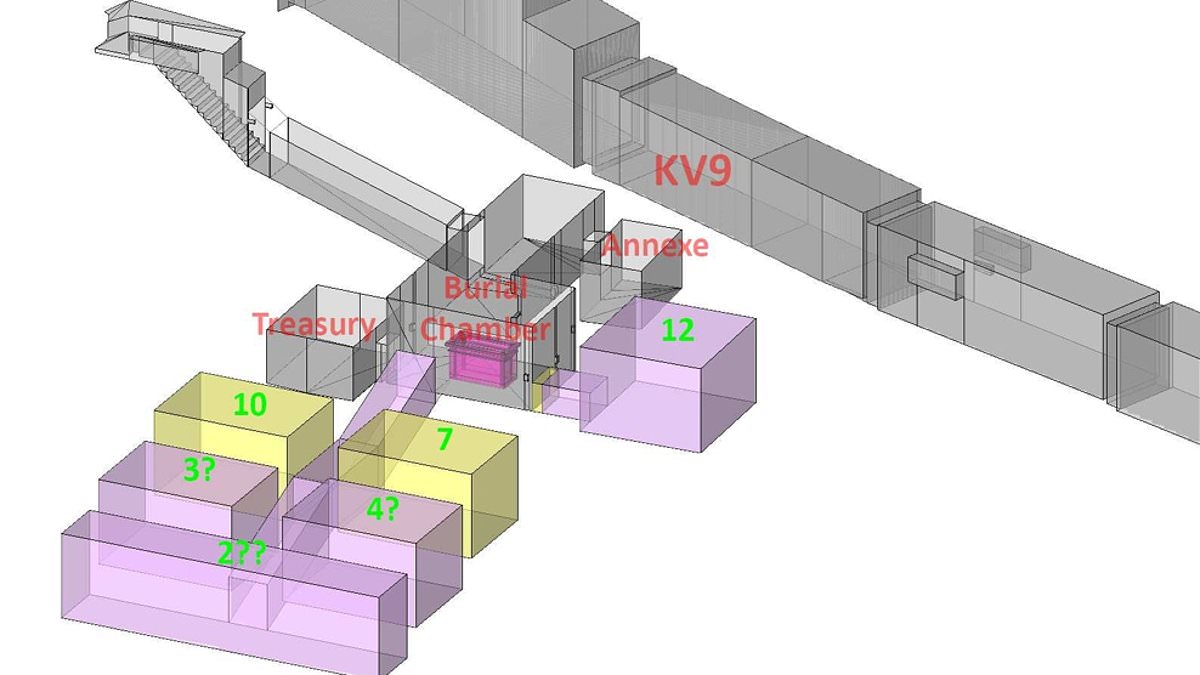
Tutankhamun's tomb is widely regarded as the most famous and best–preserved archaeological find in Egypt.Now, more than a century after Howard Carter first stumbled upon it, archaeologists believe they may have uncovered a secret hiding beyond its walls.New scans have revealed tantalising evidence of a previously unknown network of corridors and chambers just metres from the young pharaoh's burial chamber.And if the researchers are right, they could contain one of ancient Egypt's greatest missing treasures – the long–lost burial place of his stepmother, Queen Nefertiti.The study, first reported in Nature, involved a range of geophysical surveys and clues from ground–penetrating radar.Analysis of the tomb structure, the ground around it and wall paintings indicate there is a 'hidden complex' of corridors and rooms.They appear to pre–date the entombment of Tutankhamun, the experts said – suggesting they could hold the remains of his stepmother.And, if confirmed, the discovery could 'rank among the most transformative archaeological discoveries of the modern era'. New scans have revealed tantalising evidence of a previously unknown network of corridors and chambers (pictured in purple and yellow) just metres from the young pharaoh's burial chamber (in grey). KV 9 refers to the nearby tomb of the pharaohs Ramesses V and Ramesses VI A room inside the tomb of King Tutankhamun, who died at the age of 18 or 19, in the Valley of the Kings in Luxor, Egypt. Analysis of the tomb structure, the ground around it and wall paintings indicate there is a 'hidden complex' of corridors and rooms The idea that there could be a hidden chamber within the tomb containing Tutankhamun's predecessor, Nefertiti, was first proposed in 2015 by British Egyptologist Nicholas ReevesHe said lines and cracks in the north wall of the burial chamber, as well as alterations to the room's paintings, made him believe the structure was a false wall.The tomb itself is unexpectedly small for a royal burial, leading some to think it is part of a larger network of chambers.Mr Reeves proposed that when Tutankhamun died unexpectedly, as a teenager, a much larger royal tomb was adapted for his burial, with the deeper sections blocked off.For the new study, archaeologists at Egypt's National Research Institute of Astronomy and Geophysics used powerful ground–penetrating radar to probe the interior walls of the tomb.Their analysis indicates a 6.5 foot (two metre) wide corridor leading away from the burial chamber.George Ballard, co–author of the study, said previous teams may have missed it because they were searching for a large void immediately behind the wall.Further investigations involving a microgravity survey – a technique that can measure density through tiny variations in the Earth's gravitational field – pointed to a series of hidden chambers tucked into the rock behind. Further investigations involving a microgravity survey – a technique that can measure density through tiny variations in the Earth's magnetic field – pointed to a series of hidden chambers tucked into the rock behind (depicted with dashed yellow lines) The proposed opening to the corridor, in what experts believe could be a 'false wall' in the side of Tutankhamun's tombThe study, published in Occasional Papers of the Amarna Royal Tombs Project, compares the layout of Tutankhamun's tomb to others, including that of Hatshepsut – one of ancient Egypt's most powerful female pharaohs.The team point out that the exit in Tutankhamun's tomb is left–turning – identical to the layout of Hatshepsut's resting place.However, tombs for kings during this period all have right–turning exits.'The implication of this leftwards turn is clear,' the team wrote. 'KV 62 [Tutankhamun's tomb] conforms to the architectural grammar of neither a private nor a kingly monument.'The plan Tutankhamun's tomb follows is that of an Eighteenth Dynasty Queen.'The researchers add that Tutankhamun's burial chamber may have initially served as an intermediary space separating the tomb's visible outer apartments from an original burial suite further back.This adds to the theory that the tomb was originally for Queen Nefertiti, before being adapted for the early death of her stepson.The walls of Tutankhamun's burial chamber may contain another clue. Experts believe some of the paintings were originally created for an earlier royal – and that images of Nefertiti may have been altered to portray her stepson after his unexpected death. Experts believe some of the paintings were originally created for an earlier royal – and that images of Nefertiti may have been altered to portray her son after his unexpected death View of the proposed funerary complex, showing how it cuts deep into the rock in the Valley of the Kings'Close analysis confirms that the space employed as a burial chamber for Tutankhamun had not been conceived as such,' the researchers wrote.'It had originally played a very different, median role within a larger, ultimately regal tomb.'The identification of the owner and original occupant of this larger tomb is dependent on satisfying a tightly constrained set of conditions: to have been female, as tomb type indicates… to have enjoyed full pharaonic status, and to have been Tutankhamun's immediate predecessor.'With none but Nefertiti… meeting these criteria, it comes as no surprise to find the north wall's ownership imagery replicating the precise profile of this very lady.'The team suggest that Tutankhamun's death – barely a decade after his stepmother passed away – prompted the reopening of Nefertiti's tomb and for the outermost rooms to be repurposed as his burial chamber.'[This room] was now redesigned as a burial chamber for Tutankhamun, with satellite side–rooms newly quarried,' the team wrote.'[The] single, north wall scene was then revised to suit its new ownership and role.'By the time these changes had been fully implemented, KV 62 presented the appearance of ownership by Tutankhamun alone – which, for more than a century, is how it has been completely misunderstood.'One chamber in particular appears to be closed off, with no link to other entrances.The researchers said there's a chance it could be filled with objects – which may not have been touched since they were first put there more than 3,000 years ago.The decision to enter the supposed chambers is in the hands of Egypt's Supreme Council of Antiquities.If approved, careful drilling to deploy tiny tractors equipped with cameras could start in the next two months.KING TUTANKHAMUN: THE PHARAOH WHO RULED EGYPT MORE THAN 3,000 YEARS AGOThe face of Tutankhamun was an Egyptian pharaoh of the 18th dynasty, and ruled between 1332 BC and 1323 BC. Right, his famous gold funeral maskTutankhamun was an Egyptian pharaoh of the 18th dynasty, and ruled between 1332 BC and 1323 BC.He was the son of Akhenaten and took to the throne at the age of nine or ten.When he became king, he married his half-sister, Ankhesenpaaten.He died at around the age of 18 and his cause of death is unknown.In 1907, Lord Carnarvon George Herbert asked English archaeologist and Egyptologist Howard Carter to supervise excavations in the Valley of the Kings.On 4 November 1922, Carter's group found steps that led to Tutankhamun's tomb.He spent several months cataloguing the antechamber before opening the burial chamber and discovering the sarcophagus in February 1923.When the tomb was discovered in 1922 by archaeologist Howard Carter, under the patronage of Lord Carnarvon, the media frenzy that followed was unprecedented.Carter and his team took 10 years to clear the tomb of its treasure because of the multitude of objects found within it. For many, Tut embodies ancient Egypt's glory because his tomb was packed with the glittering wealth of the rich 18th Dynasty from 1569 to 1315 BC. Egypt's antiquities chief Zahi Hawass (3rd L) supervises the removal of the lid of the sarcophagus of King Tutankhamun in his underground tomb in the famed Valley of the Kings in 2007.
Has Queen Nefertiti finally been found? New scans provide fresh evidence for a hidden chamber beyond Tutankhamun's tomb that could hold the remains of his long-lost stepmother
Full Article
Original Source
Read the full article at Dailymail →KhanList aggregates and links to publicly available news content. We do not host full articles from third-party sources. Always verify important information with original sources.