
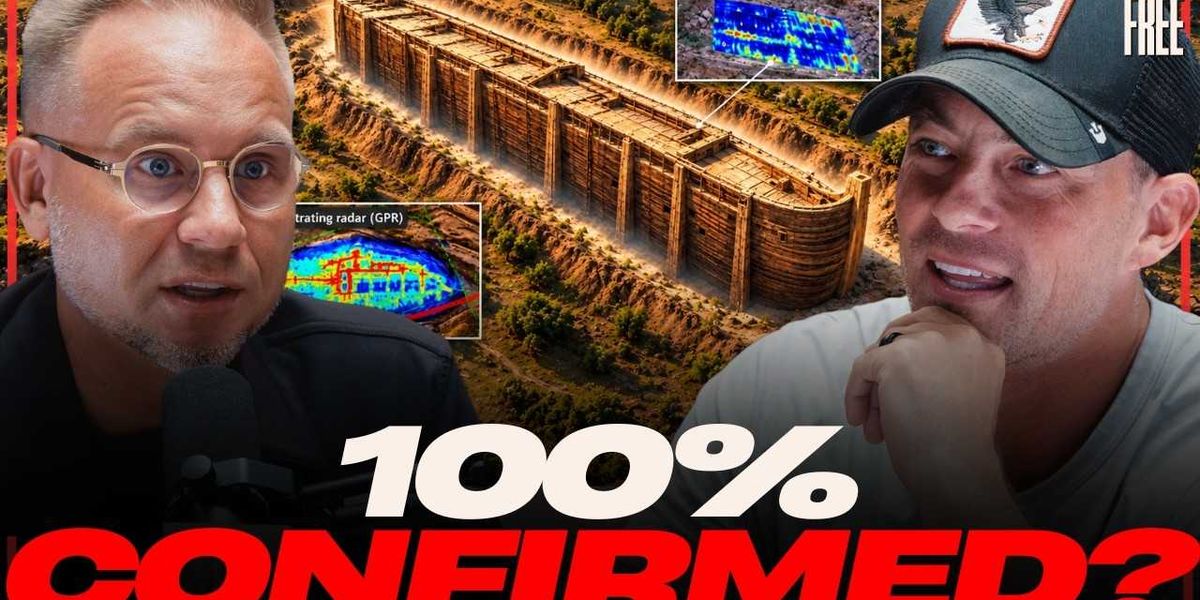
Over the summer, an archeological team led by Turkish archaeologist Cenker Atila in partnership with the U.S. group Noah’s Ark Scans began drilling and scanning the long-known boat-shaped Durupınar mound near Mount Ararat in Turkey. The hundreds of soil samples they collected are still being tested in labs. Thus far, however, there has been no proof it’s Noah’s ark, despite a wave of headlines and social media posts claiming the ark had been found. Dr. Jeremiah Johnston — a New Testament scholar who has written extensively on biblical artifacts, including the Shroud of Turin, the James Ossuary, and Dead Sea Scrolls — joined BlazeTV host and pastor of Lakepointe Church Josh Howerton. Howerton begins with a straightforward question: “Why haven't they just dug the thing up yet?” “I wish they would. If you have a half-million dollars, I'll go there and start excavating today,” Johnston jokes. One of the main reasons the ark hasn’t been excavated, he explains, is because the nation of Turkey is predominantly Muslim. “They want you to go to Konya and see the whirling dervishes. They want you to go see Muhammad's beard and cry over that. …So there is a resistance from the government to anything that would confirm the biblical narrative for Christianity and Judaism,” he tells Howerton. Johnston suspects that the archeological team likely had to resort to “bribery” just to conduct scans and collect samples. “I'm sure they've had to pay a few people off just to get the exceptions to do it,” he says. But even without a proper excavation, there are several facts Howerton says have people believing that the ark is indeed Noah’s, most notably: The length and width of the Durupınar formation is consistent with biblical measurements for the ark; the location (near Mount Ararat) is consistent with the Bible’s description of where Noah’s ark landed; ancient pottery fragments were discovered near the formation; and the Arzap stones — large upright stones with holes drilled near the top — were found in villages near the Durupınar formation, which some believe to be drogue anchors (weights) from the ark.Howerton points out that the evidence has been convincing enough for some outlets to report that the Durupınar formation has been “100% confirmed” to be Noah’s Ark. The following day, the official Noah’s Ark Scans account posted: “We are 100% sure that the Daily Mail will come under fire for this headline. But knowing what we know now, we are also 100% sure that they are not going to have to issue a retraction. We will be releasing more information soon.”Johnson takes a cautiously hopeful approach. “I want to see what all of the evidence actually has to say,” he says, “and so I'm all for digging. I'm all for finding it.” “I hope that we find parts of Noah's ark someday in our lifetime. … I believe we're living in a time, thanks to technology, where there is a controlled revelation based on technology where God is using the stones to cry out that totally authenticate the Word of God. It's the most exciting time ever to be a Christian,” he continues.However, there are still many questions to be answered. “We got to have discernment,” says Johnston, citing 1 Thessalonians 5:20’s directive to "Prove all things."“Durupınar is named after the captain that saw it. He went back in 1960 to Durupınar and studied it with geologists, who concluded that it is a freak of nature. It is a natural geological formation, not Noah's ark,” he says. Further, the formation, he explains, is in a “valley” of the Ararat Mountains, not on the peaks, as scripture indicates, meaning “there’s an elevation issue.” Thirdly, the reigning consensus among archeologists, both secular and Christian, is that the Durupınar formation is not Noah’s ark. “Archaeology is a full-contact sport,” says Johnston. “To get an archaeologist to agree with another archaeologist is a miracle. The one thing that 100% of credentialed archaeologists agree on is that Durupınar is not the site of Noah's ark.” To hear all the reasons why the long-standing view among geologists and archaeologists who have studied the site is that the Durupınar formation is a natural geological feature, and not the remains of a wooden vessel or Noah’s ark, watch the episode above.Join BlazeTV+ and start watching Josh Howerton today at blazetv.com/JOSH. Use promo code JOSH to get $20 off your subscription.
Has Noah’s ark really been found? Dr. Jeremiah Johnston breaks down the Durupınar claims with Josh Howerton.
Full Article
Original Source
Read the full article at Theblaze →KhanList aggregates and links to publicly available news content. We do not host full articles from third-party sources. Always verify important information with original sources.