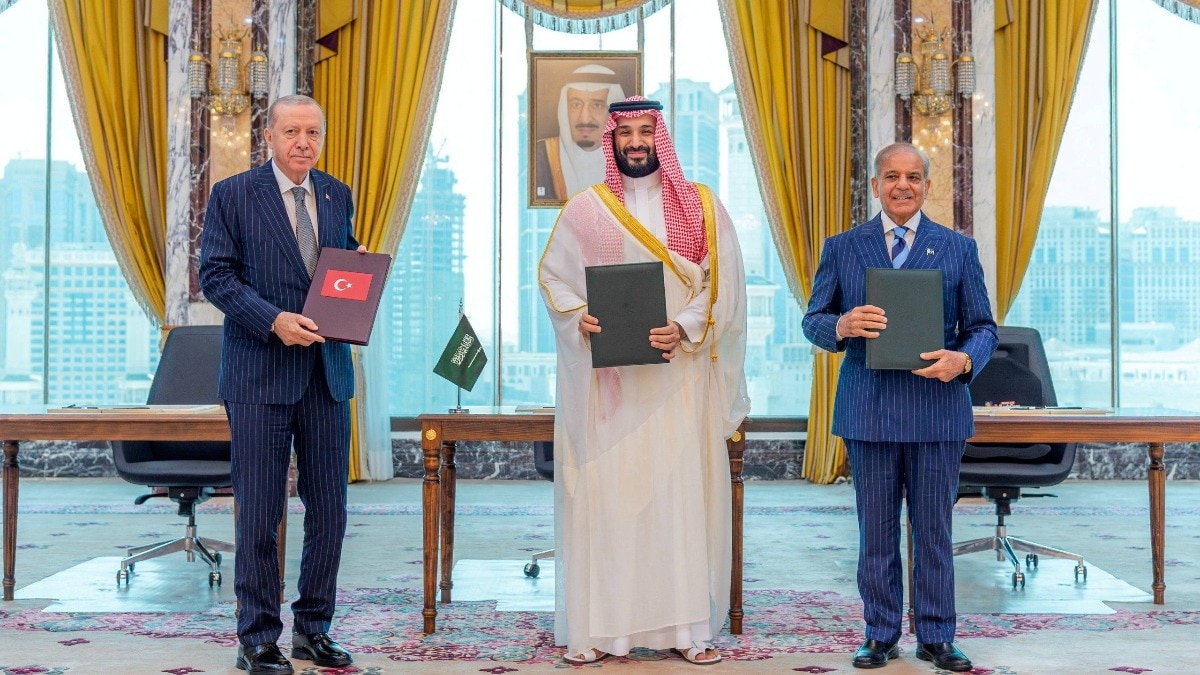
The Mecca Joint Defence Agreement between Pakistan, Turkey and Saudi Arabia was signed only days ago, and its architects have already begun casting the net wider to bring in more members. But even as the ink is barely dry, the pact could deepen fault lines between two key Arabian powers, Saudi Arabia and the UAE.Prominent Emirati voices are questioning why Riyadh needed a new security partnership with powers outside the region when the Gulf Cooperation Council (GCC), a six-nation political, economic and security bloc, already exists. Saudi Arabian commentators have in turn questioned Abu Dhabi's defence ties with India and security cooperation with Israel.The Mecca pact was signed on August 7 in the holy city of Mecca by Saudi Crown Prince and PM Mohammed bin Salman, Turkish President Recep Tayyip Erdogan, and Pakistan Prime Minister Shehbaz Sharif. Under the pact, an attack on one country will be treated as an attack on all three. The agreement brings together oil-rich Saudi Arabia, nuclear-armed Pakistan and Turkey, which has Nato's second-largest military and a rapidly expanding defence industry. Its architects have already made clear their intention to bring more countries into the fold, with Egypt, Qatar, Kuwait, Jordan, Azerbaijan and Syria among those reportedly being considered.The new security grouping, dubbed an "Islamic Nato" by some experts, appears to have reopened tensions between Saudi Arabia and the UAE, two of the Gulf's biggest economies and once iron brothers. While the two countries remain allies on paper, Riyadh and Abu Dhabi have increasingly pursued divergent foreign-policy objectives, with Saudi Arabia drawing closer to Turkey and Pakistan, while the UAE has strengthened its security and strategic partnerships with Israel and India. The Saudi-UAE fault line is stark in Yemen. Riyadh has backed the internationally recognised government while Abu Dhabi has supported the southern separatist STC.SAUDI QUESTIONED FOR JOINING BLOC WITH PAK TURKEY DESPITE BEING PART OF GCCThe Mecca pact has triggered criticism from prominent Emirati voices, who have questioned why Saudi Arabia is pursuing a new joint defence agreement outside the Gulf Cooperation Council (GCC), the six-member grouping of Saudi Arabia, the UAE, Qatar, Kuwait, Bahrain and Oman. Established in 1981 after the outbreak of the Iran-Iraq war, the GCC was created to coordinate its members' political, economic and security policies and has gradually developed mechanisms for joint military cooperation between member states.Its members have a Joint Defence Agreement, under which an attack on any GCC state is considered an attack on all, with the bloc repeatedly stressing that the security of its members is "indivisible". The GCC also has a Unified Military Command and mechanisms for coordinating defence policy and responding to regional threats.It is against this backdrop that Dubai-based political analyst and former aide to UAE President Mohammed bin Zayed Al Nahyan, Abdulkhaleq Abdulla, questioned the logic of the Mecca pact."Strengthening Gulf military and political cooperation and unifying the Gulf house is far more important," Abdulla wrote on X, arguing that Riyadh should prioritise the existing Gulf framework rather than pursue a wider arrangement involving Turkey and Pakistan. He added, "So who is the enemy of the countries of this alliance?" Abdulkhaleq Abdulla in a post on X questioned the logic behind the Mecca Pact. (Image: X/@Abdulkhaleq_UAE) Abdulla's comments effectively questioned both the strategic purpose of the new pact and whether an arrangement involving powers from outside the Gulf could weaken the focus on collective Gulf security. He later posted another message on X that many interpreted as a rejection of pan-Islamic or trilateral alliances in favour of pure national interest."He whose sect is more important than his homeland, there is no safety for him... He whose nation, Arab or Islamic, is more important than his homeland, there is no safety for him," Abdulla posted.His criticism drew a sharp response from Saudi Prince Abdulrahman bin Musaid, who defended Riyadh's right to pursue its own strategic interests and asked."How can this conflict with unifying the Gulf house? Is it not the right of any state to make agreements with any state or states according to what it sees as achieving its interests?" Musaid wrote on X,Fahad al-Arabi al-Harthi, chairperson of the Riyadh-based Asbar Centre for Studies and Research, also pushed back against the Emirati criticism, arguing that the Mecca agreement was not an alliance aimed at a particular adversary. Instead, he said on X that the pact was designed for "building a collective capacity for deterrence and defence, and protecting security and stability in the face of any threat from any side."SAUDI VOICES QUESTIONED UAE's PARTNERSHIPS WITH ISRAEL, INDIAThe Saudi response soon turned the criticism back on Abu Dhabi, with Saudi commentators pointing to the UAE's own security partnerships outside the Gulf Cooperation Council (GCC), in particular those signed with India and Israel (a country which Riyadh has yet to recognise).Abdulaziz al-Tuwaijri, former head of the Islamic World Educational, Scientific and Cultural Organisation, questioned why Abu Dhabi's defence partnerships with India and with Israel were considered acceptable, while Riyadh's new security partnership with Turkey and Pakistan was being criticised."Anyone who betrays and collaborates with the Zionists will never find security," al-Tuwaijri wrote in response to Abdulkhaleq Abdulla's comments.It's noteworthy that Israel had sent an Iron Dome air defence battery along with military personnel to the UAE back in April after the latter came under sustained Iranain drone and missile strikes, marking the first overseas deployment of such a system.In another post, al-Tuwaijri directly questioned the UAE's own security arrangements, asking why its defence treaty with India and wider cooperation with Israel were acceptable while Saudi Arabia's agreement with Turkey and Pakistan was being scrutinised."Abdul Khaleq Abdullah has tweeted 11 times so far about the Mecca Agreement for Joint Defence, casting doubt on it and also tampering with it. And he is undoubtedly, like other tweeters from his country, an echo of its position. As for the joint defence treaty between his country and India, and the multi-field cooperation with the Zionist entity, those are permissible in his view," al-Tuwariji wrote on X. Abdulaziz al-Tuwaijri, former head of the Islamic World Educational, Scientific and Cultural Organisation, criticised the UAE's security ties with Israel and India. (Image: X/@AOAltwaijri) It should be noted that India does not have a joint defence treaty with the UAE, but the two have maintained formal defence cooperation since a 2003 MoU, expanding into joint exercises, defence exchanges and a Strategic Defence Partnership framework signed in January 2026, covering military technology, co-production, maritime security and counter-terrorism.Al-Tuwaijri's comments came after Saudi voices had already pointed to the UAE's 2020 Abraham Accords with Israel, with one Saudi person writing on X, "I wonder, did the UAE inform and notify the Gulf states before its alliance with the Zionist entity?"The exchanges marked a sharp escalation in the public dispute, with Saudi commentators effectively arguing that Abu Dhabi could not question Riyadh's decision to pursue security partnerships outside the GCC while maintaining its own extensive defence and strategic ties with India and Israel.- EndsPublished By: Shounak SanyalPublished On: Aug 17, 2026 10:27 IST
Has Mecca pact deepened UAE-Saudi fault line along India-Israel axis?
Full Article
Original Source
Read the full article at Indiatoday →KhanList aggregates and links to publicly available news content. We do not host full articles from third-party sources. Always verify important information with original sources.