
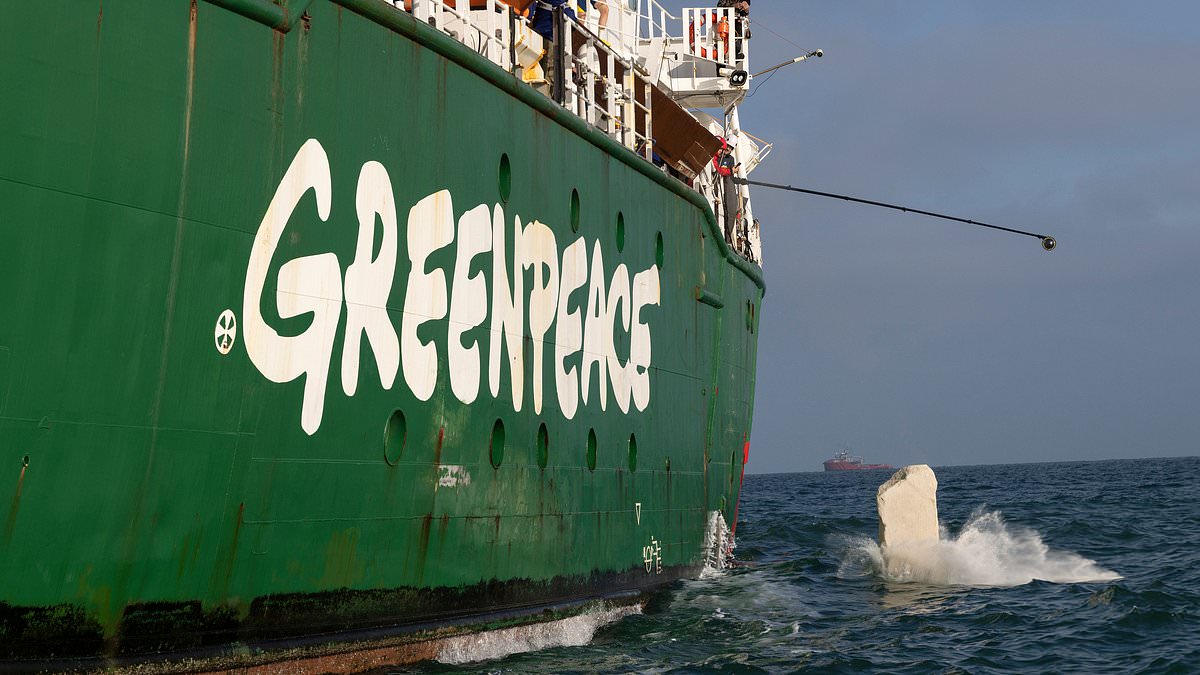
Greenpeace may have accidentally thrown a spanner in the works of one of Britain's biggest offshore wind projects after dumping boulders into the sea in protest against destructive fishing practices.The environmental group scattered around 15 tonnes of rocks, some weighing up to two tonnes each, off the Norfolk coast at the start of November to create an underwater barrier against bottom trawling.But campaigners were unaware that most of the boulders landed on the site earmarked for the £12billion Norfolk Vanguard East windfarm.The giant renewable energy scheme forms part of a major deal between German energy giant RWE and the UK government, with construction expected to begin next year.Once operational, the windfarms are expected to generate enough clean electricity to help reduce Britain's reliance on gas-fired power stations and cut carbon emissions from the electricity sector.However, RWE is now investigating the placement of the boulders – and whether they could affect construction work or its undersea cables. Earlier this month, Greenpeace dumped rocks off the Norfolk coast in a protest against seabed trawling The environmental group scattered around 15 tonnes of rocks, some weighing up to two tonnes eachGreenpeace said it created the 'boulder barrier' to protect harbour porpoises and marine habitats from bottom trawlers, which drag heavy nets across the seabed.The stunt took place in what Greenpeace describes as one of the most heavily trawled parts of the southern North Sea.When the action was first announced, Will McCallum, co-executive director of Greenpeace, said: 'Imagine a bulldozer tearing through a treasured national park like Dartmoor or the Peak District.'Out of sight, destruction on that scale is happening near our own shores in places we're told are "Marine Protected Areas".'Hulking great ships prowl the sea day after day, stripping it of fish and killing precious wildlife like porpoises, sharks and sea birds.'With our ship and a movement behind us, we're doing what the government isn't: protecting our seas.'Campaigners say they checked the area for pipelines, cables and shipwrecks before dropping the rocks without consent from the marine authorities.However, they did not realise the site overlapped with plans for the Vanguard East development. Campaigners were unaware that most of the boulders landed on the site earmarked for the £12 billion Norfolk Vanguard East windfarm (pictured) Once operational, the windfarms are expected to generate enough clean electricity to help reduce Britain's reliance on gas-fired power stations and cut carbon emissions (stock image)RWE has now opened talks with Greenpeace to establish the exact locations of the rocks.A spokesman for the company described discussions with the campaign group as 'constructive' and said the firm would 'continue to investigate the precise implications' for the Norfolk Vanguard East project.Greenpeace insists the barrier should pose little problem because developers routinely move naturally occurring boulders from the seabed before building windfarms.Mr McCallum said any suggestion the boulders would pose a genuine issue is 'absurd'.'Anyone familiar with offshore wind in the North Sea knows that energy companies routinely move naturally occurring boulders from the seabed before building windfarms,' he said.'Some of these boulders can be ten times heavier than those we placed.'Greenpeace has long championed offshore wind and will continue to do so. While we wait for this windfarm to be built, our boulders will provide an essential barrier to destructive bottom trawlers that are decimating the seabed in this protected area.' Campaigners say they checked the area for pipelines, cables and shipwrecks before dropping the rocks without consent from the marine authorities Some boulders were stencilled with the signatures of celebrities who backed the conservation campaignSome of the boulders that were dropped bore the signatures of celebrities including Simon Pegg and Benedict Cumberbatch, who backed the conservation campaign.MPs including Kerry McCarthy and Dr Roz Savage also signed their names to the large rocks.'Industrialised fishing is having a hugely destructive impact on our marine environment, yet less than one per cent of our seas are protected from it,' Ms McCarthy said earlier this month.'They can legally tear through supposedly protected areas of the ocean, wreaking havoc upon the seabed, precious habitats and the sea life that lives there.'Progress is too slow and nature can't wait, which is why I've added my name to one of Greenpeace UK's boulders.'We need a ban on bottom trawling and properly protected ocean sanctuaries, both here in UK waters and right across the Atlantic Ocean.'According to Greenpeace, industrial fishing vessels churned up an area of protected seabed 58 times larger than Dartmoor in 2025 alone.In total, trawlers and dredgers spent more than 115,000 hours scraping the seafloor inside Britain's supposedly protected marine zones – the equivalent of over 13 years of non-stop fishing.
Has Greenpeace accidentally sabotaged Burnham's windfarms? Activists could delay £12bn renewable energy project after dumping rocks off Norfolk coast in protest against seabed trawling
Full Article
Original Source
Read the full article at Dailymail →KhanList aggregates and links to publicly available news content. We do not host full articles from third-party sources. Always verify important information with original sources.