
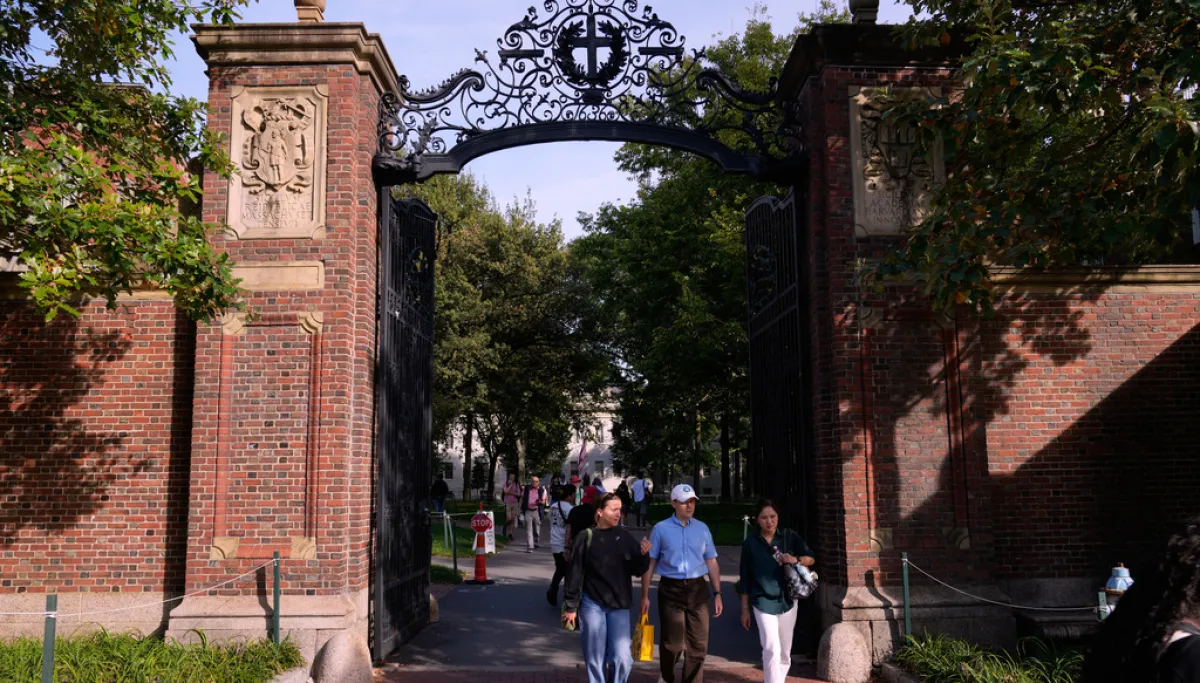
Members of the Harvard Graduate Students Union–United Auto Workers (HGSU-UAW) are on strike at Harvard University, and the Harvard Crimson’s account of what happened outside Emerson Hall on Oct. 29 raises a far too familiar question about Harvard’s leadership: Why is protecting students’ education still treated as a matter of competing rights?The background to what is going on at Harvard is quite straightforward: Roughly 250 undergraduates were taking a midterm when striking graduate students gathered with megaphones, air horns, and sirens outside the lecture hall where the exam was being administered.According to the course professor, Dr. David Jones, the noise lasted for about 75 minutes. He had bought 100 pairs of earplugs and allowed noise-canceling headphones during the exam, but nothing helped. One student reportedly walked out after 15 minutes. Professor Jones, teaching Medical Ethics and History, later explained in an opinion piece for the Crimson that the union emailed him two days before the disruption, warning that its planned picket might interfere with his class. The union urged him to cancel or relocate his class, and Jones asked about other rooms, but none large enough were available. Postponing the test made little sense during an open-ended strike, and he ruled out a take-home exam because of generative AI.Jones says in his own account that he has always supported the union’s right to strike. After the exam, the HGSU sent an email to Jones’s class that blamed him for the disruption: “As fellow students, we recognize that exams are stressful enough without disruption. To avoid such disruption, HGSU leadership notified your instructor 48 hours in advance of our picketing plans and encouraged them to move the class. Unfortunately, they did not.”Jones was trying to perform his teaching duties, and Harvard should have made sure he could do so, without leaving him to find another classroom or hand out earplugs.I earned my Ph.D. at Harvard and have spent almost two decades teaching undergraduates. I understand how difficult it can be to survive while training to be an academic. I also work with Harvard Alumni for Free Speech (HAFFS), because I believe universities must protect free expression, including speech that is unpopular or deeply uncomfortable. I also support the right to organize, bargain, and strike. But Harvard has an obligation to protect those rights while keeping its classrooms functioning.At a faculty meeting after the exam incident, Faculty of Arts and Sciences Dean Hopi Hoekstra spoke of “the tension that we feel” between students’ right to take an exam uninterrupted and the rights of graduate students in the union. And to this I say: No. Full stop.I keep hearing college administrators use the word “tension.” I hear it at Sarah Lawrence, where I teach, far too often as well. Higher education leaders tend to mimic each other. Sometimes there really are competing rights and obligations — but this is not one of those cases. Harvard can protect the right to strike and insist that examinations proceed without disruption. Calling this a “tension” turns a straightforward question of enforcing the rules into a moral dilemma, and it just isn’t one.Free speech on college campuses is crucial — it enables students and community members to pursue and establish truth. Certainly, striking students may criticize Harvard verbally and in writing, picket outside its buildings, and make their case forcefully within university rules. Their message is not the issue.However, as the Foundation for Individual Rights and Expression (FIRE) has explained, universities may enforce reasonable, content- and viewpoint-neutral limits on amplified sound when it interferes with classes. Protecting an examination from air horns is not censorship or suppression of speech at all; it is protecting education and respecting the rights of the students and the professor.What concerns me at Harvard, and at Sarah Lawrence, is the qualification that so often follows an assurance of support. College leaders, from the school president down to a resident dean, owe every student the same protection and standing, without qualification, around their political views or personal characteristics.Importantly, this obligation of protection and equal standing cannot depend on who is protesting, whose education is interrupted, or how difficult enforcement might be — though many recent situations on campuses nationwide suggest that identities matter. Students should not have to wonder whether their college will hold the line for them. But these simple ideas of actual equity and inclusion are not upheld as often as many would like.As with so much at Harvard, there is a history here. After Hamas’s horrific Oct. 7, 2023 attack on Israel, then-president Claudine Gay struggled to explain where Harvard drew the line between protected speech and prohibited harassment or intimidation. When Gay was asked at a December congressional hearing whether calling for the genocide of Jews violated Harvard’s rules, she answered, “It can be, depending on the context.” She later apologized, and she had condemned Hamas in October. While the hate speech back then and the disruptions on campus now are different questions, Gay’s testimony left Jewish students with good reason to question whether Harvard would protect them.Harvard’s own 2025 task force on antisemitism and anti-Israeli bias identified “insufficient rules and enforcement around disruptive protest.” Harvard’s own review identified the problem. Its leaders should not still be struggling to explain the obligation.In 2024, students and faculty staged silent protests inside Widener Library. Widener was sacred ground to me as a graduate student, a place where people with widely different views could sit near one another and work quietly. Hoekstra defended Harvard’s restrictions on organized library protests, noting that students rely on libraries to “study for their midterms.” She explained that there were other places to protest, and she was completely right. I fail to see why protecting an actual midterm from sustained noise is suddenly a tension between competing rights.Fortunately, Harvard’s own rules answer the question. Harvard’s university-wide Statement on Rights and Responsibilities protects orderly picketing but directly rejects interference with the university’s normal work.Harvard College Dean David Deming and Dean of Undergraduate Education Amanda Claybaugh publicly objected on Oct. 29, and a Nov. 4 letter from Harvard’s Office of Labor and Employee Relations warned of discipline. A Nov. 6 letter from Paul Curran, the managing director of the Office of Labor and Employee Relations, repeated that warning over other alleged obstructions. Cambridge police eventually intervened on Oct. 29, but the students had already endured the disruption. Jones had asked Harvard’s registrar about another room, but none large enough was available. Harvard did respond to the disruption, but it did not protect that exam.It troubles me that I even have to write this: A college or university cannot function if every academic obligation becomes negotiable whenever someone organizes a protest. Norms and rules must be clear, and they must mean something; schools must enforce consequences when expectations and rules are broken.UNIVERSITIES BESIEGED BY VIOLENT, FIERY PROTESTS WEIGHS CRACKDOWN MEASURES AFTER TRUMP PRESSUREFaculty must be able to teach, students must be able to study, and exams must be administered fairly and cannot be allowed to be disrupted by protests. Administrators should stop disruptions while they are happening and follow through on discipline when violations are established. These are core collegiate functions and are simply not negotiable. The fact that this is even up for discussion may meaningfully contribute to America’s decline in confidence in higher education.Harvard knows exactly where the line is on expression and disruption, and the school needs to act on it. The school’s rules are quite clear, and Hoekstra herself defended them just two years ago. Harvard clearly understands its responsibilities toward all of its students; the question is whether its leaders are willing to fulfill them.
Harvard won’t protect students from protesters disrupting their exams
Full Article
Original Source
Read the full article at Washingtonexaminer →KhanList aggregates and links to publicly available news content. We do not host full articles from third-party sources. Always verify important information with original sources.