
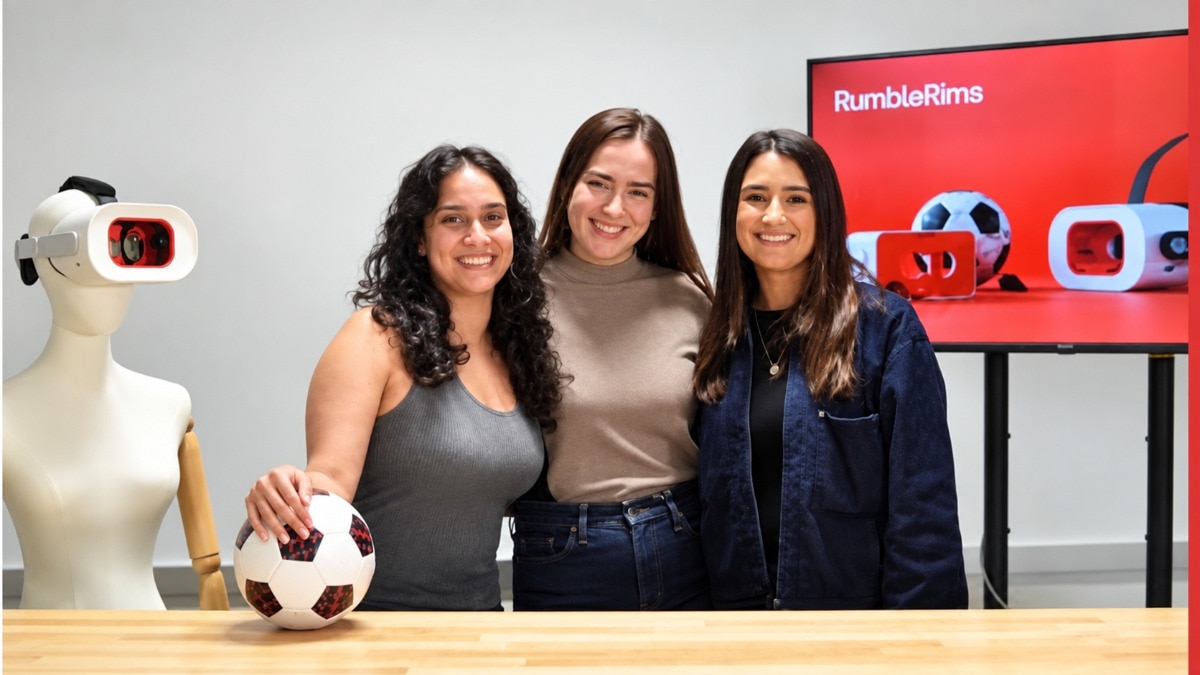
Three Harvard students have turned a simple idea into an award-winning prototype. Their Rumble Rims headset uses infrared eye tracking to screen athletes for possible concussion in about 60 seconds, earning the team the 2026 US James Dyson Award and funding for further testing.Harvard students win James Dyson Award for 60-second concussion headset (Image: jamesdysonaward.org)When an athlete takes a head hit, the next few seconds can be crucial. Three Harvard students have developed a headset that uses infrared cameras to track eye movements and is designed to screen for possible concussion in about 60 seconds. The idea has now won the 2026 US James Dyson Award.Developed by Harvard students Radhika Saran, Cleo Pontone and Sophia DeVito, the invention has been named Rumble Rims. The team will receive USD 6,500 in prize money to support further development, prototype testing and validation of the technology.WHY DID THE STUDENTS BUILD RUMBLE RIMS?A suspected concussion can leave coaches with little time to decide whether an athlete should remain on the field. Current assessments often combine symptom checks, balance tests and clinical judgement, but athletes may underreport symptoms when they are keen to continue playing. The Rumble Rims team demonstrates the headset and its screening interface. (Image: jamesdysonaward.org) The need for better sideline assessment is particularly relevant in youth sports. US Centers for Disease Control and Prevention (CDC) data cited by the James Dyson Award shows that around seven in 10 emergency department visits for sports- and recreation-related traumatic brain injuries among children involve those aged 17 and under. Contact sports make up roughly 45 percent of these cases.Under current guidance, an athlete with a suspected concussion should be removed from play and should not return until cleared by a healthcare provider. Rumble Rims aims to complement this process by adding objective eye-tracking data to the initial sideline assessment.HOW DOES THE RUMBLE RIMS HEADSET WORK? Rumble Rims combines a portable infrared headset with a coach-facing mobile display and recovery dashboard. Its infrared cameras and hot mirrors track the athlete's eye movements during a short oculomotor test, while allowing them to see normally.The data is converted into real-time information that can flag eye-movement patterns potentially linked to neurological disruption. The system is designed to support decisions about removing an athlete from play and seeking medical evaluation, rather than diagnosing a concussion. The headset features an infrared camera, hot mirror and adjustable head strap. (Image: jamesdysonaward.org) The recovery dashboard enables repeat testing over time, creating an objective record that can be shared with families and healthcare professionals. The team stresses that Rumble Rims is a screening tool, not a diagnostic system, and that return-to-play decisions should be made by qualified healthcare providers.FROM HELMETS TO A WEARABLE HEADSETThe final design was developed after the students explored several concepts, including helmets, mouthguards and an enclosed testing structure.Through conversations with athletes, coaches and medical professionals, they found that creating a completely controlled testing environment was not necessarily the key challenge. Instead, they needed to maintain a consistent relationship between the athlete's eyes and the cameras.That insight led to the headset design, which moves with the athlete's head while keeping the display separate and the setup simple enough for use on the sideline.The students also consulted Matthew McTague, a certified physical therapist and former collegiate athlete. He highlighted the importance of testing athletes in more realistic conditions, including eye-tracking tasks that could reveal changes that might not be obvious when an athlete is simply resting.WHAT HAPPENS NEXT?The USD 6,500 prize will help the team build and test a higher-fidelity prototype, refine its oculomotor test and conduct further validation with athletes, coaches, trainers and medical advisers. The students also hope to eventually pilot Rumble Rims with schools and youth sports programmes and explore medical-device validation pathways.However, the technology is still in development and has not yet been clinically validated as a concussion diagnostic tool.The next phase will need to establish whether the eye-movement signals detected by the headset reliably correspond with clinically meaningful changes associated with concussion and whether the system performs consistently across different athletes and real-world sporting environments.If further testing supports the technology, Rumble Rims could potentially offer schools and community sports programmes a more accessible way to gather objective information during a suspected concussion. For now, the invention remains a prototype, with further testing and validation being the crucial next steps before wider use.- EndsPublished By: Apoorva AnandPublished On: Sep 20, 2026 14:06 IST
Harvard students win James Dyson Award for headset screening athletes for concussion
Full Article
Original Source
Read the full article at Indiatoday →KhanList aggregates and links to publicly available news content. We do not host full articles from third-party sources. Always verify important information with original sources.