
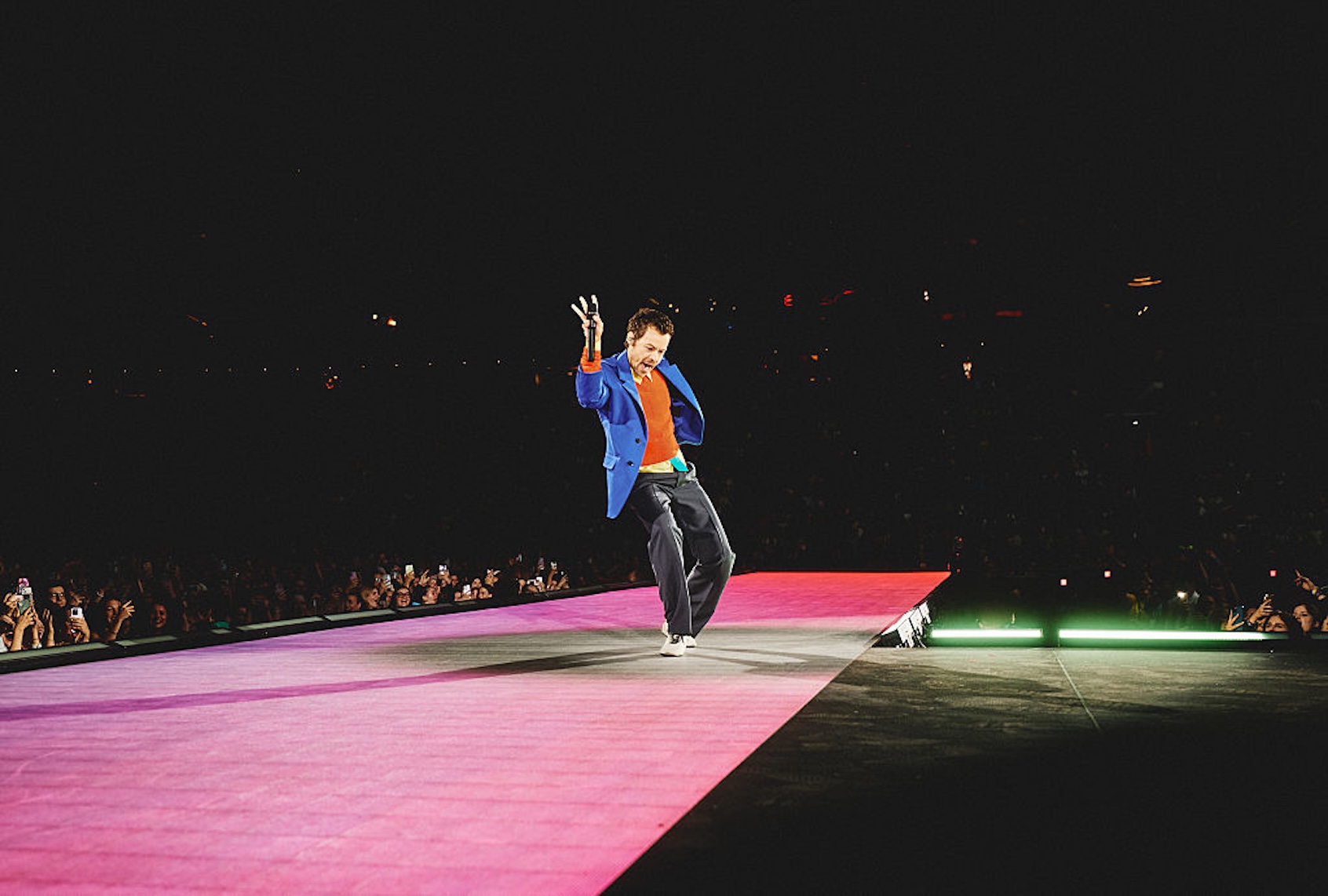
commentary The pop star's queer takeover of Madison Square Garden offers America a better way of manhood Published September 6, 2026 6:30AM (EDT) Harry Styles performs on stage during his "Together, Together" tour on May 17, 2026, in Amsterdam, Netherlands. (Anthony Pham/Getty Images for HS) I walked into Manhattan’s Rawhide one night with four blond supermodels on my arm, and we danced until we were soaked. It was a room where desire moved in the open air and nobody apologized for a body, where sex was just weather and everyone was welcome in it. The models loved it, because for a few hours no one wanted anything from them except to dance. That was the gift of those places. They did not ask you to be useful or presentable or legible. They just let you in. I was never the man working the door. I was the guest, the frequent — and I mean frequent — guest, the kind of regular who has a life measured in rooms. I welcomed myself to the city over and over from inside Splash in Chelsea, where the odd one out could arrive alone and, within a song, become the hot child in the city. I spent nights on the 18th floor at the Boom Boom Room in the Standard, a room that offered an honest view of both heaven and hell, where anyone and everything went, everything everywhere all at once, the way New York used to be. I want to tell you what those rooms were, because they are almost all gone now, and because a pop star with a banner in the rafters of Madison Square Garden is doing three things at once that I did not think anyone could do again. Start with the loss, because it came first. Splash opened in 1991 and closed in 2013, serving for 22 years as the anchor of gay Chelsea. Rawhide, my Rawhide, went dark that same year after 34 years. It did not happen all at once, the way a demolition does. It happened place by place, inch by inch, a dusty disco ball left in the rummage while a Starbucks or a boutique gym rose to serve the freshly gentrified block around it. Rents quadrupled and kept climbing. Zoning tilted toward condos over dance floors. As mayor, Rudy Giuliani declared war on nightlife in the ‘90s and the city never fully called it off. The apps — Grindr, Scruff and the like — arrived and told us we no longer needed a room to find one another. Chelsea was emptied of its clubs, the community drifted north to Hell’s Kitchen, and something specific and irreplaceable went quiet. Because those rooms were never only about the dancing or the drinking or the men. They were about permission. You could arrive as the odd one out and be handed, at the door, a version of yourself you were not allowed to be anywhere else. High socks, short shorts, a shirt barely buttoned, and you were not a spectacle, you were the welcome. Young and old stood shoulder to shoulder, celebrating everything queer about being alive in Manhattan, and for a few hours the hierarchy of the daylight world simply did not apply. I got 20 years of that. Then I watched the city decide, one shuttered marquee at a time, that it could live without it. Which is why I did not expect to feel it again — and then Harry Styles came to Madison Square Garden. The congregation that lost its churches when Splash and Rawhide went dark has found a new one big enough to hold 20,000 of them at a time. The English pop star is in the middle of 30 nights at the iconic venue, running from August 26 through October 31, the only United States stop on his entire tour, with Jamie xx opening and a permanent banner already hanging overhead from his fifteen sold-out nights in 2022. It’s the largest single-engagement run in the arena’s history, but it’s not a concert. It’s a residency, which is to say it is a room you return to, a place that reconstitutes the same crowd until they are less an audience than a congregation. I have followed these nights obsessively, the way I once lived inside the rooms this one replaced, and what I keep seeing is unmistakable: The congregation that lost its churches when Splash and Rawhide went dark has found a new one big enough to hold 20,000 of them at a time. The energy is enigmatic and it is contagious. Night after night the crowd arrives in the old uniform, high socks and short shorts and barely buttoned shirts, boas and glitter and mesh, young and old alike, as though the door has finally reopened after 12 years. Jamie xx warms the blood, the lights drop and the roar that goes up is not the roar of fans. It is the cry of a people who were told for a decade that their room was closed and have just discovered it was only relocated. Strangers hold each other. Grown men cry into sequins. And when it lets out after three hours, the feeling does not stay in the building. It floods down the steps and onto Seventh Avenue, with thousands still singing, leaving glitter on the pavement. The permission is back. It just costs more and seats more and echoes louder. Here is the second thing, and it is the one that turns an elegy into an argument. It matters enormously who is standing at the center of that room, and what kind of man he is. Start your day with essential news from Salon. Sign up for our free morning newsletter, Crash Course. Because the Garden is also the building where, just 11 days after his election victory in November 2024, Donald Trump was paraded to a UFC card and greeted like a returning general by Dana White and Joe Rogan, the caged octagon anointed in that moment as the official temple of American manhood. This is the masculinity being pressed on us now, from the cage and from the podium and from 10,000 podcasts: masculinity as dominance, as grievance, as a permanent clenched fist. Democratic New Jersey Sen. Cory Booker, watching a version of that spectacle, called it “counterfeit masculinity,” toughness performed to paper over the absence of the real thing, and the phrase has stuck with me because it is exactly right. It is a model with room for precisely one kind of man, and it spends most of its energy telling the rest of us we are failures or frauds. Now, two years later, Harry Styles walks onto that same floor in pearls and a feather boa, singing about tenderness and change and wanting. Only 31, he does not do it by out-toughing the cage. He does it by ignoring it entirely. He offers a masculinity with actual range, one that can be soft and adored and unafraid to be looked at, one that treats femininity as a color to wear rather than a threat to survive. That his residency now dwarfs, in sheer scale, the fight-night masculinity the same building helped crown is not a coincidence I am willing to let pass quietly. It is a rebuke, delivered in America’s most public room, that the men selling the clenched fist would very much prefer you not notice. Their queer advocate has the keys to the temple, and he is redecorating. You can hear the whole argument in the arc of his songs. Although nearly 10 years old, “Sign of the Times” still lands with me, and so does “Dance No More” off his latest record “Kiss All the Time. Disco, Occasionally.” “Watermelon Sugar” was the summer the whole city seemed to be drinking it in. “As It Was,” his hit from 2022, was the very sound of change, of a person clocking that nothing would return to how it had been and choosing to keep moving anyway. And “Aperture,” the culmination, is Harry in his comfort phase, the New Yorker who has watched everything around him get renovated and priced out and has grown, in spite of it, into his own confidence. That is a very particular kind of survival, and this city, and this community, knows it intimately. So is this a hopeful story or a sad one? I have gone back and forth, and I have landed on this: It is an elegy. This is what is left. The rope is gone, the disco ball is in someone’s basement in Bushwick, and the sanctuary now seats 20,000 and sells out in an hour to people who will never know it stands where a hundred smaller sanctuaries used to. Something intimate died so that something enormous could take its place, and I will not pretend the trade was even. But an elegy is not a surrender. If two decades on those dance floors taught me anything, it is that the room always migrates. It went from the loft to the club to the mega bar, and now it has gone to the arena. One day it will go somewhere none of us can picture yet, because the need that built Splash, Rawhide and other clubs like them does not die. It only moves. Harry Styles’ queer residency, and other spectacles like it, are what is left until a new bygone era arrives in time. And it will. I have walked through enough doors to believe another one is already, somewhere in this city, about to swing open. Related Topics ------------------------------------------ Related Articles
Harry Styles is the antidote to MAGA’s counterfeit masculinity
Full Article
Original Source
Read the full article at Salon →KhanList aggregates and links to publicly available news content. We do not host full articles from third-party sources. Always verify important information with original sources.