
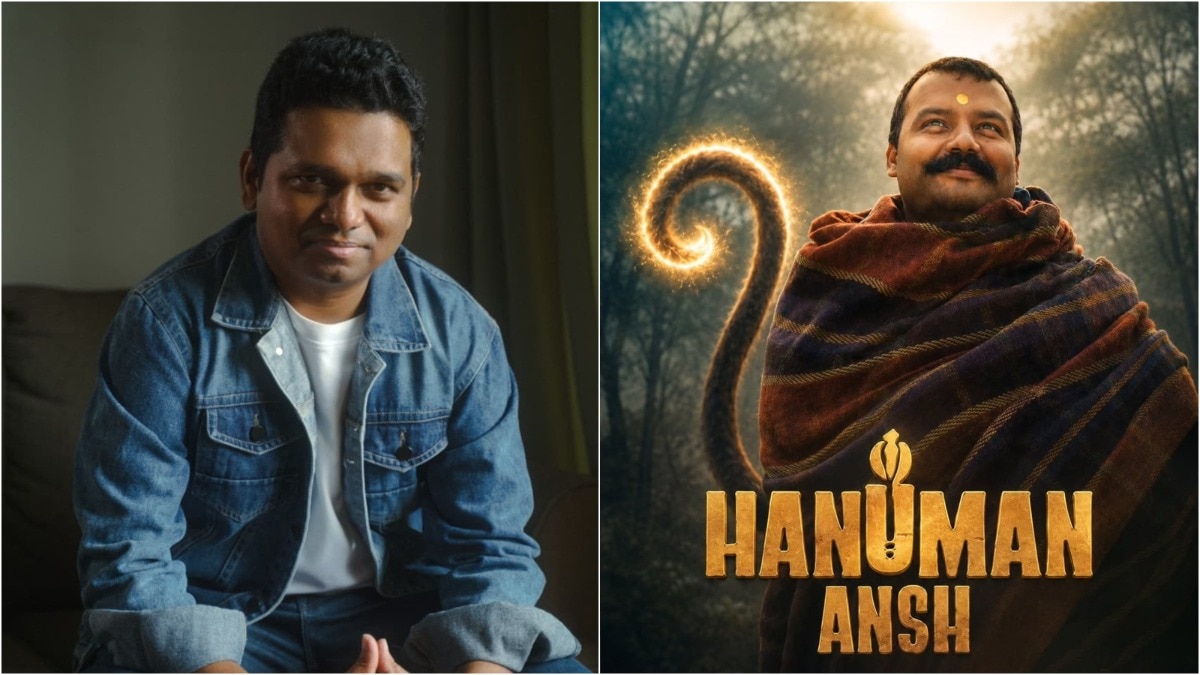
For musician and producer Dhirendra Mulkalwar, Hanuman Ansh did not begin with a film narration, a studio meeting or a phone call from a filmmaker. It began with a visit to Kainchi Dham. After trying for four years to visit Neem Karoli Baba’s ashram, the composer finally made it there last April. A couple of months later, director Vishal Chaturvedi asked him if he would score his film on the spiritual leader.“I could not believe what was happening. I was just surprised, and it felt like a miracle. When Vishal asked me, I felt like it was all a miracle,” he shared in an exclusive chat with India Today.If that sounds like the kind of coincidence that acquires meaning only in hindsight, Mulkalwar has another one. The song, Siyavar Ramchandra Ki Jai, that has now become one of the musical signatures of Hanuman Ansh was never supposed to be a song.It emerged while he was working on the background score for a pivotal sequence involving a revolutionary and Neem Karoli Baba, who helps him evade the British by disguising him as a sanyasi. The scene itself offered the answer for the composer. He added, "I just got this idea that the chants of Sita Ram should happen, and Vishal ji said yes. Basically, we combined patriotism with spiritualism. That same part was even used in the trailer, and then became a full-fledged song."For Mulkalwar, the word miracle has another layer because his connection with Neem Karoli Baba predates the film by more than a decade. Around 2010, he came across a video of Ram Dass, the American spiritual teacher and Baba’s disciple. He became curious about Baba’s life and began reading about his influence, including stories surrounding devotees and admirers such as Julia Roberts and Steve Jobs.Released in August, Hanuman Ansh has gone on to find an audience far larger than the team initially expected, with its theatrical run extending and the film also releasing globally.For the people involved, the early signs were emotional rather than commercial, as the background scorer said, “When we had the previews, we were very satisfied and happy because we put all our heart and soul into it. There were people who got so emotional. It was made with such honesty and the bhav of spiritualism was there. We knew people would like the film. But the commercial success that it received is beyond our imagination.”Dhirendra Mulkalwar grew up in Chandrapur, Maharashtra, close to the Tadoba-Andhari Tiger Reserve, in what he describes as a very small, resource-constrained environment. Music was not an obvious career option. His introduction to it came through his guru, late tabla player Rajiv Pillai, while his elder brother exposed him to music that made him imagine a completely different life. "I somehow started thinking that I can be a music director. I basically came to Mumbai to learn audio engineering. After that, I worked in radio for one year. While I was working, I was making my demos at night and meeting people and playing my music. Then I started doing some ad jingles. I have composed more than 500 ads and jingles," he said.There was always a film composer inside him, though. As a child, Mulkalwar would play audio cassettes and pretend he was conducting an orchestra. His surroundings fed that imagination too. He was involved in wildlife rescue and conservation and spent time in the forests around Tadoba, where sound itself became a kind of music.He recalled, "Sometimes in the forest, you hear beautiful sounds out of this world. I used to close my eyes and imagine myself in some nature symphony."The dream took nearly two decades to materialise in the form he had imagined. And there was another problem: Mulkalwar had learnt music, not the business of getting movies made. "A lot of my friends advised me to understand the business part. I come from a very small town. What I learnt is basically music but realised there are other important factors too. My basic instinct is not towards that but I am learning," he said.His earlier work, including Uri: The Surgical Strike and Article 15, eventually brought him to the notice of Chaturvedi. That familiarity helped turn a long-standing professional relationship into the opportunity that Mulkalwar had been waiting for. Hanuman Ansh may now have opened another door.Mulkalwar says he has already started receiving calls and is in conversations about several projects. But after spending years waiting for things to happen, he is not rushing to declare what comes next.- Ends
Hanuman Ansh composer Dhirendra Mulkalwar says Kainchi Dham led him to film
Full Article
Original Source
Read the full article at Indiatoday →KhanList aggregates and links to publicly available news content. We do not host full articles from third-party sources. Always verify important information with original sources.