
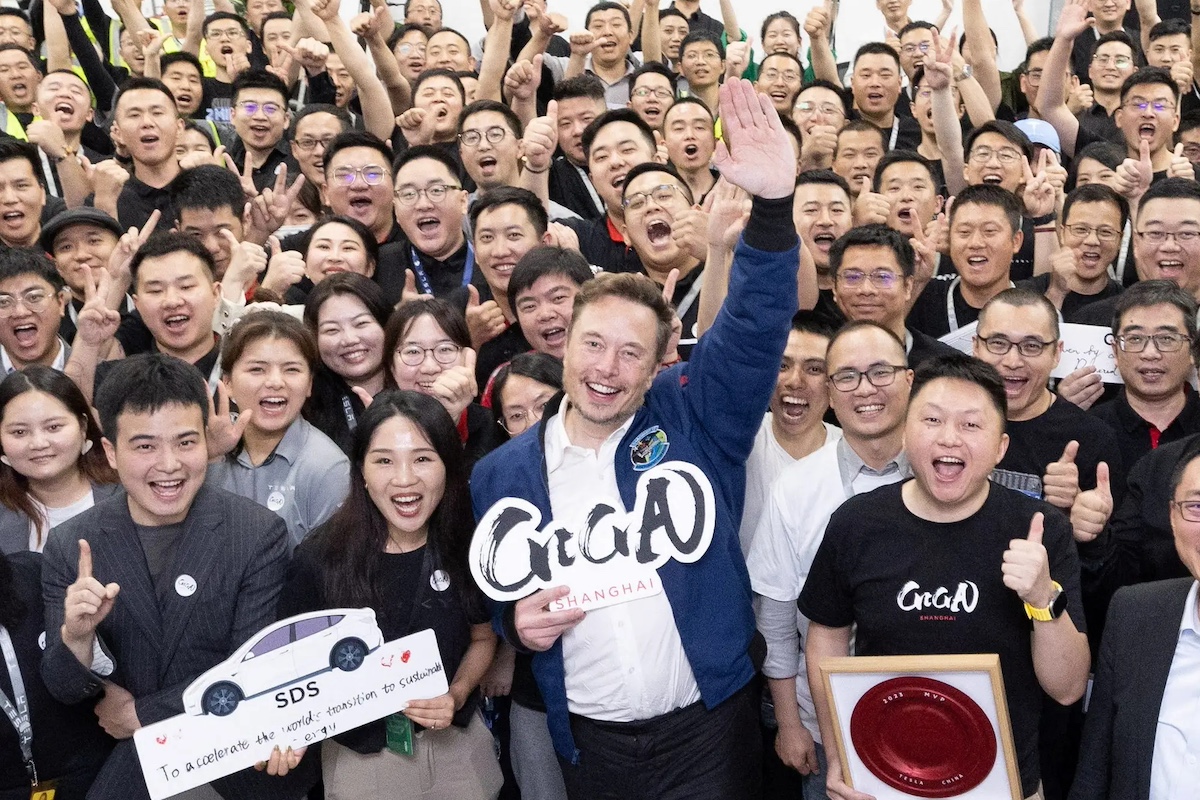
Hey, Stephen, I could give you fifty reasons Why I should be the one you choose All those other girls, well, they’re beautiful But would they write a song for you? (Ha-ha) – Taylor Swift “Repetition is reputation!” the grizzled banking industry veteran told the young Turks at a department training event. A few talking points were all we needed. The rest was noise, hand waving, glad-handing and binge drinking. We made our sell-side reputations through endless repetition of maybe five bullet points. Silence was the enemy – worse than being wrong, worse than being tiresome, worse than looking like a fool. Words must be said. Reports must be published. Noise must be made. Or the cash register stops ringing. This is Han Feizi’s 50th article for the Asia Times. Three years ago, Asia Times columnist David Goldman (now Senior Advisor at the US State Department) invited one of his habitual Twitter trolls (Han Feizi’s alter ego) to write an article on China’s misunderstood consumption. And now Han Feizi is typing out his 50th article. Liberated from the sound of the ringing cash register and freed from the straitjacket of asphyxiating compliance departments, Han Feizi is free, on the pages of Asia Times, to explore myriad subjects and ideas… only to find that old habits die hard. Forty-nine articles over three years and Han Feizi’s Asia Times oeuvre is just repetition of five bullet points: 1) China has been lowballing GDP for decades and is, by far, the biggest economy in the world. 2) The continual upgrade of China’s human capital through education has and will, for decades to come, fuel China’s growth engine. 3) The United States, trapped by its asset values, faces an enormous challenge in reindustrializing and competing with China. 4) The American Empire is an anachronism and its dissolution will be beneficial for all parties involved – especially the US. 5) Cars are cool and the world’s economic, social and political trends can be tracked by taking the pulse of this most sublime of industries. For those who don’t know, Han Feizi is Chinese American and, as such, writes about China and America. The columns are in English and target a Western audience, hoping to cut through the conformity, pabulum, willful ignorance and outright deception of mainstream Anglo media. Specifically, I write for an American audience – the one I know best. Formative years are, for better or for worse, formative. Perhaps more difficult for many to accept, Han Feizi is an American patriot with a track record of national service and the 49 articles were written with the best interests of the United States in mind. Unfortunately, as Vivek Ramaswamy has discovered, the easiest way for an Asian American to sabotage the United States of America is to offer helpful advice. Many Americans will refuse to listen out of sheer spite. Han Feizi’s method is merely stating the obvious. I am only pointing out obvious things – I’m not that smart. In the twilight of empires, believers cling to shibboleths with ferocious, blinding desperation. The Qing Dynasty could not accept the obvious for over one hundred humiliating years. This is not an original idea, but it must be said – there is a pernicious element central to American culture called “face.” Face is the social value, reputation, dignity and standing one (or one’s tribe) holds in the eyes of others wholly tangential to intrinsic worth. Face is gained when others treat you with respect, acknowledge your high status or indulge you with flattery. Face is lost when you are publicly criticized, humiliated or exposed. The American mind expends an inordinate amount of effort in “saving face” – a stratagem to avoid public humiliation rather than rectify an underlying defect. In November 2017, Elon Musk announced a new Tesla Roadster to be launched in 2020. Expectations were high as the company collected deposits of up to US$250,000. Elon promised under-two-second 0-60 mph acceleration, a 250 mph top speed, and 1,000 km of range. 2020 came and went. In the meantime, Chinese EV makers introduced six sports cars with over 1,000 horsepower. Multiple variants have achieved 0-60 mph acceleration in under two seconds. Prices were as low as $80,000 (Xiaomi SU7 Ultra). In October, Elon Musk held a demonstration of the “Tesla Roadster,” which, to any auto engineer worth his salt (Han Feizi in a previous life), can only be described as cringe-inducing. Whatever contraption Tesla got to fly over parked cars and hang upside down on a track bears zero resemblance to any car that will ever be sold – if, that is, a Roadster will ever be sold. In a weasel move, Tesla pushed Roadster’s delivery date out to 2028. Americans are easily bamboozled by parlor tricks. This naked attempt at saving face is all the more embarrassing as a parade of Tesla fanboys surrendered multiple standard deviations of IQ points, fawning over a ridiculous circus act disguised as automotive engineering. Tesla will miss its original deadline by at least eight years. China’s electric sports cars have humiliated Tesla so much that its CEO needs to perform face-saving stunts to hide its incompetence. This would be a minor distraction if it were merely about a low-volume flagship sports car. Unfortunately, the Roadster demonstration is an attempted face-saving of far greater consequence. Tesla’s car sales have been flat since 2023, while BYD’s have increased over 60% to nearly three times Tesla’s. The company, having discontinued the Model S, Model X and Cybertruck, now sells just two models versus over 30 from BYD. Musk lobbied for and got 100% tariffs on imports of Chinese cars. Tesla’s American fan base waxes idiotic over Full Self Driving (FSD), which, given the 100% tariff, is the only level 2+ city navigation on autopilot (NOA) system offered in the country. Tesla charges $99/month for the privilege. Americans are not allowed to own anything. Level 2+ city NOA is available on over 140 models in China, from budget compacts to ultra-luxury sedans to hardcore off-roaders. Only NIO operates a subscription model; the rest are buy-to-own. At least six different providers, from OEMs to third-party start-ups, supply multi-sensor technology stacks. The company that conspicuously does not offer L2+ city NOA in China is Tesla. China’s urban traffic, with its dense concentration of cars, scooters and pedestrians, has so far proven beyond the capability of Tesla’s vision-only system. Tesla FSD self-parking is also D-tier compared to higher-fidelity multi-sensor systems, an important consideration for urban China’s tight streets and underground parking. This article will enrage Tesla fanboys, and that is entirely the point. I am only pointing out the obvious. Nothing in this article is something Musk doesn’t know and fully comprehend. He knows that Tesla is uncompetitive as a car company and is desperately trying to pivot to humanoid robots and robo-taxis. Who knows? Maybe it will work. Those technology stacks, however, are also being pursued by China’s BYD, XPeng, Geely, Chery, Xiaomi, Li Auto, Baidu, Unitree, AgiBot, UBTECH and others. I am not particularly picking on Musk in this exercise. He is a big boy, has a record of success and has heard it all before. He will be fine. I am specifically picking on the deliberate blindness of certain Tesla fans who, in their small way, are contributing to America’s decline. These are the Americans who, because of the necessity of saving face, let themselves be bamboozled by fast-talking oligarchs. Not only will these Americans put up with not having nice things, but they have also been trained to say thank you for buying overpriced and mediocre products from monopolies that abuse them. Musk had to lobby for 100% tariffs on Chinese cars precisely because too many Americans would rather save face than fix an underlying defect. America’s car industry, Tesla included, is uncompetitive because the math skills of China’s workforce have far surpassed that of the US. The 2018 Program for International Student Assessment (PISA) results were sobering. The US got a reprieve in 2022 as China did not participate due to Covid. The just-released 2025 results are, for lack of a better word, catastrophic. According to the 2025 results, there are ~525,000 advanced (level 6) 15-year-old math students in Beijing-Shanghai-Zhejiang-Jiangsu (BSJZ, 30% of test takers), a region with a population of 200 million. This compares with ~32,000 in the US (1% of test takers) and ~57,500 in the EU (1.55% of test takers). In 2018, BSJZ had an average math PISA score of 591. 16.5% of students scored a level 6, the highest level. In 2025, BSJZ had an average math PISA score of 612. 30% of students scored a level 6, the highest level. In 2018, the US had an average PISA math score of 478. 1.5% of US students scored a level 6. In 2025, the average US math score fell to 463, and the US got a U (unreliable), estimated at ~1%. Extrapolating to the rest of China in 2018 yields 45x the number of advanced-ability math students in China versus the US. The same exercise in 2025 yields 115x as many advanced math ability students. This is, of course, wrong. BSJZ are the wealthiest cities/provinces in China with deep scholarly histories. The rest of China does not have the same caliber of students and educational resources. But did BSJZ really improve from 16.5% achieving level 6 in 2018 to 30% in 2025? That is perfectly understandable given the general surge in China’s education levels over the past quarter century, with about twice as many 15-year-olds growing up with college-educated parents in 2025 compared to 2018. 115x the number of advanced math students in China versus the US in 2025 is certainly wrong. Readers are free to take whatever haircut they deem reasonable. I estimate 60-90x in 2025. That means there are 60-90x as many Chinese students with the math skills of America’s top 1%. China graduates only 6.8x as many engineers and computer scientists as the US. That suggests America is graduating engineers from elite schools who may not be admitted to engineering programs in China, and that factory technicians have the math chops of Ivy+ engineering grads. Is it that surprising that there are ~400 EV models on China’s market versus a few dozen in the US and that level 2+ city NOA is offered on over 140 models versus only two in the US? Is it all that surprising that Tesla’s Roadster is a cheap party trick and the Cybertruck, Model S and Model X were canceled? From the horse’s mouth, Musk said that the number one bottleneck in Silicon Valley is the perpetual shortage of talent. Tesla needs to prioritize in ways BYD, Geely, Xiaomi, and Xpeng do not. It was, in fact, Tesla Shanghai that had to send engineering teams to the company’s Austin and Freemont factories to fix Cybertruck, Model S and Model X production bugs. The fact that all these models have recently been canceled speaks volumes. America is willing to talk about tariffs. It is willing to talk about industrial subsidies. The country is obsessed with H1B’s from India stealing tech jobs from Americans. What nobody seems able to talk about is the low-hanging fruit. China producing ~60-90x the number of students with the math skills of America’s top 1% is far outside what innate ability like IQ can explain. If math ability were purely determined by IQ and China’s average IQ were 105 versus 98 for the US (Lynn-Vanhanen/Becker), China should expect to have only ~13x as many advanced-level math students as the US. While that is still a big discrepancy, it is not ~60-90x big. If the US could get close to a ~13x ratio through intensive math education (with a significant assist from brain-draining the rest of the world), the US would increase the number and caliber of its engineers by multiples. In such a world, Tesla may not have had to cancel the Model S, Model X and Cybertruck. Ford and GM may not be in such dire straits. The US may not need tariffs, and American consumers can benefit from the competition and choice offered by exports from China. But that is not part of anyone’s agenda in Washington. Vivek Ramaswamy was pilloried for suggesting such a thing. Han Feizi will be ignored if not despised. Many Americans will refuse to listen out of sheer spite. It took China 100 years of humiliation to straighten itself out. Change is difficult with face cultures. 50 articles in the Asia Times are only the beginning.
Han Feizi’s 50th: Tesla, Chinese math and America’s face problem
Full Article
Original Source
Read the full article at Asiatimes →KhanList aggregates and links to publicly available news content. We do not host full articles from third-party sources. Always verify important information with original sources.