
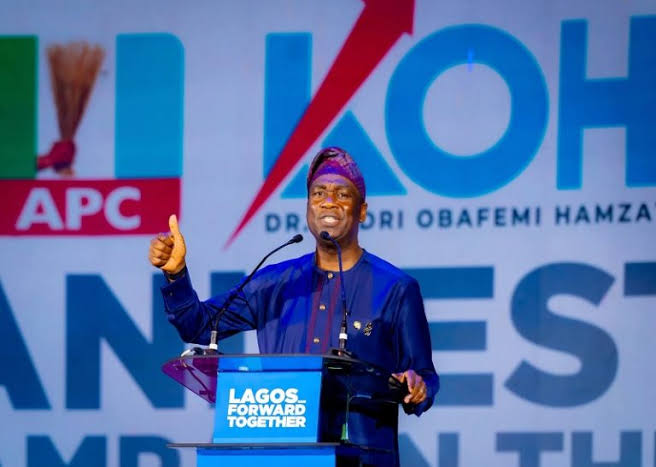
In this brand analysis, Raheem Akingbolu examines how Dr Kadri Obafemi Hamzat’s 100-point manifesto, The Lagos Promise (Ileri Eko), seeks to translate governance commitments into everyday value for Lagosians, strengthening public trust and shaping a new narrative of development, inclusion and accountability Every morning, millions of Lagos residents set out with familiar concerns. How long will the journey to work take? What will transport cost today? Can a family member receive medical attention without spending hours searching for care? For young graduates, the concern is often finding a job or gaining the experience needed to build a career in a competitive economy. These questions shape household decisions and business activity across the state. They also influence how residents judge those who govern them. A policy may sound convincing at a public presentation, but its value becomes clearer when it affects the cost of getting to work, the availability of healthcare, the quality of a school or the ability of a small business to remain open. Against this backdrop, Dr Kadri Obafemi Hamzat’s The Lagos Promise (Ileri Eko) enters the political conversation. Unveiled on 30 October 2026 at the Wole Soyinka Centre for Culture and Creative Arts, formerly the National Theatre, Iganmu, the 100-point manifesto sets out proposals for the next phase of Lagos development. Its seven pillars are People First, Renewal, Opportunity, Machinery of Government, Inclusion, Security and Resilience, and Everyday Dignity. The document raises an important question about the relationship between government and the people it serves: what should residents expect from public institutions, and how can those expectations be met? Its proposals cover transport, healthcare, education, housing, enterprise, security and public administration. The challenge will be to turn this broad programme into services and improvements that people can identify in their communities. For a commuter, governance may mean spending less time on the road. For a trader, it may mean predictable charges and a better route to market. A parent may measure it by the quality of a nearby health centre or school. These are the everyday tests against which the manifesto’s ambitions will eventually be judged. There is also a brand dimension to the document. In business, a brand earns recognition through the experience people have with a product or service, not simply through advertising. Government is no different. Public confidence grows when institutions perform consistently, respond to complaints and deliver what they have promised. The words ‘The Lagos Promise’ will carry weight only if residents can connect them with results. The expression ‘Gbese ni Ileri’, which presents a promise as a debt, gives the manifesto a pointed message about responsibility. A public commitment should not end with an announcement. It creates an obligation to explain what will be done, how it will be funded, who will be responsible and when people can expect to see progress. That is the standard by which the proposed programme must be assessed.Transport is one area where the consequences of policy are felt almost immediately. For workers and traders, a long journey takes time away from family, business and rest. Unpredictable travel also makes it difficult for employers to plan and for small businesses to move goods efficiently. Improving mobility is therefore an economic and social concern, not merely an infrastructure ambition. Hamzat’s proposals include increasing the state’s bus fleet from 1,000 to 4,000, extending the Blue Line to Okokomaiko and developing the Green Line from Marina to the Lekki Free Trade Zone. The agenda also includes an interchange between the Red and Blue rail lines at the National Theatre, the Fourth Mainland Bridge, the Lekki-Epe Regional Road and the second phase of the Opebi-Mende Link Bridge.The proposed Omi Eko water transport programme is another significant part of the plan. It envisages 140 kilometres of water corridors, 15 ferry routes, 25 terminals and jetties, and 75 electric vessels. For communities along the waterways, a reliable ferry service could offer an alternative to congested roads. Its success, however, will depend on safety, affordability, dependable schedules and convenient connections with other transport services. The enterprise proposals address a different but equally pressing concern. Small businesses, from neighbourhood shops and workshops to growing service companies, provide livelihoods and support local economic activity. Their ability to grow is often affected by the cost of doing business, access to finance, infrastructure and the complexity of dealing with public agencies. The manifesto promises a more supportive environment, including better access to resources, skills development and a coordinated approach to lawful charges.Financial assistance alone will not resolve the difficulties facing business owners. They also need reliable power, access to customers, clear regulations and public institutions that do not make routine processes unnecessarily difficult. The impact of the proposed reforms will be seen in whether traders, artisans, manufacturers and service providers find it easier to register, operate, expand and employ others. Young people face another transition: moving from education into work. Employers increasingly look for practical experience and technical skills alongside academic qualifications. Hamzat’s agenda includes digital skills programmes, vocational training, internships and stronger links between education and industry. These initiatives could help prepare young people for available opportunities, provided the training is relevant and leads to employment, enterprise or further professional development. Healthcare is perhaps the most personal measure of public service. A pregnant woman, a parent with a sick child or an older person managing a chronic condition needs more than a policy announcement. They need a facility within reach, trained health workers, essential medicines and a system that can respond when treatment is required. The manifesto proposes to expand healthcare access and strengthen public facilities across the state. The commitments include increasing Maternal and Child Centres from 10 to 15 and extending Ilera Eko coverage to one in three residents. Proposed hospital projects include a 150-bed Massey Children’s Hospital, a 280-bed Ojo General Hospital and a 150-bed Somolu General Hospital, as well as new general hospitals at Ogombo and Ibeju-Lekki. The manifesto also proposes upgrading 100 primary healthcare centres. The emphasis on primary care deserves attention. Large hospitals are important, but local health centres are often the first place residents turn for routine treatment, preventive services and early diagnosis. Their value depends on staffing, equipment, medicines, funding and proper supervision. Without these essentials, new buildings alone cannot provide the dependable service families need.Education and housing also feature prominently in the proposed programme. Building on EKOEXCEL, Hamzat’s manifesto sets out plans for teacher development, a review of teachers’ remuneration and a University of Medicine and Health Sciences. It also proposes internships and a leadership academy. On housing, it promises to complete 10 schemes and introduce mortgage arrangements with a 10 per cent deposit, single-digit interest rates and longer repayment periods. The details of funding and eligibility will determine how accessible these opportunities become. The inclusion agenda includes Obinrin Eko, Omo Eko, Iyi Eko and One Lagos, alongside a proposed Child Protection and Nutrition Agency. These initiatives place attention on women, children and other groups whose needs require specific public intervention. Hamzat’s experience as Deputy Governor since 2019 and his engineering background form part of the leadership case presented alongside the manifesto. The endorsement of Governor Babajide Sanwo-Olu and senior party figures also frames the candidacy around continuity, while the proposals set out priorities for the next administration. The proposed Hamzat Compact is central to the manifesto’s accountability argument. It identifies 87 firm commitments and 13 aspirations, with measures intended to make performance more visible to the public. These include acknowledging complaints within 48 hours, providing answers within seven days and resolving them within 30 days. Town hall meetings across the five IBILE divisions, annual scorecards and an independent Performance Council are also proposed. Their value will depend on transparent reporting and whether public concerns lead to action. For Lagos residents, the final judgement will be made beyond the campaign platform. It will come from the journey that becomes shorter, the health centre that is properly equipped, the business that can operate without unnecessary obstacles and the public office that responds when approached. The Lagos Promise seeks to bring these expectations under the campaign theme, ‘Lagos… Forward Together’. But a public brand cannot be sustained by a theme or a list of commitments. Its standing will depend on what government delivers, how openly it accounts for its performance and whether people can see a difference in their daily lives.
Hamzat’s Promise Campaign as Brand Proposition for a Changing Lagos
Full Article
Original Source
Read the full article at Thisdaylive →KhanList aggregates and links to publicly available news content. We do not host full articles from third-party sources. Always verify important information with original sources.