
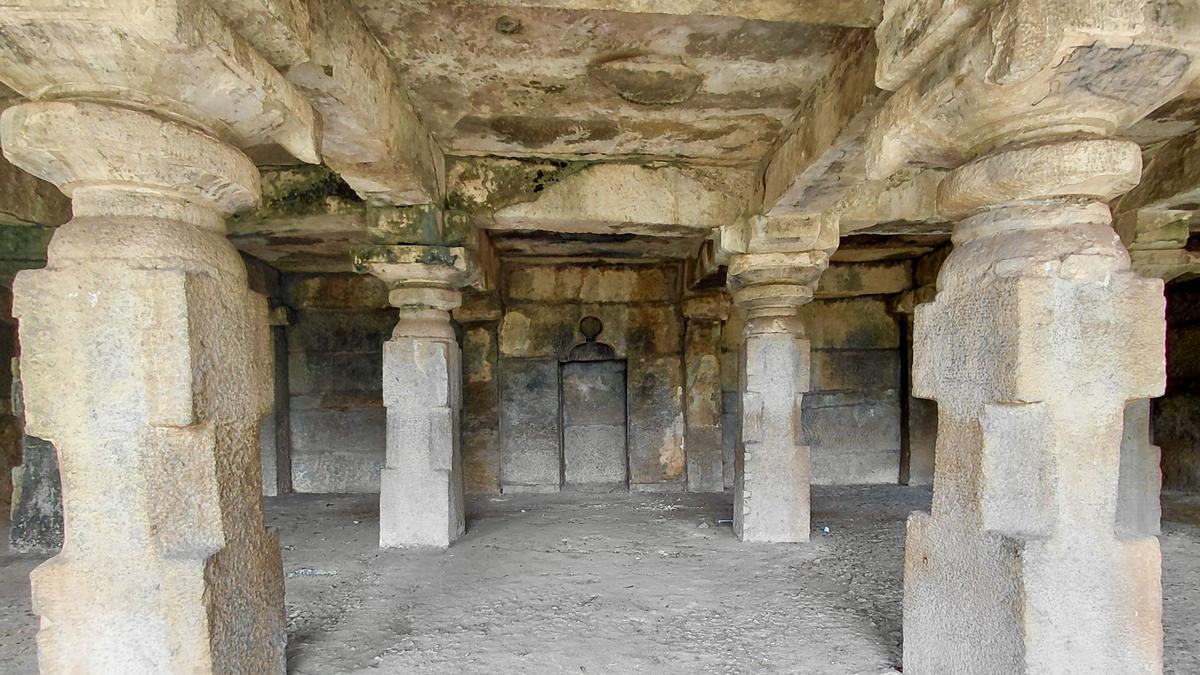
Amid the magnificent ruins of palaces, bazaars and temples at Hampi stand several Islamic monuments, scattered across what was once the imperial capital of the Vijayanagara Empire. Even in their ruined state, the mosques, Sufi dargahs and dilapidated Muslim settlements bear testimony to a significant chapter in the empire’s history — one that challenges the simplistic Hindu-Muslim binary through which the history of the Vijayanagara empire has often been interpreted.The presence of Muslims in Hampi is also reflected in numerous bas-relief sculptures, particularly those depicting horses and the men accompanying them as traders, handlers or riders. Such representations appear on the walls of Hampi’s temples and even on the imposing Mahanavami Dibba, the ceremonial platform in the Royal Enclosure.Long before the emergence of Vijayanagara in the 14th century, South India was home to diverse religious beliefs and communities. An early 10th-century Rashtrakuta inscription — dating to a period when the dynasty ruled much of the Deccan, mentions a territorial division called Samyana being placed under the governorship of a Muslim. Further south, inscriptional evidence and accounts of foreign travellers point to the presence of Muslims in the administrations of the Chola and Pandya kingdoms. They also served in the Pandyan army, a fact that reportedly surprised Malik Kafur during his invasion of Madurai in the early 14th century, according to Amir Khusrau’s chronicle Khazain al-Futuh. Ahmed Khan Mosque and a tomb nearby. | Photo Credit: Courtesy: Kombai S. Anwar and Rahamath Tarikere One of the most vivid firsthand accounts of Vijayanagara at the height of its power comes from Domingo Paes, a Portuguese traveller who visited the kingdom around 1520 CE, during the reign of Krishnadevaraya. His observations offer valuable insights into the empire’s social and military composition. Domingo writes: “…and of these Moors (Muslims) there are many who are natives of the country, and who are paid by the king and belong to his guard”. Other visitors, including Abdur Razzak, Fernao Nuniz, and Duarte Barbosa, also describe similar Muslim presence in Vijayanagara society.A 1420 CE inscription, during the reign of Devaraya, found on a large boulder a few kilometers from the Royal Enclosure, off the road leading to the Malayavanta Raghunatha Temple, records that Basava and Ramanayaka constructed a mosque, a tomb and a compound for Miya Ravutta. The reference is significant, as it highlights not merely the presence of Muslims but also the social cohesion within Vijayanagara society.Although the mosque is difficult to identify amid the sprawling ruins, another intriguing monument survives nearby: the Ahmed Khan Dharmasala or Ahmed Khan Mosque. The structure resembles a large Dravidian mandapam — a simple, pillared granite hall that blends remarkably well with Hampi’s architectural landscape. The hall opens towards the east and is enclosed by granite walls on its other three sides. Inside, at the centre of the western wall, is a beautifully carved mihrab, indicating the direction of Muslim prayer towards Mecca. A Kannada inscription inside, dated 1439 CE, records that Ahmad Khan, a servant of Devaraya II, built it for the merit of the king. The monument is noteworthy for its architectural character, representing an early synthesis of local Dravidian building traditions and Islamic religious requirements.The constant military engagements with the Bahmani Sultans prompted Devaraya II to rethink his military organisation. According to Ferishta, the medieval Persian chronicler, the king, after consulting his ministers, decided to recruit Muslim archers into his army, allotting them land and providing a mosque for their use in the city. The king is also said to have placed a copy of the Holy Quran on a raised dais in his court, allowing his Muslim subjects to pay their respects to their sacred scripture. These accounts offer a fascinating glimpse into the pragmatic and inclusive approach adopted by the Vijayanagara rulers. Interestingly the neighbouring Deccani Sultans had Hindu officers in their administration and military, giving us a glimpse of the times. Bas-reliefs on the Hazara Rama Temple wall. | Photo Credit: Courtesy: Kombai S. Anwar and Rahamath Tarikere The growing interaction, through conflict as well as alliances with the Deccani Sultanates, brought new architectural influences to Vijayanagara. This Indo-Saracenic Architectural evolution is reflected in royal buildings such as the Muhammadan Watch Tower, Guards Room, Lotus Mahal, Queen’s Bath and the Elephant Stables. The tomb constructed adjacent to the Ahmed Khan Mosque and Islamic monuments built thereafter in Hampi follow the Indo-Saracenic Architectural style. Climbing the adjoining hill, one encounters many tombs, wells and Islamic buildings, suggesting that the area was once part of a sizeable Muslim settlement. Based on a 1564 CE inscription of the Vittalasamy Temple, S.Y. Somasekhar of Kannada University concludes that this Muslim settlement of Hampi was then known as ‘Gori Kelagana Grama’.Further east, in what is now known as Kaddirampura, several Islamic structures survive within a large compound. Among them, two imposing and beautifully constructed tombs stand out. A Kannada inscription in the compound records that Syed Peer Ali constructed a dome in 1,505 CE, during the reign of Vira Narasimha. The dargah in Kaddirampura. | Photo Credit: Courtesy: Kombai S. Anwar and Rahamath Tarikere According to Ferishta, when Ibrahim Adil Shah I ascended the throne of Bijapur in 1,535 CE, he abandoned his predecessors’ Shia practices and replaced them with Sunni religious ceremonies. Many disgruntled Shia nobles and commanders fled to neighbouring kingdoms. Rama Raya not only granted asylum to 3,000 of them and inducted them into his service, but also permitted them to construct a mosque in their residential quarters. Ferishta further records in his History of Dekkan that, “He (Rama Raya) had the Koran placed before him when they came to pay their compliments, that they might salute him without breach of the rules of their religion.” From Deva Raya II to Rama Raya, such instances suggest a continuing tradition among Vijayanagara rulers of accommodating the religious practices of their Muslim subjects and extending patronage to their religious institutions.Besides these, one does find a structure being referred to as a mosque inside Danaika’s enclosure, right next to the Royal enclosure. As pointed out earlier, many royal and administrative buildings have adopted the Indo-Islamic architectural style, characterised by multiple arches and a raised platform. However, as this structure displays Hindu-style decorative motifs on its walls, some historians doubt whether it functioned purely as a mosque.Nevertheless, the surviving Islamic monuments, inscriptions and literary accounts collectively reveal a complex, interconnected, inclusive Vijayanagara Muslims were not simply foreign soldiers, traders or political adversaries. They were also inhabitants, administrators, military commanders, artisans and religious figures who helped shape the empire.Hampi’s Islamic heritage, therefore, is not an incidental or peripheral chapter in Vijayanagara’s history. It is an essential part of the story of a cosmopolitan capital and kingdom, shaped by interaction, accommodation, conflict and cultural exchange.
Hampi’s Islamic heritage: An overlooked chapter in Vijayanagara history
Full Article
Original Source
Read the full article at Thehindu →KhanList aggregates and links to publicly available news content. We do not host full articles from third-party sources. Always verify important information with original sources.