
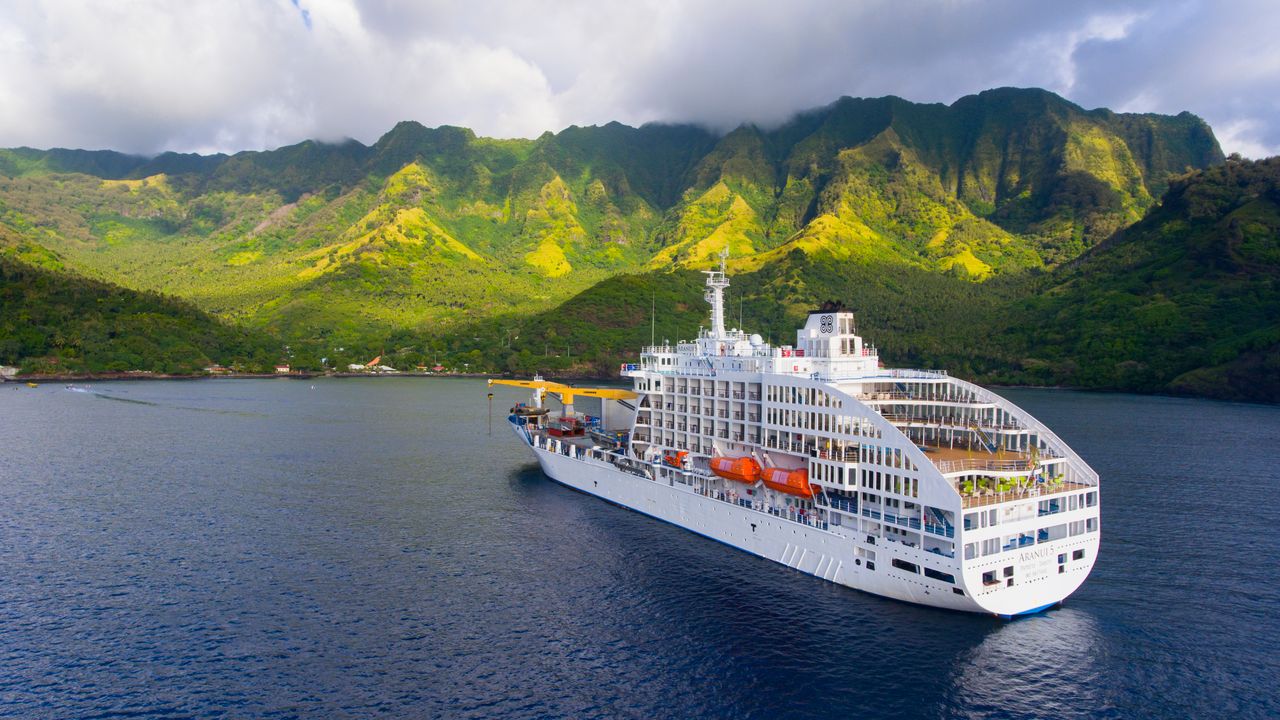
It’s certainly a romantic notion to hop a freighter and sail to the distant South Pacific. One could spend days at sea staring at nothing but seabirds and cargo pallets, waking up to the sound of those pallets being offloaded onto a tiny concrete wharf, meeting a community nestled among palms. One could take the day to hike or tour the island, or feast on fresh catches with the locals, while the offloaded pallets are filled with grapefruits, dried coconut husks, and flowers to be sold elsewhere—Tahiti, perhaps.It might come as a surprise to know that one company has been offering dedicated cruises built around that very premise for over 40 years. In French Polynesia, the locally owned cruise line Aranui Cruises offers combination passenger and cargo services from Papeete, Tahiti, to the dramatically jagged volcanic pitons and pastoral scenes of the Marquesas Islands.Fatu Hiva in the Marquesas Islands has no airport and is only accessible by sea. GettyThe idea is simple: a ship operates a cargo service to the remote islands (two of them, Fatu Hiva and Tahuata, have no airport and are only accessible by sea), and while the inbound cargo of soft drinks, groceries, building supplies, and even racing canoes is unloaded in the port, the passengers can use the time to go touring. In March 2026, I joined one such sailing, onboard the purpose-built Aranui V to see exactly what the 12-night, nearly-thousand-mile journey to the Marquesas looks like.I like to refer to the vessel as the “mullet ship”— cargo up front, cruise in the back. During the voyage, when I wasn’t swimming in the onboard pool, or enjoying a cocktail from the bar, I filled my days with lectures Dr. Carole S. Ivory, professor emerita from Washington State University, who specializes in the study of Marquesan culture and art.I got to witness that culture up close on Aranui’s included shore excursions. The experiences were visits to archaeological sites and volcanic pitons by car on Nuku Hiva, or various organized hikes on several of the other islands. There are also optional excursions for an additional fee, like the scenic drive between two sides of the island on Fatu Hiva. The drive, which traced a narrow mountain road between villages, offered spectacular vistas from the sea cliffs and, to rejoin the ship, a bonus sunset barge ride—a worthy add-on.The Aranui V ship is a passenger cruise in the front and a cargo ship in the back. Aranui MediaLocal residents hired by Aranui guide passengers in their personal cars as these tiny islands have no buses. On tiny Ua Huka, our mahu driver (a person of third-gender common in Polynesia) wearing a red flowered dress and straw hat, spent the day chatting with passengers and eating. And oh, how we ate! Baguette sandwiches during a morning stop at a craft center. A plate of chow mein from the snack bar at the botanical garden. A tour-of-the-island plate from the buffet heaped with coconut milk-roasted goat, the raw fish salad poisson cru, steamed taro, rice, and magenta-colored mashed banana swimming in sweet condensed coconut milk.On each of the islands, we passengers from the Aranui V were greeted with local musicians and artisans, typically in a community pavilion. The Marquesas are noted for their skilled carvers, working in both wood and bone to create intricately decorated bowls, decorative canoe paddles, and jewelry. Carvers also work in stone called te ke’a pua (flower stone), also known as garnet phonolite, a polished volcanic rock that has the natural appearance of being covered in crystalline flowers. The rocks themselves are found on the island of Ua Pou, and are worked into a variety of shapes: ornamental fish hooks, decorative whales and birds, and pestles used to smash taro called kea tuki popoi.Unlike most cruise lines, which have multinational crews, Aranui instead runs a local cargo service that just happens to have a large international tourism component. This means all of the onboard crew are Polynesians, many of them originally from the Marquesas themselves. The service is friendly and informal, and I was often greeted on a first-name basis. A couple of the crew recognized me from my previous sailing to another island group, already some four years hence.The passenger half of the ship has basic amenities like a pool and cocktail bar. Aranui MediaAranui also doesn’t enforce the same separation between passengers and crew that is prevalent on other ships—passengers and crew can freely mingle. After dinner, many crew members and officers end up in the bar for nightcaps right alongside the passengers. On my previous voyage with Aranui, to the Austral Islands, I joined an impromptu card game in the onboard pearl boutique and watched the head of housekeeping handily clean out the ship’s captain over the course of several hands of poker, all while we and the silken strands of Tahitian Pearls in the display cases bore witness.When my only pair of sandals broke alighting from the landing craft on Ua Huka, Aranui staff directed me to the ship’s French doctor, who fixed it with tape from his medical bag. “Come back later onboard,” he said, “and we’ll do surgery on the shoe.” While I waited, I took great amusement with a large notice on the door of the ship’s infirmary, warning that many of the fruits served onboard and in the islands have “diuretic and laxatif (sp) effect,” urging passengers to consume in moderation. I wondered how many passengers had visited the infirmary over the years with the same complaint before they felt the need to put up a sign.At the end of our stop on Ua Huka, we all gathered on the deck of Aranui V. We still had calls on the islands of Rangiroa and Bora Bora scheduled, but it was time to bid our goodbyes to the Marquesas in a traditional manner. A member of the onboard staff invoked a prayer of thanks for the voyage and fond farewell to these magnificent islands, which we did with armfuls of local flowers and plants cast into sunset-dappled sea to watch float ashore.That, however, wasn’t the lasting image of the Marquesas for me. For weeks after my trip, I awoke each morning in a home that seemed suddenly foreign, recalling the smell of the straw hats, the taste of the baked banana, the green of the mountains, the red floral dress of the snacking mahu, and the pallets of coconuts and grapefruits stacked on the tiny wharf.
Half Cruise, Half Cargo Ship? What It's Like to Sail French Polynesia Aboard a Local Freighter
Full Article
Original Source
Read the full article at Cntraveler →KhanList aggregates and links to publicly available news content. We do not host full articles from third-party sources. Always verify important information with original sources.