
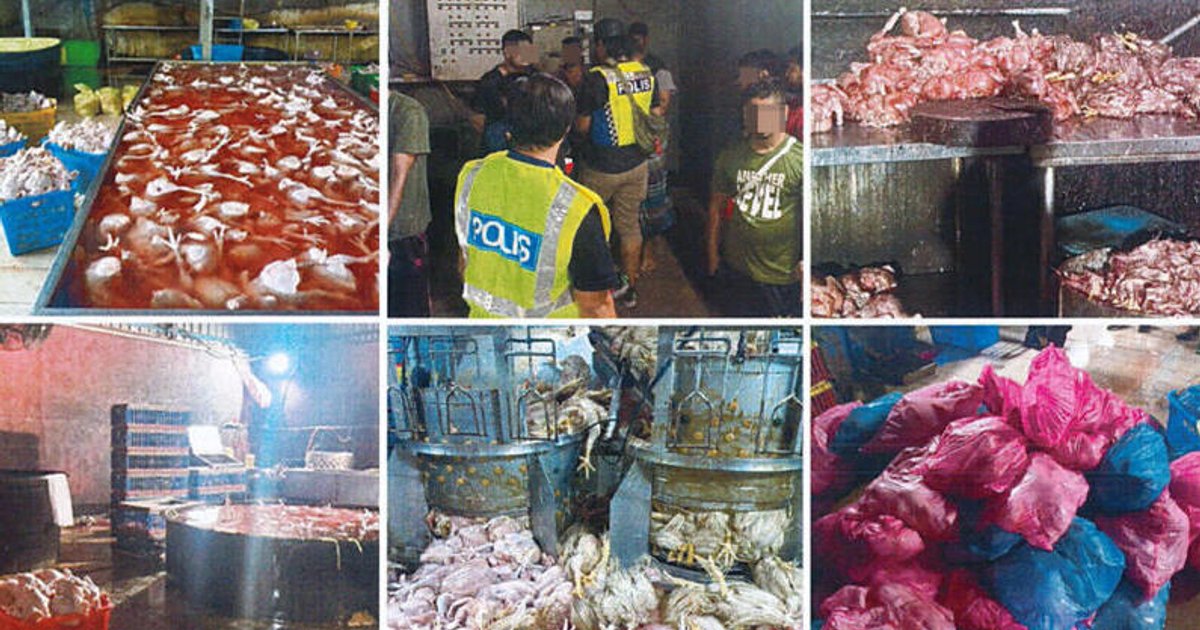
KUALA LUMPUR – A raid at a chicken slaughterhouse in Selangor that uncovered more than 6.5 tonnes of poultry suspected of being slaughtered in violation of Islamic requirements has raised concerns about the integrity of Malaysia’s halal supply chain.Selangor Menteri Besar Amirudin Shari on Nov 2 called for firm action, including prosecution, against slaughterhouses and poultry processing facilities found to have broken the law.He said halal certification bodies and local authorities needed to work together to ensure regular monitoring of sensitive operations such as slaughterhouses.“Regular inspections must be carried out so that we can ensure sensitive operations are conducted according to the procedures and requirements that have been set,” he was quoted as saying by The Star daily.The halal issue in multiracial Malaysia is a sensitive matter and has the potential to cause racial tensions.The discovery is particularly troubling because the premises in Puchong reportedly operated for about 20 years without valid halal certification, despite prior notices and reminders from the authorities.The scale of the operation has also drawn attention. The facility could process more than 40,000 chickens a day, and the poultry was believed to have been distributed to grocery shops, restaurants and other businesses in areas in the Klang Valley including Puchong, Putrajaya, Damansara, Cheras, and Bangi.There is no indication that the Puchong premises supplied Singapore or that any of the seized poultry was destined for the Singapore market.The case has prompted concerns over how such an operation could continue for so long, and how a facility allegedly operating outside regulatory requirements could process and distribute poultry on such a scale. It also puts the effectiveness of enforcement and monitoring under the spotlight, at a time when Malaysia is seeking to strengthen its position as a leading global halal hub, across not just food and beverages but also pharmaceuticals, fashion, and finance.Initial investigations suggested that the chickens had been electrically stunned using a water-bath method, with the voltage allegedly so far above the prescribed limit that some birds died before slaughter.“This is a matter of grave concern as the slaughtering method is one of the key elements in determining the halal status of a chicken product,” Bukit Aman Internal Security and Public Order Department deputy director (Operations) Muhammad Abdul Halim was quoted as saying by the Bernama news agency.Selangor Islamic Religious Council (MAIS) chairman Salehuddin Saidin said the authorities had raised the possibility that the poultry might have been supplied to restaurants owned by Muslims.The premises were raided in the early hours of Oct 30 under Ops Taring Chiller, a joint operation involving the police, the Selangor Islamic Religious Department (JAIS), the Department of Islamic Development Malaysia (JAKIM), the Department of Environment and the Petaling District Health Office.JAKIM said the factory was suspected of slaughtering, processing and distributing fresh chicken without local authority permits and approvals. It also did not hold a halal certificate.Malaysia has positioned its halal certification system as a competitive advantage in attracting investment, expanding exports and establishing itself as an international reference point for halal standards.The implications extend beyond Malaysia’s domestic market. The country is a key supplier of poultry to neighbouring Singapore, making the credibility of its halal certification and regulatory oversight relevant to regional trade. According to Observatory of Economic Complexity trade data, Malaysia exported some RM56 million (S$17.6 million) worth of poultry meat to Singapore between September 2025 to August 2026.Malaysia’s halal exports grew 10.9 per cent to RM68.52 billion in 2025, up from RM61.79 billion in 2024, with China as the largest destination. The incident has also revived concerns about Malaysia’s track record in enforcing halal standards, particularly after a meat cartel scandal in 2020, in which investigations found that non-halal meat had been passed off as halal using fake logos and documentation.Research director at Iman Research, Aziff Azuddin, said the latest case could further erode public confidence in the country’s halal certification system, even as Malaysia continues to enjoy a strong international reputation in the sector.Malaysia’s halal trademark is registered and recognised in nearly 50 countries, Prime Minister Anwar Ibrahim said in September 2025. The Malaysian International Halal Showcase (MIHAS) 2026, a key halal exhibition held on Sept 23 to 25, recorded a total sales of RM6.78 billion, up 12 % from 2025.“Instances like this chicken factory issue will affect how Malaysians themselves see and trust the halal certification,” he told The Straits Times.He said the case pointed to wider concerns about enforcement.“The fact that the factory operated for over two decades and were emboldened to slaughter the chickens in a non-syariah compliant method could only mean that there was a lack of monitoring,” he said.Syaza Shukri, a political analyst at the International Islamic University Malaysia, said the incident could dent Malaysia’s reputation for maintaining stringent halal standards, but noted that the raid and earlier notices issued by the authorities could also indicate that enforcement agencies were taking steps to ensure compliance.She said the case could prompt wider questions about whether similar breaches had occurred elsewhere and the status of poultry already consumed by the public.“We have a reputation for supposedly strict halal standards, and yet this could (still) happen,” she told ST.She added that the authorities would need to address these concerns.“There will be a lot of questions. What matters is whether they can be answered and more importantly, action is taken to ensure it doesn’t happen again.”The incident has also sparked an outcry on social media, with both Muslim and non-Muslim consumers expressing dismay over the alleged breaches.A Threads user, maryamsky9, questioned how such an incident could happen in Malaysia, which is known for its halal standards.“This is bad. This is not a small issue. As far as I know, Malaysia really takes care of “halal”. How could this happen?” the user wrote.On X, user Choen Lee posted on Nov 2: “OK this is disgusting. It’s not even about halal or not.”Another Threads user, shinchan27324, wrote: “As a non muslim i also feel disgusted.”The facility has been ordered to close for two weeks while investigations are carried out.Sign up for our weekly Asian Insider Malaysia Edition newsletter to make sense of the big stories in Malaysia.
Halal checks in Malaysia questioned after 6.5 tonnes of chicken seized
Full Article
Original Source
Read the full article at Straitstimes →KhanList aggregates and links to publicly available news content. We do not host full articles from third-party sources. Always verify important information with original sources.