
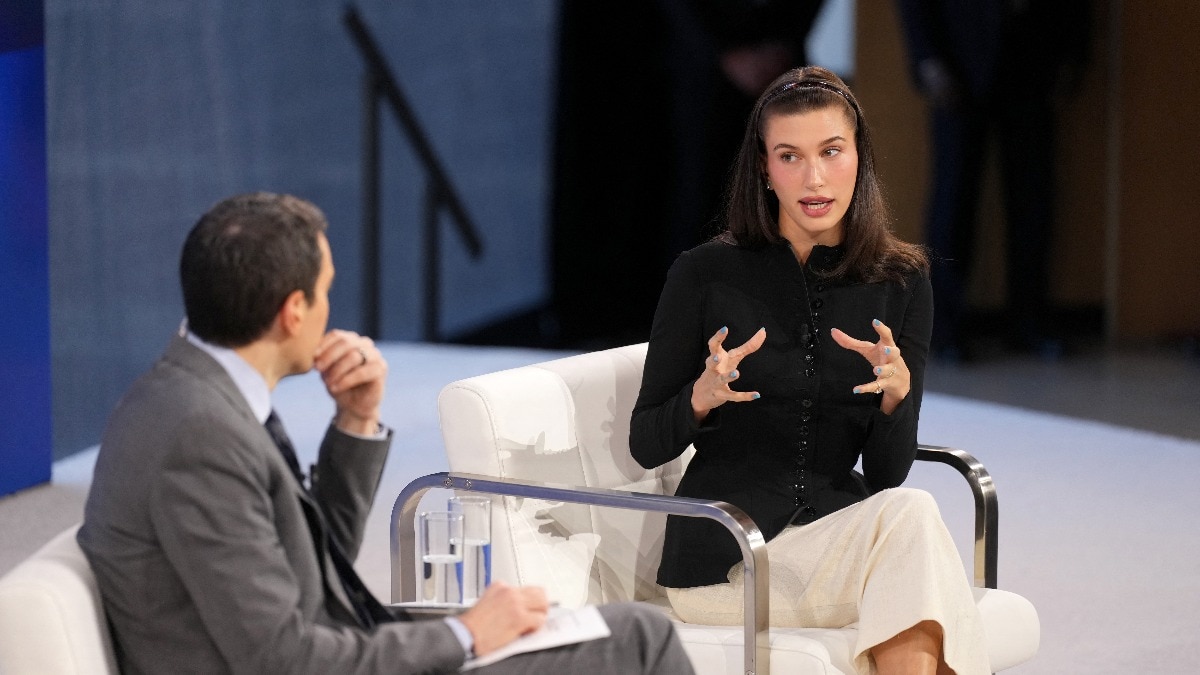
Hailey Bieber's response to a question at the New York Times' annual DealBook Summit sparked trolling online.Andrew Ross Sorkin and Hailey Bieber speak onstage during the NY Times Dealbook Summit. (Photo: AFP)New Delhi,Nov 23, 2026 16:29 ISTHailey Bieber found herself at the centre of an online debate after her appearance at the New York Times’ annual DealBook Summit in New York on November 18. The model and entrepreneur sat down with journalist Andrew Ross Sorkin for a conversation about her beauty brand Rhode, its billion-dollar sale to e.l.f. Beauty, and her relationship with social media.Bieber was among a high-profile line-up of speakers at the summit, which included Elon Musk, OpenAI CEO Sam Altman, Microsoft CEO Satya Nadella and New York City Mayor Zohran Mamdani. But her conversation has since attracted attention for reasons that go beyond her business success.The interview, which was expected to offer a closer look at how Bieber built Rhode into a billion-dollar brand, has prompted criticism from social media users who felt she missed an opportunity to explain the business strategy behind its success. Some also questioned her responses to Sorkin's questions, particularly when she spoke about the valuation of her company.Why is Hailey Bieber facing criticism?During the conversation, Sorkin asked Bieber what she believed had helped Rhode stand out in an increasingly crowded celebrity beauty market. Bieber spoke about building a brand that felt like an extension of her personality, and creating a larger world around its products, packaging, branding and storytelling. When the conversation turned to the company's valuation, Bieber said that a billion dollars was the figure below which she would not have considered selling Rhode. Asked why she believed she could reach that number, she replied: “Delusion.”She went on to say, “You have to have a certain sense of optimistical delusion.” It was the use of the word “optimistical” that quickly caught the internet's attention, with users questioning whether it was even a real word. But the criticism was not limited to her choice of vocabulary.Some viewers felt Bieber had not gone into enough detail about the decisions and strategy that helped Rhode become such a successful business. Others argued that she had been given an opportunity to demonstrate her credentials as an entrepreneur, rather than being seen simply as the face of a celebrity beauty brand.the difference in comments on Andrew Ross Sorkin interview with Mandani vs Hailey Bieber is very telling. https://t.co/NT9W6a9ACx— fae (@demismonarchy) November 21, 2026she literally said “ optimistic delusion “ yall how is this admirable??? Genuinely curious no shade— angel (@angeinwonder) November 22, 2026ion think so anyone is gon listen to "optimistical manifestation, delusion, delulu, solulu, stars bla bla" as an answer to a question that requires figures and numbers. he realised midway that she's prolly dumb.— Voodoo (@TaylenaVoodoo) November 21, 2026@PopCrave he didnt said anything wrong, she's just a dropout of high school who owns a brand but couldn't even take the time to study finances to avoid embarrassement. Now she's stuck giving shallow answers like "optimistical delusion".— Val (@fresap1nk) November 20, 2026"Optimistical delusion" https://t.co/pxKAqXTqek— DenouementLawyer (@Itsthatlawyer_) November 21, 2026The interview also sparked a separate conversation about the nature of celebrity interviews. While some viewers felt Sorkin's questions were too challenging, others defended his approach, arguing that a journalist interviewing the founder of a billion-dollar business should be expected to ask probing questions.Hailey Bieber responds to the criticismBieber, however, appeared to have a response ready for those who questioned her use of the word “optimistical”.On November 20, she shared a screenshot of the dictionary definition of the word on her Instagram Story. The definition described “optimistical” as a version of “optimistic”. She added a brief “Anyways...” over the screenshot, seemingly addressing those who had mocked her choice of words.The post came after the phrase from her interview had made the rounds online, with critics taking particular issue with her use of the word while discussing the sale of Rhode.What else did Hailey Bieber speak about at the summit?The conversation was not limited to Rhode's business journey. Bieber also spoke candidly about the toll that years of online scrutiny have taken on her.Recalling the abuse she faced after she began dating Justin Bieber, she said she had people telling her to kill herself in the comments every day. She also spoke about being yelled at in public and seeing tip jars at Starbucks framed around her and another person.“The way people were making me feel was that maybe it would be better if I wasn't here anymore,” she said, describing how intense the hostility had become.Bieber also discussed the complicated relationship people have with social media, particularly the way filters can alter appearances and distort how users see themselves. She acknowledged that such tools can be harmful and misleading, even as they have become part of the online world.Asked how she deals with the constant scrutiny, Bieber said she is someone who pays attention to what people say about her and does not pretend that negative comments do not affect her. Over time, she said, she has learnt to build resilience and practise what she described as “internal regulation”, reminding herself to put her phone away and be present.She also spoke about her plans beyond Rhode, revealing that she was in the early stages of thinking about her next venture. However, she made it clear that she intends to remain closely involved with Rhode and is not planning to step away from the brand anytime soon.- Ends
Hailey Bieber's NYT interview goes viral for all the wrong reasons
Full Article
Original Source
Read the full article at Indiatoday →KhanList aggregates and links to publicly available news content. We do not host full articles from third-party sources. Always verify important information with original sources.