
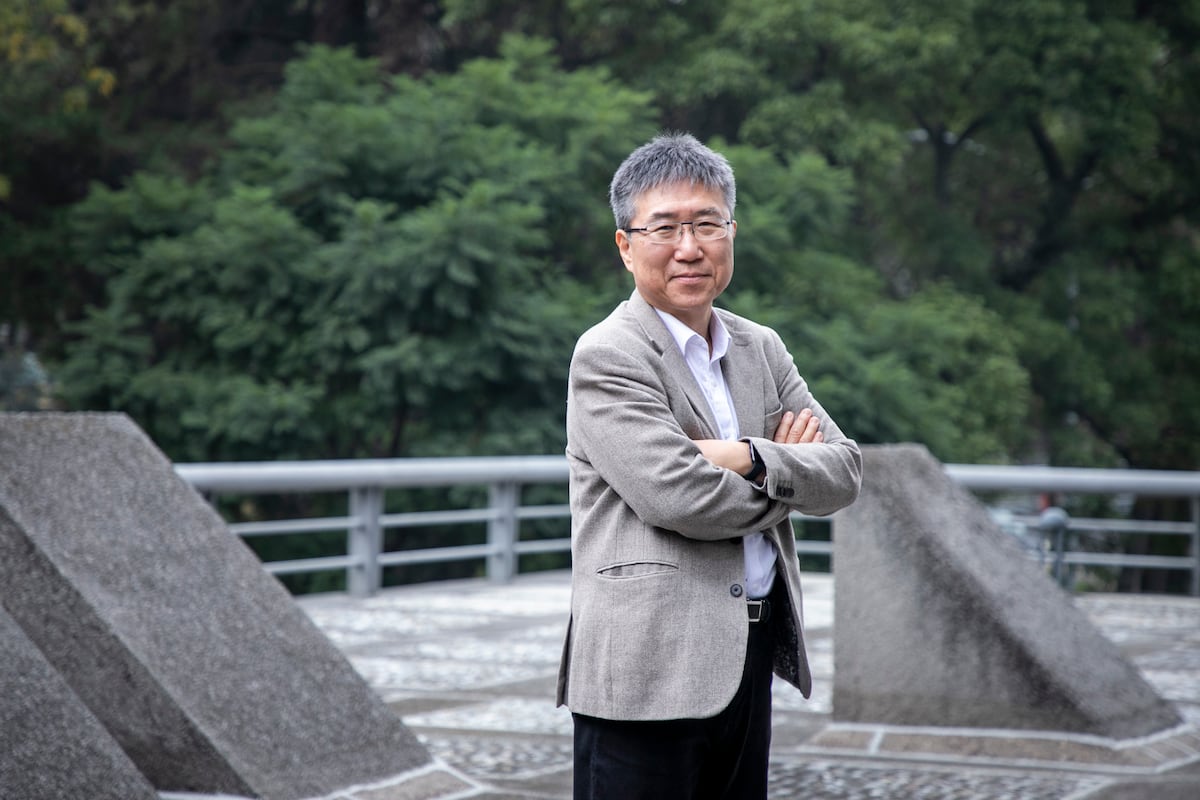
The interest in hearing the ideas of Ha-Joon Chang, 63, was evident as the auditorium of the School of Economics at the National Autonomous University of Mexico (UNAM) filled up. The Korean economist, who has a long career in British academia and is a professor at the School of Oriental and African Studies at the University of London, traveled to Mexico to speak about the global economic crossroads and the need to tighten industrial policy in developing countries. Students knew his reputation as a heterodox thinker and were eager for less conventional ideas.Chang’s bibliography includes the bestseller 23 Things They Don’t Tell You About Capitalism, a book that challenged classical schools of economics more than a decade ago and sought to demystify neoliberalism. In his latest book, Edible Economics: A Hungry Economist Explains the World, he declares himself a fan of Mexican chocolate and says that whenever he visits the country he always eats at least one plate of chicken in mole poblano, one of his favorite dishes of Mexican cuisine. Chang has visited Mexico more than a dozen times, he tells EL PAÍS in an interview, and has studied its evolution since it entered free trade more than 30 years ago.Question. Your talks in Mexico focus on the role of the state in countries’ growth. What is your position on this?Answer. I have been a longtime advocate for a more active role of the state in economic development. When I began my research as a graduate student in the late 1980s, that was a very unpopular view. But if you look at the economic history of capitalism, there’s really no country that has become rich on the basis of free trade and free market policy alone. We were told that the reason Britain became the first global empire and the United States became so prosperous was their free-trade and free-market policies. But I have shown in many of my works, especially in my book titled Kicking Away the Ladder, that rich countries used all kinds of interventionist policies: trade protection subsidies, regulation of foreign investment that included things like local content requirements, obligations that foreign companies hiring in their country employ local workers or invest in research and development. They developed their economies on the basis of these policies and, after getting rich, said ‘let’s all have free trade and free markets.’ Which, at that point, benefits them, because it means others will open their markets to their exports while they put restrictions on what other countries can do. It’s like someone who uses a ladder to climb to the top and then kicks it away so others can’t follow.Q. That seems to be the case between Mexico and the United States.A. Yes, absolutely.Q. What can Mexico do, immersed in a free trade agreement that it keeps renegotiating with the United States? A. Free trade between countries with similar development levels is good because they stimulate each other, but when it’s between rich and poor countries, trade benefits the rich countries much more than the poor countries. If you have free trade between two countries with very different technological levels, it means the poorer country cannot develop its own enterprises. When Mexico signed NAFTA in 1995, it was basically signing a promise that its level of technology and businesses would remain frozen. There could be some incremental development, but it wasn’t going to develop an entire domestic computing or automotive industry. Everything became work for foreign companies, mainly U.S. ones, that came to set up factories here. The wisdom of that agreement was highly questionable. Not everything was bad. Despite China’s rise as a manufacturing superpower, Mexico has been able to maintain the level of industrialization it had in the 1980s. The underlying problem is that Mexico integrated its economy with the United States on the assumption that it would be the most powerful economy in the world forever, but now the United States is declining rapidly. The treaty will remain, but there are other sectors where Mexico should work with Koreans, Japanese or even Chinese, instead of just the Americans. Build possible collaborative relationships with Brazil, Indonesia, Turkey and other powerful developing countries, rather than trying to find its space within this trade agreement (USMCA). Mexico has to restructure its relationship with the United States, otherwise it will sink with it. Q. Is now a good time to approach China?A. The short answer is yes, but I think that’s the wrong way to look at it. You need a more pragmatic approach. The country is not growing well, it is struggling to create jobs, it is having difficulty upgrading the economy—partly due to its own inability to invest and innovate, but also because of USMCA’s constraints. So my suggestion is it has to think in practical terms, forget about whether it should ally with Asia, the United States or Europe, just focus on your own problems and see what allies are best to help solve each one. Q. That’s what Canada is doing.A. At least in some sectors. The goal is clear: you don’t want to be too dependent on anyone. Want to modernize your industries? Choose strategic industries. And then, for those strategic industries, think about who you should work with—I bet that seven times out of ten it won’t be the Americans.Q. What can Mexico learn from Korea’s case and the transformation of its automotive industry?A. Like Mexicans, we depended on foreign technologies. But the difference was that in Korea, once the automotive industry was established, the government did everything possible to ensure companies developed and ultimately controlled their technologies. Otherwise, they would only be doing screwdriver work. Mexico took a very different route by saying it would never aspire to create its own Toyota, but would become the most efficient producer of the foreign models brought in. In fact, Mexico has some of the most productive auto assembly plants in the world. So now Mexico is stuck and must seriously consider whether, given all the capabilities it has accumulated in the automotive industry, there is any way to, for example, create its own automobiles. Maybe the conclusion is that it cannot. Q. You argue that the public and private sectors must work together for economic development. How can this be implemented in Latin America when both sides distrust one another?A. There are many successful cases of industrial development in Latin America where there was cooperation between the private and public sectors. The argument that the state cannot be trusted is basically invented by businessmen who do not want state interference. But it also means that, in exchange for no interference, they are not receiving any support. So a new bargain must be forged, so to speak, between the government and the private sector. The government should approach the private sector and say, ‘please invest in these industries. These are strategic sectors. We will give you all the support you need in financing, training, research, etc. But you must deliver results.’ That needs to be recreated, because if the government continues to see the private sector as thieves, and the private sector continues to see the government as robbers, everyone loses.Q. What do you suggest for Latin American economies with stagnating growth?A. Latin American countries achieved a lot in the past. I don’t know why they have become so unambitious. In 1970, Brazil produced more manufactured goods than China, Korea, Thailand and Malaysia combined. It was a major industrial success. Mexico’s income was three to five times higher than South Korea’s until the 1970s. It is their elites who lack ambition. They only want an easy life; they prefer an overvalued currency, which makes exports difficult because it cheapens the annual shopping trip to Miami. There is also the free-market ideology that has become so dominant in Latin America in recent decades. Latin Americans are the most pro–free-market people in the world, more so than Americans and the British.Q. Any reflections on this visit to Mexico? A. I was invited to give a lecture in a room full of government officials. I think in Mexico there is recognition that things cannot continue as they have for the past four decades. Alternatives are still being sought and there is at least recognition that they need to redirect their economy and society. Hopefully they will find a good strategy. It will be a long-term process, probably not something elected politicians with four- or six-year terms want to hear, but ultimately the most important thing is not which party or which president is in power, but whether a new social consensus can be built. Some still want to cling to the United States, others want to work with China, and others want to do something else—if they don’t reach an agreement, energy will dissipate.Sign up for our weekly newsletter to get more English-language news coverage from EL PAÍS USA Edition
Ha-Joon Chang: ‘Mexico must redesign its relationship with the US or it will sink with it’
Full Article
Original Source
Read the full article at English →KhanList aggregates and links to publicly available news content. We do not host full articles from third-party sources. Always verify important information with original sources.